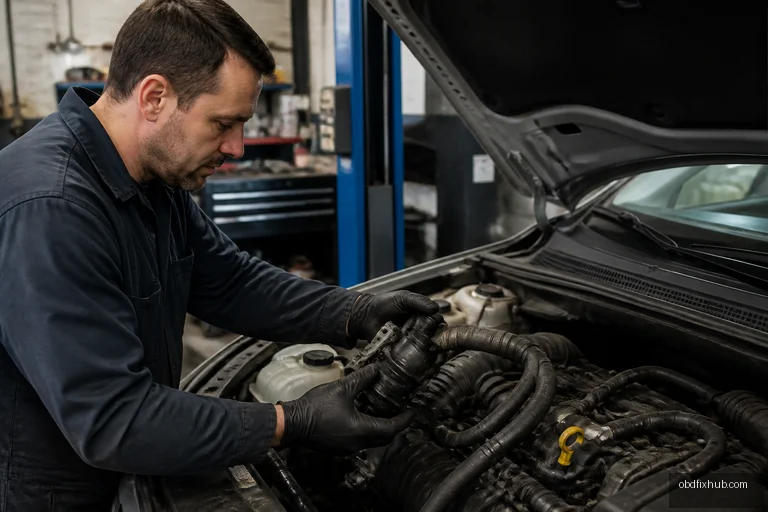
P0411 Secondary Air Injection System Incorrect Flow Detected means the engine computer has detected that the secondary air injection system is delivering too much, too little, or poorly timed airflow during a cold-start emissions test. The vehicle will often still drive normally, but the check engine light will remain on and the fault can cause an emissions-test failure.
In real-world diagnosis, P0411 is frequently blamed on the air pump alone. That is a mistake. A failed pump, blocked injection passages, a stuck check valve, damaged vacuum tubing, wiring faults, and exhaust leaks can all produce the same code. The fastest repair comes from testing the complete system in the order the engine computer operates it.
What Does P0411 Mean?
The secondary air injection system reduces cold-start emissions. For a short period after the engine starts, an electric air pump pushes fresh air into the exhaust stream. This extra oxygen helps the catalytic converter and exhaust gases reach an effective operating condition more quickly.
The powertrain control module, or PCM, monitors the result through oxygen sensor feedback and sometimes a dedicated pressure sensor. If the measured change does not match the commanded airflow, it stores P0411. Depending on the manufacturer, the same code may be described as incorrect flow, insufficient flow, excessive flow, or an abnormal flow condition.
- P0411 does not automatically mean the air pump is bad.
- The code is usually most relevant during cold starts, often within the first 30 to 90 seconds.
- System design varies significantly between manufacturers, so the factory wiring diagram and test procedure matter.
P0411 Symptoms to Watch For
Many drivers notice only the malfunction indicator light. Because the system operates briefly during a cold start, the vehicle can feel completely normal once the engine is warm. However, the following clues are common:
- Check engine light illuminated
- Failed emissions or inspection test
- An electric pump that is unusually loud, silent, or runs continuously
- A brief rough idle immediately after a cold start
- Cold-start hesitation or an occasional stumble
- Additional secondary air injection codes, such as P0410, P0412, P0413, P0414, or P0418
- A fuse that repeatedly blows when the pump is activated
A rough idle that continues after the engine warms up usually points to another problem, such as a vacuum leak, ignition fault, fuel issue, or intake problem. P0411 by itself is primarily an emissions-system fault, not a direct indication of internal engine damage.
Common Causes of the P0411 Code
1. Water-damaged or failed air injection pump
The pump is often mounted low in the engine bay, where it can ingest water through a failed drain, cracked inlet hose, or missing splash shield. A seized motor may draw excessive current and blow the fuse. A worn pump may still run but fail to produce enough pressure.
2. Stuck secondary air injection check valve
Check valves prevent hot exhaust gas and condensation from traveling backward into the pump. When a valve sticks open, exhaust heat can damage the pump. When it sticks closed, the pump may operate normally while no air reaches the exhaust manifold. Carbon deposits are a common reason for restricted valve movement.
3. Blocked air passages or carbon buildup
The small ports where fresh air enters the exhaust can become restricted by carbon. This is especially likely on vehicles with high mileage or long-term secondary air system faults. Installing a new pump without clearing the passages often leads to the same P0411 code returning within a few drive cycles.
4. Vacuum control or switching valve failure
Many systems use an electrically controlled solenoid and engine vacuum to open the air valve. A cracked vacuum hose, disconnected line, failed solenoid, or incorrect hose routing can prevent the valve from opening. On some vehicles, a leaking vacuum diaphragm allows exhaust pressure to disturb the system’s operation.
5. Wiring, relay, fuse, or connector problems
Corroded connectors near the pump are common, particularly in vehicles exposed to road salt. Check the fuse and relay, but do not stop there. A power supply can be present with no load and collapse when the pump is commanded on because of high resistance in a connector or ground circuit.
6. Exhaust leaks or oxygen sensor issues
The PCM uses oxygen sensor behavior to confirm that fresh air entered the exhaust. A leak upstream of the sensor can draw outside air into the exhaust and imitate secondary air flow. A slow or biased oxygen sensor can also create misleading feedback, although it should not be condemned until the pump and valve operation have been verified.
How to Diagnose P0411 Correctly
Diagnosis should begin with a cold engine because the PCM may run the secondary air test only during the first start of the day. A scan tool with bidirectional controls is especially useful because it can command the pump and switching valve independently rather than waiting for the vehicle to perform its own test.
- Scan all stored and pending codes. Record freeze-frame data, coolant temperature, battery voltage, and whether other air injection or oxygen sensor codes are present.
- Inspect the system visually. Check the pump inlet, air hoses, vacuum lines, valves, electrical connectors, grounds, and the exhaust manifold area for cracks or soot marks.
- Listen during a cold start or active test. A healthy pump usually produces a strong, steady electric-motor sound for a short time. A grinding sound suggests bearing or motor damage; no sound requires electrical testing.
- Measure pump power and ground under load. Test voltage while the pump is operating. Do not rely only on an open-circuit voltage reading. Check current draw against the manufacturer’s specification.
- Verify valve operation. Use a hand vacuum pump where applicable and confirm that the valve holds vacuum and opens when commanded. A valve that leaks exhaust backward is defective even if it moves.
- Check actual airflow. Depending on the design, use a pressure gauge, scan data, oxygen sensor response, or a smoke machine. The exact test method must match the vehicle’s service information.
- Inspect for blocked ports. If the pump and valves work but the oxygen sensor response is absent, remove and inspect the injection passages for carbon restriction.
A practical diagnostic clue is timing. If the pump sounds normal but P0411 returns only after rain or washing, investigate water intrusion and the pump inlet before replacing electronic parts. If the code appears immediately after a valve replacement, verify hose routing and connector placement; reversed hoses are surprisingly common.
How to Fix P0411
The correct repair depends on the failed component. Common fixes include replacing a water-damaged air pump, installing a new check valve, repairing a vacuum line, replacing a relay or corroded connector, cleaning blocked injection passages, or repairing an upstream exhaust leak.
When replacing the pump, inspect the check valve at the same time. A valve that allowed exhaust gas into the old pump may quickly damage the replacement. Also check the air filter or inlet screen, if fitted, and correct the source of water entry rather than treating the pump failure as an isolated event.
After the repair, clear the code and perform the manufacturer’s drive cycle. A normal idle with no immediate warning light does not prove the repair is complete; the secondary air monitor may need a cold soak followed by a cold start before it runs. Re-scan for pending codes and confirm that the monitor reaches complete status.
Can You Drive With P0411?
Usually, short-distance driving is possible if the engine runs normally and there are no signs of overheating, severe misfire, or electrical burning. The vehicle may fail an emissions test, and a damaged pump or shorted wiring can worsen if ignored. Stop driving and investigate promptly if the fuse repeatedly blows, the pump runs continuously, or the engine develops a serious misfire.
Typical P0411 Repair Cost
Repair cost varies widely by vehicle and access to the components. A cracked vacuum hose or blown relay may be inexpensive, while a pump, valve, or carbon-restricted exhaust passage can require substantially more labor. Before approving a pump replacement, ask whether the technician tested the check valve, power supply, ground, and air passages; those checks prevent replacing an expensive part that was never the root cause.
Final Takeaway
P0411 indicates that the commanded secondary air injection flow does not match the flow the PCM expects. Treat it as a system-level diagnostic problem, not a pump-only code. Start with cold-start operation, electrical load testing, valve function, exhaust leaks, and blocked passages. Once the underlying cause is repaired, clear the code and verify the monitor through a complete cold-start drive cycle.
Frequently Asked Questions About P0411
Is P0411 serious?
It is usually not an immediate engine-damage warning, but it can cause an emissions-test failure and may damage the air pump if exhaust gas or water continues entering it.
Can a bad oxygen sensor cause P0411?
Yes, a faulty oxygen sensor can report an abnormal response, but it is not the first part to replace. Confirm pump operation, valve control, wiring, exhaust leaks, and air passages before condemning the sensor.
Will clearing P0411 fix the problem?
No. Clearing the code only turns off the warning temporarily. If the PCM detects the same incorrect flow during a later cold-start monitor, P0411 will return.
Why does my car have P0411 after replacing the air pump?
The check valve may be stuck, the injection ports may be carbon-blocked, or the pump may not be receiving proper voltage under load. Incorrect hose routing and an upstream exhaust leak are also frequent causes.
Does P0411 affect fuel economy?
Usually, the effect on fuel economy is small because the system operates only briefly during cold starts. However, related faults, a continuously running pump, or additional engine codes can create a larger drivability or fuel-consumption problem.




