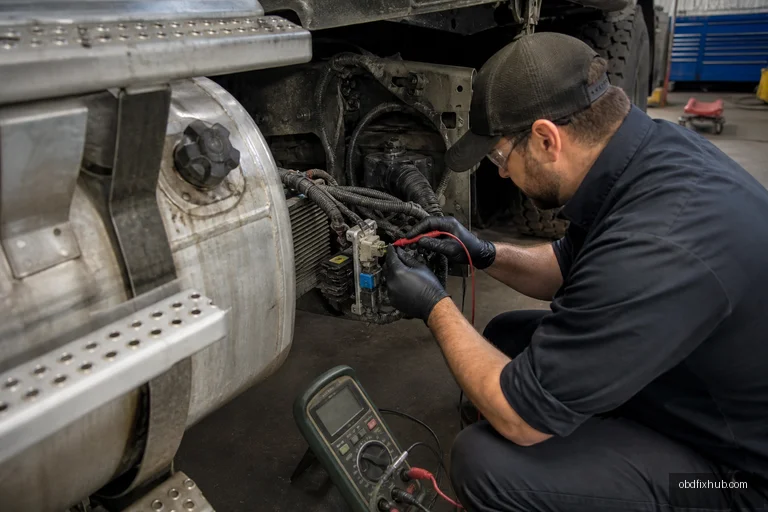
P056D Reductant Control Module System Voltage means the vehicle has detected an abnormal power supply or voltage condition at the reductant control module. In practical terms, the fault is usually caused by a weak battery, charging-system problem, blown fuse, poor ground, corroded wiring, or a communication-related power issue—not automatically a failed DEF module.
This code is associated with the diesel exhaust fluid (DEF) or AdBlue system used to reduce NOx emissions. The exact voltage thresholds and diagnostic procedure vary by manufacturer, so the vehicle’s wiring diagram and service information matter. A careful voltage and ground test should come before replacing an expensive reductant pump, heater, injector, or control module.
What Does P056D Mean?
P056D is a powertrain diagnostic trouble code related to the reductant control module system voltage. The module monitors its own supply voltage and may also be monitored by the engine or emissions control module over the vehicle network. If voltage falls below, rises above, or becomes unstable outside the permitted range, the vehicle stores the code.
The reductant control module manages components such as the DEF pump, tank heater, pressure control, level and temperature sensors, and dosing system. Depending on the vehicle design, the module may be mounted near the DEF tank, under the vehicle, or integrated into the tank assembly. That location exposes connectors and wiring to road salt, water, mud, and DEF crystallization.
Common Symptoms of P056D
A vehicle may still start and drive normally when this code first appears. The emissions system, however, can enter a restricted operating strategy if the voltage fault prevents reliable DEF dosing or system monitoring.
- Illuminated Check Engine or emissions warning light
- “Service DEF,” “AdBlue system fault,” or reductant warning message
- Reduced engine power or limited-performance mode
- DEF gauge or range display showing an incorrect value
- Failure of the DEF pump to build pressure
- Hard starting or a no-start countdown on some diesel vehicles
- Additional communication, low-voltage, or charging-system trouble codes
A no-start warning does not necessarily mean the DEF tank is empty. If the module loses power intermittently, the vehicle may incorrectly interpret the event as a reductant system failure. Do not add unnecessary DEF until the fluid level and quality have been verified.
Most Likely Causes of P056D
1. Low battery or charging voltage
A weak battery can produce a voltage drop during cranking that the reductant module records as a system-voltage fault. An alternator with a poor diode, loose belt, damaged cable, or unstable regulator can also create voltage fluctuations while the engine is running.
As a practical reference, a fully charged battery often measures close to 12.6 volts with the engine off, while many charging systems operate around 13.5 to 14.8 volts with the engine running. These are general values, not universal specifications. Smart-charging vehicles may intentionally vary system voltage, so compare your readings with the manufacturer’s data.
2. Blown fuse, relay, or poor power feed
The reductant module may have separate feeds for battery power, ignition power, pump operation, and heaters. A fuse can fail because of a shorted pump or heater, while a damaged relay or overheated fuse-box terminal can create intermittent voltage loss without leaving obvious visual evidence.
3. Corroded ground connection
A ground can look tight and still fail under load. Ground points near the frame, battery, DEF tank, or rear body harness are especially vulnerable to moisture and salt. A voltage-drop test is more reliable than checking resistance with the connector unplugged.
4. Damaged wiring or connectors
Wiring routed beneath the vehicle can be rubbed through by brackets, damaged by road debris, or saturated with water. DEF residue forms white crystalline deposits that can enter connectors and increase resistance. Look closely for green corrosion, pushed-back terminals, broken locking tabs, and wires stretched tightly near the tank.
5. Defective reductant control module or integrated tank assembly
The module itself can fail, but it should be considered only after its power, ground, network communication, and load circuits have been tested. On some vehicles the control electronics, pump, sensors, and heater are integrated into one tank module, making the repair considerably more expensive than a simple fuse or harness repair.
How to Diagnose P056D Properly
- Record all codes and freeze-frame data. Use a scan tool capable of communicating with the engine, emissions, and reductant modules. Note whether the code is current, pending, or stored, and record battery voltage at the time it set.
- Check the battery and charging system. Test battery state of charge, cranking voltage, alternator output, and excessive AC ripple. A battery that drops sharply during starting can trigger multiple unrelated-looking module codes.
- Inspect the relevant fuses and relays. Test both sides of each fuse with the circuit energized. Do not rely solely on a visual inspection; a hairline fuse failure or overheated terminal may be difficult to see.
- Perform a loaded voltage-drop test. With the reductant system powered, measure voltage between the module ground and battery negative, then between the module power terminal and battery positive. A significant drop indicates resistance in the ground or power path.
- Inspect the tank-area harness. Disconnect the connector only as directed by the service procedure. Check for moisture, DEF crystals, terminal corrosion, chafing, and evidence of water entering the connector from above.
- Check communication and live data. Look for module offline faults, implausible supply voltage, pump command versus actual pressure, and reductant temperature or level readings. A module that repeatedly disappears from the scan tool may have a power or network problem rather than a fluid problem.
- Clear the code and verify the repair. After correcting the fault, clear the codes and perform the required ignition cycles or road test. Some systems need a DEF pressure test, dosing test, or manufacturer-specific relearn before the warning message disappears.
Common Repair Solutions
- Replace a weak battery or repair the charging system
- Replace the correct fuse or relay after identifying why it failed
- Clean and tighten battery, chassis, and reductant-module grounds
- Repair damaged wiring using sealed automotive splices and correct wire sizes
- Replace corroded terminals or a damaged connector body
- Repair or replace a failed reductant pump, heater, or tank assembly when testing confirms the component is defective
- Program or configure a replacement reductant control module when required by the vehicle manufacturer
Aftermarket modules may not work correctly without software configuration. If the replacement unit cannot be programmed, communicates intermittently, or reports implausible sensor values, confirm part numbers and calibration requirements before condemning the new component.
What Not to Do When P056D Appears
Do not clear the code repeatedly and continue driving while ignoring a DEF countdown. Some vehicles eventually prevent restarting after the displayed distance reaches zero. Also avoid applying ordinary grease to electrical terminals or forcing a test light into small module pins; either action can damage sealed connectors or sensitive control circuits.
Do not assume that adding DEF will fix this fault. P056D concerns electrical system voltage, while a low-fluid or poor-fluid-quality code is a different diagnosis. The DEF level should still be checked using the correct fluid, but the power supply must be tested separately.
Can You Drive With P056D?
Short-term driving may be possible if the vehicle has no reduced-power message, overheating, stalling, or severe charging warning. However, the fault should be diagnosed promptly because an intermittent power loss can disable DEF dosing and lead to an emissions-related no-start countdown.
Stop driving and arrange professional testing if the battery warning light is on, the engine is stalling, voltage is unstable, or multiple control modules are losing communication. A charging failure can leave the vehicle stranded and may damage electronic modules.
Frequently Asked Questions
Is P056D caused by low DEF?
Usually not. P056D identifies a reductant control module voltage problem. Low DEF can produce separate level or range codes, although several faults may appear together.
Does P056D mean the DEF pump must be replaced?
No. A bad battery, ground, fuse, relay, connector, or harness can create the same code. The pump should be replaced only after its power supply, ground, wiring, and commanded operation have been tested.
Can a weak battery trigger P056D?
Yes. Low cranking voltage and unstable charging voltage are common starting points, particularly when the code appears after a difficult start or during cold weather.
Will disconnecting the battery permanently fix the code?
It may erase the stored code temporarily, but it does not repair the underlying fault. If the voltage problem remains, P056D will return after the module completes its self-check.
When should a technician diagnose P056D?
Seek professional diagnosis when the DEF warning includes a no-start countdown, the module cannot be accessed with a scan tool, wiring is corroded, or the vehicle requires module programming after replacement.
Key Takeaway
P056D Reductant Control Module System Voltage is best treated as an electrical diagnosis first. Verify battery and alternator performance, test fuses and voltage drop under load, inspect the DEF tank harness, and confirm module communication before buying replacement parts. That sequence prevents an expensive tank or control-module replacement when the real cause is a corroded ground or unstable power feed.




