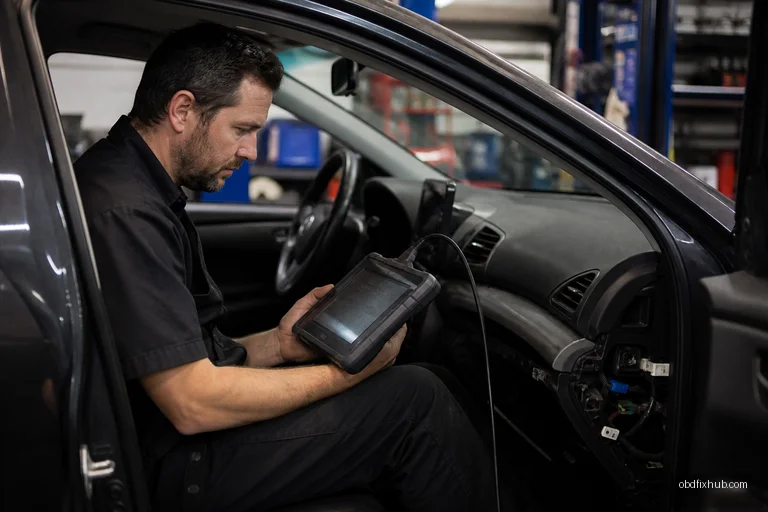
The P0600 code means the vehicle has detected a malfunction in the serial communication link between the engine computer and one or more control modules. In practice, the fault is often caused by low battery voltage, a poor ground, damaged CAN wiring, corrosion at a connector, or a module that has stopped communicating. Do not replace the PCM simply because P0600 is stored; prove the power, ground, network, and module condition first.
What Does the P0600 Code Mean?
P0600 is a generic OBD-II diagnostic trouble code for Serial Communication Link Malfunction. Modern vehicles contain several computers, including the engine control module, transmission control module, ABS module, body control module, and instrument cluster. These units exchange information through a communication network, usually a CAN bus.
When the PCM or another primary controller cannot communicate correctly with a required module, it may store P0600. The code does not identify one specific failed part. It describes a communication failure, so the diagnosis must establish whether the problem is electrical, network-related, software-related, or caused by a defective control module.
Common Causes of a P0600 Code
- Weak battery, incorrect battery installation, or a charging-system fault
- Loose, corroded, or damaged battery and chassis grounds
- Blown fuse or missing power supply to a control module
- Open, shorted, crushed, or water-damaged CAN bus wiring
- Corroded terminals or poor pin tension inside a module connector
- A failed body, transmission, ABS, or engine control module
- Aftermarket alarms, remote starters, trackers, or audio equipment interfering with the network
- Interrupted programming or an incompatible software update
- Low voltage during a battery replacement or jump-start
A particularly common real-world pattern is a P0600 that appears immediately after a flat battery or jump-start. The low voltage may not have permanently damaged a module, but it can create multiple communication codes and leave one controller offline until the battery and connections are restored.
P0600 Symptoms to Watch For
The symptoms depend on which module has stopped communicating. Some vehicles drive almost normally while others enter a reduced-power or fail-safe mode. Typical signs include:
- Check Engine, ABS, traction-control, transmission, or airbag warning lights
- Hard starting, a no-start condition, or intermittent stalling
- Harsh shifting or the transmission remaining in one gear
- Loss of traction control, cruise control, speedometer, or other functions
- Electrical accessories operating intermittently
- A scan tool that cannot access one or more vehicle modules
- Several U-codes appearing at the same time as P0600
If the engine runs but the instrument cluster, ABS, or transmission controller is offline, the communication fault may be more important than the drivability symptoms suggest. A vehicle can appear usable while safety systems are unavailable.
How to Diagnose the P0600 Code Properly
Professional diagnosis begins with a complete network scan, not with clearing the code or installing a PCM. Record every stored and pending code from every accessible module. The first code in the timeline is often more useful than the longest list of secondary communication codes.
- Check battery voltage. A healthy battery should generally measure about 12.4–12.7 volts with the engine off. With the engine running, charging voltage is commonly around 13.5–14.8 volts, although specifications vary by vehicle. Test during cranking as well; excessive voltage drop can reset modules.
- Inspect power and grounds. Check the PCM, body-control, ABS, and transmission-module fuses. Perform a voltage-drop test on both the positive supply and ground circuits rather than relying only on a visual inspection.
- Identify the missing module. Use a scan tool to see which controller will not communicate. If only one module is absent, its power, ground, connector, and local wiring are the first targets.
- Inspect the CAN network. Look for rubbed-through wiring near the battery tray, transmission, engine harness, door hinges, and areas exposed to water. On many systems, approximately 60 ohms across CAN-H and CAN-L with the network powered down is a useful initial check, but the manufacturer’s test procedure takes priority.
- Check for aftermarket interference. Temporarily isolate non-factory alarms, remote starters, tracking devices, and poorly installed stereo equipment. These accessories can interrupt network messages or keep a module awake.
- Verify software and module configuration. A replacement module may require programming, configuration, or immobilizer relearn. A correctly powered module that still fails communication may need manufacturer-level testing or replacement.
One practical diagnostic clue is whether the code returns immediately after clearing. An instant return with ignition on usually points to an active power, ground, network, or module problem. A code that returns only after driving may be linked to vibration, heat, moisture, or an intermittent harness fault.
What Is the Most Common Fix for P0600?
The most common fix is repairing the cause of the communication interruption: a weak battery, poor ground, blown fuse, corroded connector, or damaged CAN wire. Battery replacement alone is not a reliable repair unless testing confirms the battery is defective. In many workshop cases, cleaning a ground connection or repairing a harness resolves the code without replacing an expensive computer.
PCM replacement is appropriate only after the module has verified power and ground, the network wiring has passed testing, and other possible causes have been eliminated. The replacement PCM will usually need programming and, depending on the vehicle, immobilizer pairing and configuration.
Can You Drive With a P0600 Code?
Sometimes, but only for a short distance to a repair facility if the vehicle starts, shifts normally, and no critical safety systems are affected. Do not continue driving if the engine stalls, the transmission is stuck in a gear, steering or braking warnings appear, or ABS and stability-control functions are disabled.
Before driving, check whether the warning lights include ABS, airbag, or red brake warnings. A P0600 accompanied by multiple module failures can leave the vehicle without important safety assistance. If the car has a no-start condition or rapidly changing electrical behavior, towing is the safer option.
What Does the Ford P0600 Code Mean?
On Ford vehicles, P0600 generally indicates that the PCM has detected a failure in serial communication with another electronic control module. The exact affected circuit depends on the model, year, powertrain, and network architecture. Ford-specific scan data and service information are therefore important; a generic code reader may show P0600 without identifying the offline module.
Ford diagnosis should include a full module scan, battery and ground testing, fuse checks, and inspection of the CAN network. If the problem began after water intrusion, a battery event, aftermarket accessory installation, or module replacement, that history can significantly shorten the diagnostic process.
What Does the U0600 Code Mean?
U0600 is a network communication code, but its exact description can vary between manufacturers and scan-tool databases. It is commonly associated with invalid data received from a control module or an unidentified communication fault. Unlike P0600, which is a powertrain-related serial communication malfunction, U0600 belongs to the network-code family.
Do not diagnose U0600 from the code label alone. Check the complete code suffix, the module that reported it, freeze-frame data, and any related U-codes. A low-voltage event can produce both P0600 and U0600, while a single defective module or wiring fault can generate a large group of communication codes.
When to Use a Professional Diagnostic Shop
Network faults are a good reason to use a scan tool capable of communicating with every vehicle module and displaying a network topology or module status list. A basic code reader can retrieve P0600 but usually cannot show which module is missing or whether the CAN bus is shorted.
Seek professional help when the vehicle has multiple warning lights, intermittent no-start symptoms, water intrusion, a suspected immobilizer problem, or a module that requires programming. Guessing with control modules can become far more expensive than testing the circuit first.
Key Takeaway
P0600 is a communication warning, not a diagnosis of a failed computer. Start with battery voltage, charging output, grounds, fuses, connectors, and CAN wiring; then identify the module that is offline. Drive only when the vehicle remains safe and fully controllable, and replace or program a PCM only after electrical and network tests support that decision.
Frequently Asked Questions
Is P0600 a serious code?
It can be serious because it may disable transmission, ABS, stability, starting, or engine-control functions. Severity depends on the missing module and the symptoms present.
Will disconnecting the battery fix P0600?
Disconnecting the battery may clear a temporary low-voltage communication event, but it does not repair damaged wiring, poor grounds, or a failed module. The code should be rescanned after the vehicle is driven and the underlying cause is tested.
Does P0600 always mean the PCM is bad?
No. A PCM can report P0600 because another module is offline or because the network cannot carry messages. Verify PCM power, grounds, CAN circuits, and module communication before condemning the PCM.
Can a dead battery cause P0600?
Yes. Low voltage during starting, jump-starting, or battery replacement can interrupt module communication and trigger P0600. Battery condition and charging performance should be checked before deeper network repairs.




