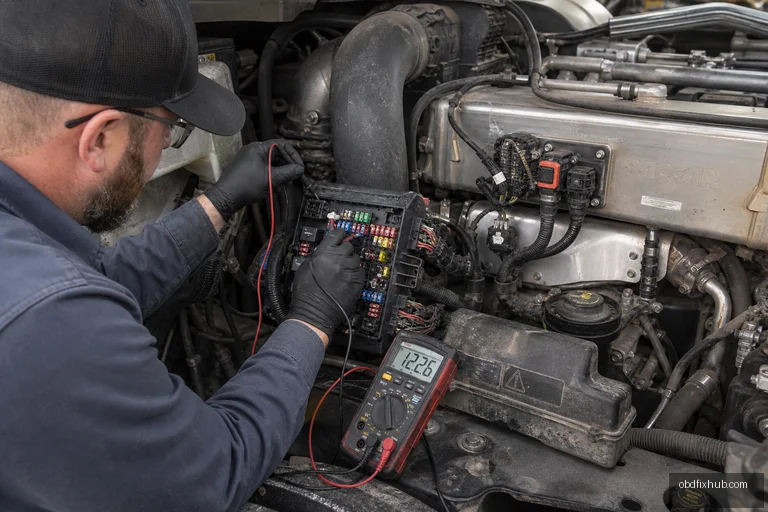
P05F3 means the engine computer has detected an open or electrically abnormal control circuit for the exhaust aftertreatment power relay. In practical terms, the relay that supplies power to diesel emissions equipment may not be switching as commanded. The fault can affect the DPF, DEF/SCR, NOx sensor, dosing, or exhaust temperature-control system, depending on the vehicle.
This is an informational diagnostic code, not a parts-replacement instruction. A failed relay is only one possibility; a blown fuse, corroded connector, damaged wiring, poor ground, or a control-side fault can create exactly the same code.
What Does Code P05F3 Mean?
P05F3 is a generic OBD-II power-management fault related to the exhaust aftertreatment power relay control circuit. The ECM or PCM monitors the relay circuit and expects to see a predictable voltage when it commands the relay on or off. If that voltage is missing, remains present at the wrong time, or the circuit is electrically open, the module stores P05F3.
The word open usually means that electrical current cannot travel through the intended path. An open circuit may be caused by a broken wire, a backed-out terminal, a failed relay coil, an unplugged connector, or an internal fuse-box fault. It does not automatically mean the exhaust catalyst or DPF itself has failed.
What Is the Exhaust Aftertreatment Power Relay?
On diesel vehicles, aftertreatment equipment needs stable battery voltage to operate heaters, sensors, dosing components, and control modules. The power relay acts as an electronically controlled switch. The ECM or PCM commands the relay, and the relay then supplies high-current power to the emissions hardware.
Depending on the engine and model, the circuit may feed components such as:
- Diesel particulate filter temperature sensors and related electronics
- Selective catalytic reduction or DEF dosing equipment
- NOx sensors and their control modules
- Exhaust gas temperature sensors
- Aftertreatment heaters, pumps, or reductant-system components
Vehicle manufacturers use different relay names and circuit designs. Some systems use a conventional plug-in relay, while others place the relay inside an integrated power distribution module.
P05F3 Symptoms to Watch For
The symptoms depend on whether the fault is intermittent or permanent and whether the vehicle detects it during a regeneration or emissions-system self-test. A truck may still start and drive normally at first, which can make this code easy to underestimate.
- Check Engine Light or malfunction indicator lamp
- Reduced engine power or limp mode
- Failed or interrupted DPF regeneration
- DEF, SCR, emissions-system, or service warning messages
- Hard starting or extended crank time on some applications
- Increased fuel consumption or reduced throttle response
- Multiple communication, sensor-voltage, or aftertreatment codes
- A countdown warning that eventually limits speed on certain diesel models
One useful diagnostic clue is timing. If P05F3 appears immediately after engine start, suspect the relay control, fuse, wiring, or power-distribution module. If it appears only during a regeneration attempt, a heat-sensitive connection, relay contact problem, or high-current load issue becomes more likely.
Most Common Causes of P05F3
1. Failed relay or relay contacts
The relay coil can fail open, or its internal contacts can become burned and resistive. A relay may click during a basic test yet fail under load, so listening for a click is not enough. Voltage-drop testing while the system is operating provides a more reliable answer.
2. Blown fuse or fusible link
A fuse can open because of a shorted heater, pump, sensor harness, or water-damaged connector. Replacing the fuse without finding the reason it failed often results in another immediate failure. Never install a larger fuse to keep the circuit alive.
3. Damaged wiring near the exhaust
Aftertreatment wiring operates close to extreme heat, road debris, salt, and vibration. Look for melted insulation, hardened wire jackets, chafing against brackets, and wires pulled tight at the sensor or dosing-module connector. A fault may disappear when the harness cools and return after a long drive.
4. Corrosion, water intrusion, or loose terminals
Green corrosion inside a relay socket can create an open circuit even when the fuse looks perfect. Check for pushed-back terminals, moisture in the underhood fuse box, and poor pin tension. Do not rely only on visual inspection; lightly tug each suspect wire and inspect both sides of the connector.
5. Ground or ECM control-side fault
The relay control circuit needs a valid power feed, ground path, and command from the ECM or PCM. A weak engine ground, damaged module ground, or control wire shorted to power can set P05F3. An ECM should be considered only after the external circuit has passed power, ground, continuity, and load tests.
How to Diagnose P05F3 Correctly
- Record all codes and freeze-frame data. Do not erase the scan-tool information before noting battery voltage, engine temperature, vehicle speed, and whether other aftertreatment codes appeared at the same time.
- Check technical service information. The wiring diagram and manufacturer test procedure identify the relay, fuse, connector pins, and expected control voltage. Generic diagrams are not sufficient for a safe diagnosis.
- Inspect the fuse and relay box. Look for heat damage, water entry, loose terminals, and a relay that does not match the correct part number. If the relay is interchangeable, use only a confirmed identical relay for a temporary test.
- Test voltage at the relay socket. With the circuit commanded on, verify battery voltage at the relay feed and output. A test light can reveal a weak circuit that a digital meter may show as apparently normal with no load.
- Check the control side. Measure whether the ECM is supplying or grounding the relay coil as designed. The control strategy differs by vehicle, so do not assume one terminal should always be ground.
- Perform voltage-drop and continuity tests. Continuity with the circuit disconnected can miss a wire that fails under vibration or current. Test the harness under load and flex it carefully while monitoring the reading.
- Clear the code and verify operation. After repair, use the scan tool to run the relevant output test or aftertreatment self-test. A road test alone may not activate the relay under the required conditions.
Before testing, confirm that the battery is fully charged. Low system voltage can create misleading relay and communication faults, especially during cold starts or a commanded emissions-system test.
How Is P05F3 Repaired?
The correct repair depends on the failed point in the circuit. Typical repairs include replacing a defective relay, repairing a melted wire with the correct automotive-grade splice, restoring a corroded terminal, replacing a damaged fuse-box socket, or correcting a failed ground connection.
Wire repairs near the exhaust require heat-resistant protection and correct routing. Keep the harness away from the DPF, turbocharger, and sharp brackets, and restore any heat shields or retainers removed during testing. A poorly routed replacement wire may work in the driveway and fail after the first regeneration cycle.
If a fuse blows again immediately, stop replacing fuses. The downstream load should be isolated systematically, beginning with the wiring and aftertreatment components powered by that fuse. Forced regeneration should not be attempted until the relay fault is repaired, because the system may be unable to control temperature safely.
Is P05F3 the Same as P0685?
No. P0685 means “ECM/PCM power relay control circuit/open,” which concerns the main power supply relay for the engine or powertrain control module. P05F3 concerns the power relay circuit for exhaust aftertreatment equipment. They can appear together if a shared power or ground problem exists, but they are not interchangeable codes.
What is the ECM/PCM power relay control circuit open?
In plain language, an ECM/PCM power relay control circuit open means the computer cannot properly control or monitor the relay that supplies its operating power. The open may be in the relay coil, control wire, fuse-box connection, module ground, or related power feed. Because the ECM depends on this circuit, P0685 deserves priority when it is present with multiple unrelated codes or a no-start condition.
Where is the ECM/PCM power relay located on a vehicle with P0685?
On most vehicles, the ECM/PCM power relay is located in the underhood fuse and relay box, often labeled ECM, PCM, EEC, EFI, or Main Relay. Some models place it in an interior fuse panel, and others integrate it into a body or power-distribution module rather than using a removable relay.
There is no universal location based on the code alone. Use the fuse-box cover, owner’s manual, service manual, and wiring diagram to identify the correct relay. Do not assume that a relay with a similar name or position is the PCM relay; incorrect swapping can damage circuits or create additional faults.
When Should You Stop Driving?
A vehicle with only an illuminated Check Engine Light and normal operation may be driven briefly to a repair facility, but emissions-system warnings should not be ignored. Stop driving if the vehicle enters severe limp mode, shows a high-exhaust-temperature warning, loses power in traffic, overheats, or displays a DEF countdown that could leave you stranded.
Prompt diagnosis is especially important on diesel vehicles. Continued failed regeneration can load the DPF with soot, while repeated attempts to operate a malfunctioning dosing or heater circuit can create additional component damage.
Key Takeaway
P05F3 identifies an electrical problem in the exhaust aftertreatment power-relay control circuit, not proof that the DPF or catalytic converter is defective. Start with the battery, fuses, relay, connectors, grounds, and heat-damaged wiring; then confirm the ECM command with the correct wiring diagram. Repair the electrical cause before clearing the code or performing a forced regeneration.
Frequently Asked Questions
Can I drive with a P05F3 code?
Possibly for a short distance if the vehicle runs normally, but the fault can prevent regeneration or trigger reduced-power and DEF warnings. Arrange diagnosis promptly rather than continuing normal use for weeks.
Does P05F3 always mean the relay must be replaced?
No. A relay is only one possible cause. A blown fuse, corroded relay socket, broken exhaust-area harness, weak ground, or missing ECM command can all set the same code.
Can a weak battery cause P05F3?
Yes. Low cranking voltage can interfere with relay operation and module self-tests. Test battery state of charge and charging voltage, but do not assume the battery is the only problem without checking the relay circuit.
Will clearing P05F3 fix the problem?
Clearing the code only removes the stored fault temporarily. If the open circuit remains, the code will return when the ECM repeats its relay test, often during startup or an aftertreatment operating event.
Should I force a DPF regeneration with P05F3 present?
No. First repair and verify the power-relay circuit. A forced regeneration requires reliable control of exhaust temperature and dosing; attempting it with an unresolved electrical fault can be unsafe and may damage the emissions system.




