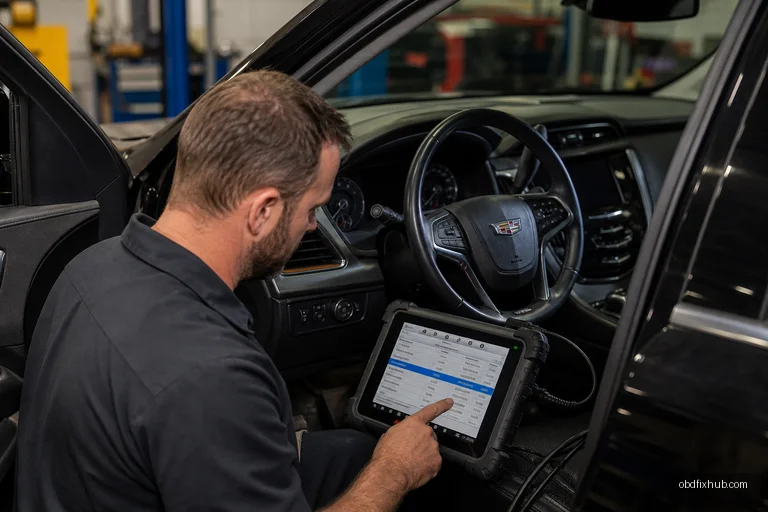
P0614 ECM/TCM Incompatible means the engine control module and transmission control module are not communicating or are not configured to work together. The fault is often caused by incorrect programming, a mismatched replacement module, low voltage during a software update, or a CAN-bus communication problem. Do not replace the ECM or TCM immediately; confirming power, grounds, network wiring, software compatibility, and vehicle configuration is the fastest way to avoid an expensive mistake.
What Does the P0614 Code Mean?
P0614 is a generic OBD-II powertrain code defined as ECM/TCM incompatible. The ECM, also called the engine control module or PCM on some vehicles, exchanges torque, speed, gear, and control information with the TCM. When the data received from the other module is invalid, unexpected, or incompatible with the vehicle configuration, the monitoring module stores P0614.
This code does not always mean that one module has completely failed. In many real-world cases, both modules are functioning electrically but contain software or configuration data that do not match. For example, a replacement TCM may have been programmed with a different transmission calibration, engine option, market specification, or vehicle identification number.
P0614 Symptoms You May Notice
The driving symptoms depend on whether the incompatibility is caused by software, communication loss, or an actual module fault. Some vehicles will continue to drive normally with the warning light on, while others enter a protective transmission strategy.
- Check Engine or transmission warning light
- Harsh, delayed, or incorrect gear changes
- Transmission stuck in one gear or limp-home mode
- No-crank or intermittent starting problems
- Reduced engine power or limited torque
- Incorrect gear display or missing transmission data on a scan tool
- Multiple U-codes related to CAN communication
- Failure to complete a module programming or relearn procedure
A useful practical clue is timing. If P0614 appeared immediately after an ECM, TCM, battery, transmission, or software replacement, configuration and programming should be investigated before suspecting an internal electronic failure.
Most Common Causes of P0614 ECM/TCM Incompatible
1. Incorrect module programming
A replacement control module may be physically correct but programmed with the wrong calibration. Modern modules are not generally plug-and-play. They may require VIN writing, immobilizer pairing, variant coding, transmission identification, and a software update using manufacturer-level equipment.
2. Mismatched ECM, TCM, or PCM hardware
Modules that look identical can have different part numbers, connector assignments, internal processors, or software families. A unit from a similar engine or model year may communicate on the network but still fail the compatibility check.
3. Low battery voltage during programming
Programming should be performed with a stable power supply, not a weak battery and a basic charger. If voltage drops while calibration data is being written, a module can be left partially programmed or unable to complete its security handshake. Check battery condition and charging voltage before attempting another update.
4. CAN-bus wiring or connector faults
The ECM and TCM usually communicate over a high-speed CAN network. Corrosion, water intrusion, loose terminals, a damaged twisted pair, or an aftermarket accessory connected incorrectly can distort communication. A single network fault may create several codes, so P0614 should be interpreted alongside every other stored code.
5. Power, ground, or fuse problems
An unstable ignition feed or high-resistance ground can make a module reset repeatedly. Inspect the relevant fuses, relays, grounds, and power feeds under load. A visual check alone is not enough; a voltage-drop test while the system is operating can reveal a connection that looks clean but cannot carry current.
6. Failed ECM or TCM
Internal module failure is possible, particularly after water damage, reverse polarity, jump-starting errors, or electrical overvoltage. It should be considered only after the wiring, power supply, software, and compatibility checks have passed.
How to Diagnose and Fix P0614
- Record all codes and freeze-frame data. Use a scan tool capable of accessing the ECM, TCM, body module, and network communication faults. Note whether P0614 is current, pending, or history.
- Check the battery and charging system. A fully charged battery and stable system voltage are essential. Test for excessive voltage drop on module grounds and power circuits rather than relying only on a static voltage reading.
- Scan both the ECM and TCM separately. Confirm whether each module is detected, whether live data is available, and whether one module reports lost communication with the other. If the scan tool cannot access the TCM, investigate its power, ground, and network circuit first.
- Inspect connectors and CAN wiring. Look for bent pins, pushed-back terminals, green corrosion, oil contamination, water entry, and harness damage near the transmission. Follow the wiring diagram for the specific vehicle; CAN resistance and voltage tests must be made according to the manufacturer procedure.
- Verify hardware and calibration numbers. Compare the installed module part number, software level, transmission type, engine variant, market specification, and VIN. Do not rely on appearance or a seller’s statement that the module is compatible.
- Perform manufacturer-approved programming. Use a stable power supply and the correct diagnostic software. Depending on the vehicle, this may include VIN registration, immobilizer synchronization, variant configuration, clutch or shift adaptations, and a transmission relearn.
- Clear codes and carry out a road test. After programming or repair, clear all modules, cycle the ignition as instructed, and verify that the ECM and TCM exchange live data. Test cold starts, multiple gear changes, reverse engagement, and normal operating temperature before declaring the repair complete.
What Does P0614 Mean in a Mahindra Vehicle?
In a Mahindra, P0614 still generally points to an incompatibility or communication problem between the engine and transmission control systems. The exact repair depends on the model, engine, transmission type, model year, and regional software. A Scorpio, XUV, Thar, Bolero, or another Mahindra variant may use different module architecture and programming procedures, so a universal pinout or generic calibration should not be assumed.
On a Mahindra vehicle, pay particular attention to recent battery replacement, jump-starting, water exposure, transmission work, ECU replacement, or an unsuccessful scan-tool update. The correct diagnostic approach is to use a Mahindra-capable scan tool, identify all module codes, confirm the module identification numbers, and check the manufacturer’s programming and immobilizer procedures. If a used ECU or TCM is installed, it may require proper configuration or may be unsuitable because it is locked to another vehicle.
When a Mahindra shows P0614 together with CAN communication codes, start with battery voltage, grounds, fuses, and network wiring. When P0614 appears alone after module replacement, software mismatch, VIN configuration, or incomplete coding becomes more likely. A Mahindra specialist or authorised workshop can confirm the correct calibration using the vehicle identification number rather than guessing from the registration year alone.
Can You Drive With P0614?
Short-distance driving may be possible if the transmission shifts normally and the vehicle has no severe warning symptoms. However, continued driving is risky when the gearbox is stuck in one gear, shifts violently, loses reverse, or the engine enters reduced-power mode. Those conditions can increase clutch and transmission wear and may leave you unable to move safely in traffic.
Do not disconnect the battery as a first-line repair. It may temporarily erase symptoms while leaving the programming or wiring fault unresolved, and it can create additional issues with learned values or security systems. Save the diagnostic report before clearing anything.
Repair Cost: What Usually Determines It?
The cost varies widely because P0614 can be corrected by repairing a ground or connector, or it can require module replacement and programming. Diagnosis is usually least expensive when the vehicle is tested before parts are ordered. Ask the repairer whether the quote includes module coding, VIN configuration, immobilizer pairing, software updates, and post-repair relearn procedures.
Final Takeaway
P0614 is a compatibility and communication warning, not automatic proof that the ECM or TCM is defective. Begin with a complete module scan, battery and ground testing, CAN inspection, and verification of hardware and software compatibility. For Mahindra vehicles in particular, use model-specific service information and a tool capable of the required coding and relearn functions. If the code appeared after a module replacement, have the programming checked before purchasing another control unit.
Frequently Asked Questions
What does the P0614 code mean and how can I fix it?
It means the ECM and TCM are incompatible or are not exchanging valid data. Diagnose power, grounds, CAN wiring, module part numbers, VIN configuration, and software calibration before programming or replacing a module.
What does the P0614 fault code mean in a Mahindra vehicle?
It usually indicates an engine and transmission control compatibility or communication issue. The exact cause varies by Mahindra model, so use a Mahindra-capable scan tool and follow the correct coding, immobilizer, and transmission relearn procedure.
Can a weak battery cause P0614?
Yes. Low voltage can interrupt communication or corrupt an incomplete programming event. Test the battery, alternator, module power feeds, and grounds before condemning either control module.
Will replacing the ECM fix P0614?
Not necessarily. An unprogrammed, incorrectly configured, or incompatible replacement ECM can produce the same code. Replacement should follow confirmed diagnosis and include manufacturer-approved programming.
Is P0614 a serious fault?
It can be. If the vehicle has harsh shifting, limp mode, no-start symptoms, or multiple communication codes, avoid unnecessary driving and arrange a professional diagnosis promptly.




