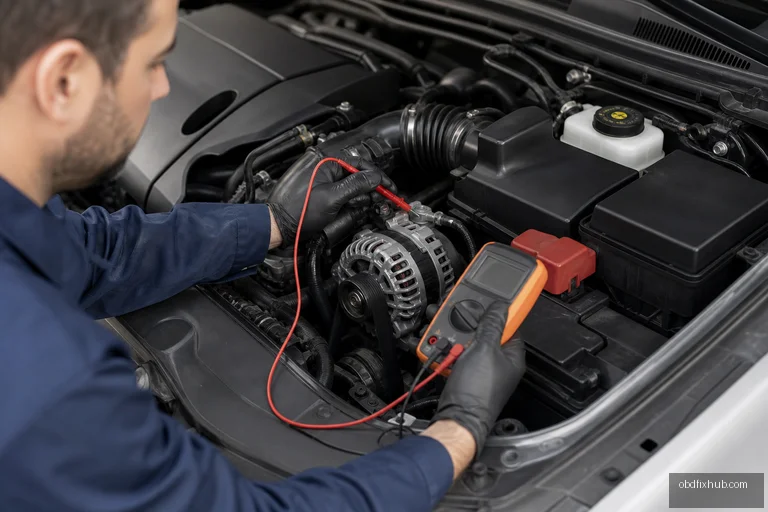
P0620 means the engine control module has detected a fault in the generator (alternator) control circuit. In practical terms, the vehicle computer cannot reliably command or monitor alternator output. A weak battery, damaged wiring, a failed alternator regulator, or a communication problem can all be involved, so replacing the alternator immediately is not always the correct fix.
This is an informational search intent: the priority is understanding the code, confirming the cause, and deciding whether the vehicle can be driven safely. The exact circuit design varies by vehicle, but the diagnostic logic below applies to most cars, trucks, and SUVs.
What Does Code P0620 Mean?
OBD-II code P0620 is defined as Generator Control Circuit Malfunction. The PCM or ECM uses the generator control circuit to regulate charging system output and verify that the alternator responds as expected.
Depending on the manufacturer, the system may use a conventional alternator field-control wire, a voltage-regulator command circuit, a duty-cycle signal, or a digital LIN/CAN communication line. For that reason, the correct test procedure is vehicle-specific. A wiring diagram and service information are more reliable than assuming every alternator has the same terminals.
“P620” is usually a shortened or mistyped reference to P0620. The leading zero matters: P0620 is the standardized five-character diagnostic trouble code.
Common Symptoms of P0620
The symptoms depend on whether the alternator is undercharging, overcharging, or simply failing to communicate with the PCM. A vehicle may still start and drive normally at first, which makes this code easy to underestimate.
- Battery or charging-system warning light on the dashboard
- Slow cranking or repeated no-start conditions
- Headlights that dim, flicker, or change brightness with engine speed
- Unstable electrical accessories, including blower motors, heated seats, or audio systems
- Low or high system voltage measured at the battery
- Stalling after the battery becomes discharged
- Multiple low-voltage communication or sensor codes stored with P0620
- Battery damage caused by prolonged overcharging
One useful clue is the pattern of the warning light. If the battery light appears only after the engine warms up, the alternator may have an internal regulator or brush fault that occurs when hot. If the light appears immediately after a battery replacement or electrical repair, inspect the connectors, grounds, and disturbed wiring first.
Can Low Voltage Trigger P0620?
Yes, low voltage can trigger P0620. A weak battery, loose battery terminal, corroded engine ground, slipping serpentine belt, or failing alternator can cause the PCM to see an implausible generator signal. Low voltage may also create several unrelated-looking trouble codes because modern control modules need stable power and communication.
However, low voltage is not proof that the alternator itself is defective. A battery with an internal short can pull system voltage down, while a high-resistance ground can make the alternator appear weak even when its output is acceptable. Clear the code only after measuring voltage under several operating conditions.
Most Common Causes of P0620
- Failed alternator or internal voltage regulator
- Open, shorted, or corroded generator control wiring
- Loose alternator plug or damaged connector terminals
- Blown charging-system fuse or fusible link
- Weak battery or poor battery connections
- High resistance in the engine, chassis, or battery ground circuit
- Slipping, loose, or damaged serpentine belt
- PCM software, driver, or internal control-circuit failure
- LIN or CAN network communication fault on electronically controlled charging systems
The alternator is a frequent cause, but it is not the only one. In professional diagnosis, the charging voltage, control signal, voltage drop, and stored companion codes are considered together. A code reader that displays only P0620 cannot identify which component failed by itself.
How to Diagnose P0620 Correctly
1. Check battery condition and basic connections
Begin with a visual inspection. Confirm that the battery terminals are tight and clean, the negative cable is secure, and the engine ground strap is intact. Inspect the positive cable and fusible link near the battery or starter for heat damage or corrosion.
With the engine off after the vehicle has been sitting, a healthy fully charged battery is typically close to 12.6 volts. Around 12.2 volts indicates partial discharge, while a reading near 12.0 volts or lower requires charging and battery testing before further conclusions are made.
2. Measure charging voltage
Start the engine and measure voltage at the battery terminals. Many conventional systems operate roughly between 13.5 and 14.8 volts, but smart-charging vehicles may intentionally vary voltage outside that range. Turn on the headlights, blower motor, rear defroster, and heated accessories, then observe whether voltage remains stable.
Do not condemn a smart alternator because it does not hold a constant 14.4 volts. Some vehicles command lower voltage during light load and raise it during deceleration or battery recovery. Always compare the reading with the manufacturer’s specification and scan-tool data.
3. Inspect the generator control circuit
With the ignition off, inspect the alternator connector for bent pins, water intrusion, oil contamination, and terminals pushed backward inside the housing. Follow the small control wires away from the alternator; they can rub against brackets, melt against exhaust components, or break internally near the connector.
Use a wiring diagram to identify the field, monitor, power, ground, and communication terminals. A continuity test alone can miss a wire that fails only under vibration or load. Voltage-drop testing and a wiggle test while monitoring the signal are often more revealing.
4. Scan for related codes and live data
Record all codes before clearing anything. Codes related to battery voltage, network communication, generator field duty cycle, or PCM power supply can point away from a simple alternator failure. Live data may show commanded generator output versus actual charging voltage, which is particularly valuable on vehicles with variable-voltage systems.
5. Test the alternator and regulator
If power, ground, wiring, and control signals are correct but output remains wrong, test the alternator using the manufacturer’s procedure. Some regulators are built into the alternator; others are controlled externally by the PCM. Installing a replacement unit with the wrong regulator type can create a repeat P0620 even when the part is new.
How Do You Fix a P0620 Code?
The correct repair depends on the failed part. Common fixes include:
- Charge and test the battery, replacing it if it fails a load or conductance test.
- Clean and tighten battery, alternator, engine, and chassis ground connections.
- Replace a blown fuse or fusible link only after finding the reason it opened.
- Repair damaged wires, terminals, connectors, or network communication wiring.
- Replace the alternator or voltage regulator when output or internal control testing fails.
- Perform required charging-system or battery registration procedures after repair.
- Check for manufacturer software updates or PCM faults if all external tests pass.
After the repair, clear the code and perform a complete drive cycle with several electrical loads active. Recheck charging voltage, scan for returning codes, and confirm that the battery warning light stays off. A short idle test may not reproduce an intermittent fault caused by heat, vibration, or high electrical demand.
Can I Drive With a P0620 Code?
Short-distance driving may be possible, but it is not generally advisable to continue driving normally. If the alternator is not charging, the engine will run only until the battery is depleted. That can happen in minutes or several hours depending on battery condition, lighting, traffic, and accessory use.
Stop driving and arrange professional diagnosis if the battery light is on, the headlights are dimming, the engine is stalling, voltage exceeds approximately 15 volts, or electrical systems are shutting down. Overcharging can damage expensive modules, while undercharging can leave you stranded in traffic.
Practical Diagnostic Tips That Prevent Misdiagnosis
- Do not test charging voltage by disconnecting the battery while the engine is running; this can create damaging voltage spikes.
- Use a meter at the battery posts, not only on the cable clamps, to identify poor terminal contact.
- Check the belt tensioner and pulley alignment if charging changes when the engine is revved.
- Compare alternator case voltage with battery negative during operation to detect a bad ground path.
- On smart-charging vehicles, use a scan tool capable of reading generator commands and LIN data.
- Do not erase all codes before recording freeze-frame data; the original operating conditions can be diagnostically important.
Summary: The Right Next Step for P0620
P0620 identifies a fault in the generator control circuit, but it does not automatically mean the alternator must be replaced. Start with battery condition, terminals, grounds, fuses, belt condition, and charging voltage. Then test the control wiring and communication circuit using the vehicle’s wiring diagram.
If the battery warning light is active or voltage is unstable, limit driving and diagnose the vehicle promptly. A careful electrical test is usually faster and less expensive than replacing an alternator, battery, and PCM through trial and error.
Frequently Asked Questions
What does the code P620 mean?
P620 is usually a typo or shortened version of P0620. The correct OBD-II code is P0620, Generator Control Circuit Malfunction.
Can a bad battery cause P0620?
Yes. A weak or internally damaged battery can cause unstable system voltage and make the PCM detect a generator-control fault. Battery testing should be completed before replacing the alternator.
Will replacing the alternator fix P0620?
It may, but only if the alternator or its internal regulator has failed. Damaged wiring, poor grounds, blown fuses, and communication faults can produce the same code.
Is P0620 an urgent code?
It can be. If the charging system is failing, the vehicle may stall once the battery is discharged. A lit battery warning lamp, dimming lights, or unusually high voltage warrants immediate attention.
How much does it cost to repair P0620?
Repair cost varies widely. Cleaning a ground or repairing a connector may be inexpensive, while an alternator, battery, wiring repair, or PCM-related diagnosis can cost considerably more. Testing the circuit first prevents unnecessary parts replacement.




