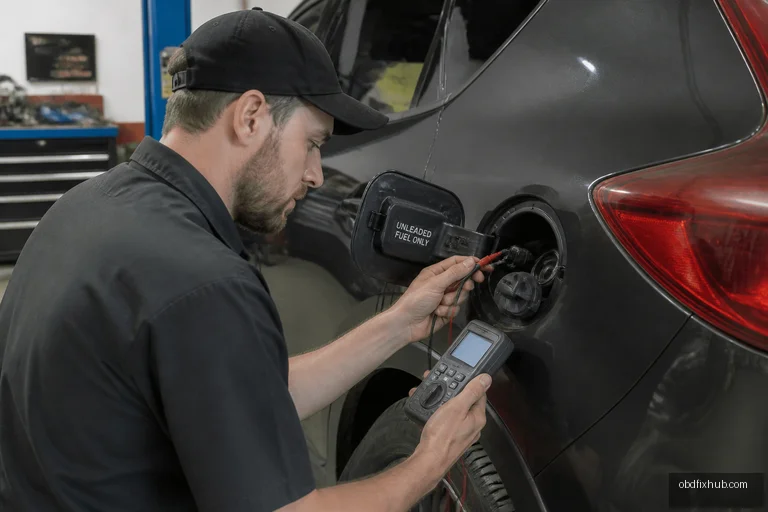
P0624 Fuel Cap Lamp Control Circuit means the powertrain control module (PCM) has detected a problem in the electrical circuit that controls the fuel-cap warning lamp. It does not automatically mean the fuel cap itself is loose or defective. In many cases, the real fault is a damaged wire, corroded connector, instrument-cluster problem, failed warning lamp, or a communication issue between control modules.
This is an informational diagnosis rather than a fuel-pump fault. A proper scan, visual inspection, and circuit test are usually needed before replacing parts.
What Does the P0624 Engine Code Mean?
P0624 is a generic OBD-II diagnostic trouble code defined as Fuel Cap Lamp Control Circuit. The vehicle’s PCM monitors the circuit used to command the fuel-cap warning indicator. When the voltage, resistance, or feedback signal remains outside the expected range, the PCM stores P0624 and may illuminate the check-engine light.
The exact warning-lamp design varies by manufacturer. Some vehicles use a dedicated “check fuel cap” message, while others use a fuel-cap icon or a warning light integrated into the instrument cluster. Always check the service information for the specific vehicle because the circuit logic and acceptable voltage readings are not identical across brands.
Common Symptoms of P0624
The check-engine light is the most common symptom, but the warning display may provide a more useful clue. A vehicle can drive normally because this code generally affects the warning circuit rather than fuel delivery or engine timing.
- Check-engine light remains illuminated.
- Fuel-cap warning lamp or message does not appear when expected.
- Fuel-cap warning stays on even after the cap is correctly installed.
- Intermittent warning messages, especially over bumps or in damp weather.
- Other body, instrument-cluster, or communication codes stored at the same time.
- In some models, the fuel-cap warning may be unavailable while an evaporative-emissions fault is also present.
Can a Faulty Fuel Cap Cause P0624?
Usually, no. A loose, cracked, or incorrect fuel cap more commonly causes EVAP codes such as P0455, P0456, or P0457. It can also trigger a check-engine light without setting P0624.
There is one important exception: some vehicles use the fuel-cap position or sealing information as part of a monitored warning strategy. If the cap contains an electronic sensor or the system detects abnormal feedback through a related circuit, a manufacturer-specific fault may appear alongside P0624. For that reason, inspect the cap, filler neck, and cap sensor if equipped—but do not assume the cap is the only problem.
Most Likely Causes of P0624
- Loose, damaged, or incorrectly fitted fuel cap.
- Open circuit, short to ground, or short to voltage in the lamp-control wiring.
- Corroded terminals near the fuel-filler area, body harness, or instrument cluster.
- Blown fuse or poor power or ground supply to the warning-lamp circuit.
- Failed fuel-cap warning bulb, LED driver, or instrument-cluster circuit board.
- Faulty PCM or body control module, although this is less common.
- Low system voltage, battery problems, or a recent jump-start causing communication faults.
- Aftermarket wiring, remote starters, or accessories interfering with the circuit.
How to Diagnose the P0624 Fuel Cap Lamp Control Circuit
1. Confirm the code and check for related faults
Use a scan tool capable of reading all available modules, not just generic powertrain codes. Record freeze-frame data and look for low-voltage, instrument-cluster, body-control, and EVAP codes. If several modules report communication or voltage faults, repair the power supply issue before chasing the fuel-cap lamp.
2. Inspect the cap and filler area
Remove the cap and check the sealing gasket for cuts, flattening, or hardening. Confirm that the cap clicks or tightens according to the manufacturer’s design. Look inside the filler neck for dirt, rust, or damage, then inspect nearby wiring for chafing caused by the fuel door, filler pipe, or suspension movement.
3. Check fuses, grounds, and connector condition
Do not rely on a visual fuse inspection alone; test for voltage on both sides of the fuse with the circuit commanded on. Look for green corrosion, pushed-back terminals, moisture, and loose grounds. A voltage-drop test under load is more reliable than simply measuring resistance with the connector unplugged.
4. Test the warning-lamp control circuit
Using the wiring diagram, identify the control wire, power feed, and ground path. A technician may command the lamp on with a scan tool or use a test light and multimeter to verify whether the PCM is producing the expected signal. Compare the measured voltage with the manufacturer’s specification rather than guessing from a universal value.
5. Check the instrument cluster and module communication
If the control signal reaches the cluster but the lamp does not operate, the cluster, LED driver, or internal circuit may be at fault. If the signal never leaves the PCM, verify PCM power, grounds, connector tension, and network communication first. PCM replacement should be the final step, not the first part installed after seeing P0624.
How to Fix P0624
The correct repair depends on the failed part. A loose cap should be correctly installed or replaced with the exact specification for the vehicle. Damaged wiring should be repaired with sealed automotive splices, correct wire gauge, and proper routing away from sharp edges and heat. Corroded terminals may require connector replacement rather than a quick spray of contact cleaner.
If testing proves that the instrument cluster or warning-lamp driver has failed, it may need professional repair, replacement, coding, or immobilizer-related configuration. A PCM or body-control module should only be replaced after power, ground, wiring, and communication tests pass. After the repair, clear the code, cycle the ignition, and perform the manufacturer’s prescribed drive cycle or functional test.
Is P0624 Related to a Fuel Pump Control Circuit Low Code?
No. P0624 concerns the fuel-cap warning lamp circuit, not the electrical supply to the fuel pump. A fuel-pump control-circuit-low fault is commonly associated with a different code, such as P0231, although the exact code depends on the vehicle and system design.
If the engine cranks but does not start, stalls, or shows low fuel pressure, diagnose the fuel-pump circuit separately. Test the pump fuse, relay or fuel-pump driver, wiring, ground, pump voltage under load, and actual fuel pressure. Replacing the fuel cap will not repair a low fuel-pump control signal.
How Long Does It Take for a Gas Cap Code to Clear?
If the problem is only a loose fuel cap, the warning may turn off after several normal drive cycles, but the timing varies. Many vehicles need three or more successful trips, including a cold start and stable fuel-tank conditions, before the monitor runs and the light clears automatically.
Clearing the code with a scan tool turns the light off immediately, but it does not repair the fault. If the underlying problem remains, P0624 or a related EVAP code will return. Disconnecting the battery is not recommended because it can erase readiness monitors, radio settings, and learned values while leaving the original defect unresolved.
Can You Drive With P0624?
Usually, the vehicle can be driven short-term if it starts, runs normally, and the check-engine light is steady. However, the warning system may no longer alert you to a fuel-cap or EVAP problem. Arrange a diagnosis soon, particularly if the light is flashing, the engine runs poorly, there is a fuel smell, or additional warning lights are present.
Practical Repair Tip
When P0624 appears after heavy rain, a car wash, or bodywork near the fuel-filler door, inspect moisture intrusion and harness routing before replacing the cap or PCM. When it appears immediately after a weak-battery event, test battery voltage and charging voltage first. These two checks often prevent an unnecessary and expensive module replacement.
Summary
P0624 identifies a fault in the circuit that controls the fuel-cap warning lamp. The fuel cap is worth inspecting, but wiring, connectors, fuses, the instrument cluster, and module communication are equally important. Scan all modules, follow the wiring diagram, verify the circuit with measured tests, and treat fuel-pump problems as a separate diagnosis.
Next step: Record every stored code, inspect the cap and filler-area wiring, then have the control circuit tested before buying replacement parts.
Frequently Asked Questions
What does the P0624 engine code mean?
It means the PCM detected an electrical fault in the fuel-cap warning-lamp control circuit. It does not necessarily mean the fuel cap itself is bad.
What are the symptoms of a faulty fuel cap?
A faulty cap may cause a loose-cap message, check-engine light, fuel odor, or EVAP codes. Common examples include P0455, P0456, and P0457. P0624 specifically points toward the warning-lamp control circuit.
How long does it take for a gas cap code to clear?
After the fault is repaired, it may clear automatically after several successful drive cycles. A scan tool can erase it immediately, but the code will return if the underlying problem remains.
How do you fix a fuel-pump control-circuit-low fault?
Diagnose it separately from P0624 by testing the fuel-pump fuse, relay or driver, wiring, grounds, voltage under load, and fuel pressure. The exact code and test procedure depend on the vehicle.




