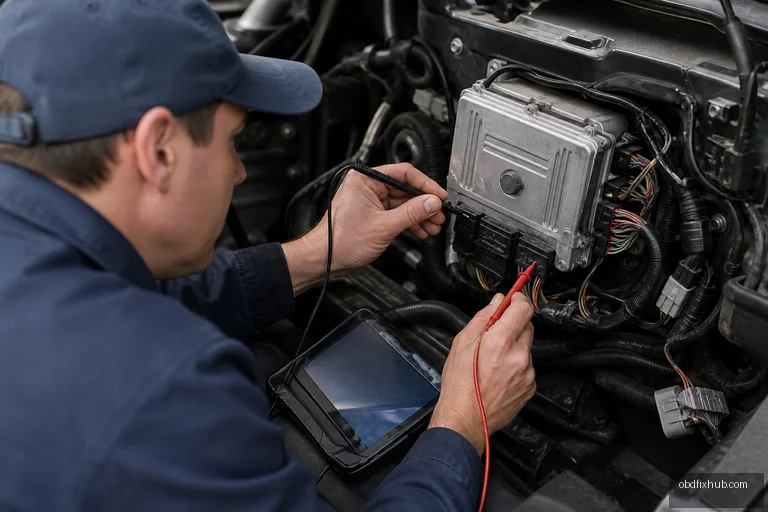
P0654 Engine RPM Output Circuit/Open means the powertrain control module (PCM) has detected a problem in the circuit that sends engine-speed information to another vehicle system, such as the instrument cluster, transmission controller, or tachometer. The fault is usually caused by an open wire, poor connector, blown fuse, shorted circuit, or failed output driver—not automatically by a bad crankshaft position sensor.
This distinction matters. Many parts are replaced unnecessarily when the real problem is a damaged harness near the transmission, corrosion in a cluster connector, or an aftermarket remote-start installation that disturbed the RPM signal wire.
What Does P0654 Mean?
The engine RPM output circuit carries a conditioned engine-speed signal from the PCM or engine control module to another module or gauge. Depending on the vehicle, this may be a digital square-wave signal, a pulsed voltage signal, or a network message interpreted as RPM data.
When the PCM detects that the output circuit is open or electrically outside its expected range, it stores diagnostic trouble code P0654. The exact circuit design varies by make and model, so the factory wiring diagram and service information are essential. On some vehicles, the code points directly to a dedicated tachometer output wire; on others, the signal passes through a body control module or instrument cluster.
P0654 Symptoms
A vehicle with P0654 may drive almost normally, particularly if the engine controller still receives valid RPM information from the crankshaft and camshaft sensors. The symptoms depend on which component relies on the faulty output signal.
- The tachometer stays at zero, drops out, or moves erratically.
- The check engine light is illuminated.
- An automatic transmission may shift harshly, late, or enter failsafe mode.
- Remote-start or aftermarket alarm systems may fail to recognize that the engine is running.
- Some modules may report missing engine-speed data or communication faults.
- The engine may crank and run normally, although stalling or a no-start condition is possible when related RPM input codes are also present.
- Vehicle speed, cruise control, or charging-system behavior may be affected on systems that share the signal or network data.
A zero tachometer with an otherwise smooth-running engine is a useful clue: the problem may be limited to the RPM output path rather than the engine’s primary speed sensors.
Common Causes of P0654
Open or damaged wiring
Broken conductors, stretched wires, rodent damage, and insulation rubbed through against a bracket can interrupt the RPM output. Pay special attention to harness sections near the battery tray, transmission case, exhaust heat shields, and engine-to-body ground strap.
Corroded or loose connectors
Water intrusion at the PCM, instrument cluster, transmission controller, or intermediate connector can create high resistance or an intermittent open. A terminal may look clean from the outside while its female contact has lost tension and no longer grips the pin securely.
Blown fuse or missing power supply
Some RPM output circuits depend on an ignition-fed module or shared fuse. A blown fuse may be the result of a short elsewhere, so replacing it without checking the circuit can cause it to fail again immediately.
Short to ground or voltage
The output line can be pulled low by a crushed wire or a failed component at the receiving end. A short to battery voltage can be equally damaging, especially when the PCM output is designed to switch only a small current.
Faulty PCM or receiving module
A failed PCM output driver is possible, but it should be considered only after wiring, power, grounds, connectors, and the receiving device have been tested. In real-world diagnostics, module replacement is much less common than an open circuit or connector problem.
Aftermarket accessories
Remote starters, tachometers, performance tuners, alarm systems, and engine swaps often tap into the RPM signal. Poorly crimped connections or a removed accessory splice can leave the factory circuit open.
How to Diagnose P0654 Correctly
- Confirm the code and record related codes. Use a capable scan tool to verify P0654 and check for crankshaft, camshaft, U-code communication, power-supply, or transmission codes. Related codes can identify whether the fault is a signal source problem or only an output problem.
- Check the vehicle-specific service information. Identify the signal’s source, destination, wire color, connector pins, expected voltage, and whether the circuit is a high-side, low-side, or frequency output. Never assume the pinout is the same across model years.
- Inspect the easy failures first. Examine fuses, battery voltage, module grounds, harness routing, connector locks, bent pins, water entry, and aftermarket splices. Gently tug each relevant wire near the terminal; a wire can be broken inside its insulation while appearing intact.
- Look for the RPM signal with a scan tool or oscilloscope. Compare engine RPM on the scan tool with the physical tachometer and the receiving module’s data. An oscilloscope is especially useful because it can reveal a missing pulse, distorted waveform, or signal that disappears when the harness is moved.
- Test continuity with the circuit powered down. Disconnect the relevant modules before measuring resistance. Verify continuity end to end, then test for unwanted continuity to ground and battery voltage. A circuit can pass a basic continuity test and still fail under load because of corrosion or a weak terminal.
- Perform a loaded circuit test. A test light or suitable load can expose a high-resistance connection that a digital multimeter misses. Follow the manufacturer’s test procedure because some PCM outputs must not be loaded directly.
- Clear the code and verify the repair. After repairing the wiring or connector, clear all codes and perform a complete drive cycle. Confirm that the tachometer, transmission operation, and module RPM data remain stable under vibration and temperature changes.
How to Fix P0654
The correct repair depends on the failed point in the circuit. A broken wire should be repaired with an automotive-grade splice, sealed heat-shrink, and proper strain relief—not household wire nuts or loosely twisted wires. If a terminal has lost tension, replace the terminal or connector pigtail rather than simply spraying contact cleaner.
Repair water leaks before installing a new connector. For corrosion inside a PCM or cluster connector, the affected terminals may need replacement, followed by verification of connector seals and mounting position. If a fuse blows again, locate the short before fitting another fuse with a higher rating; over-fusing can damage the harness or module.
If testing proves that the PCM or receiving module has a defective RPM output driver, confirm power, ground, network communication, and all external wiring first. Module replacement may require programming, immobilizer registration, configuration, or a relearn procedure, so this is normally a professional repair rather than a plug-and-play fix.
Can You Drive With P0654?
Short-distance driving may be possible if the engine runs smoothly, the transmission shifts normally, and no additional critical codes are present. However, do not ignore the code if the tachometer is dead, the engine stalls, the transmission enters limp mode, or multiple communication codes appear. Loss of RPM data can affect shifting, cruise control, charging strategy, and engine protection functions.
How Much Does a P0654 Repair Cost?
Costs vary widely. A loose terminal, fuse, or accessible wire repair may take less than an hour, while a damaged harness hidden behind the engine or a failed control module can be considerably more expensive. The diagnostic time is often the most valuable part of the repair because replacing a crankshaft sensor will not correct an open RPM output circuit unless separate sensor evidence exists.
Key Takeaway
P0654 is an RPM signal circuit fault, not a guaranteed crankshaft sensor failure. Begin with the wiring diagram, related trouble codes, fuses, grounds, connectors, and any aftermarket equipment. Test the signal at both its source and destination, repair the actual circuit defect, then verify the vehicle under normal driving conditions. This approach prevents unnecessary sensor and module replacement.
Frequently Asked Questions
Is P0654 caused by a bad crankshaft position sensor?
Usually not by itself. A crankshaft sensor creates the primary engine-speed input, while P0654 generally concerns the RPM output signal sent from the control module to another system. A bad crankshaft sensor can produce separate sensor or engine-speed codes, though both faults can occur together.
Can P0654 prevent the car from starting?
It can, but a no-start condition is more likely when the vehicle also has a missing crankshaft or camshaft signal, lost module power, or a network communication failure. If the engine starts and runs normally while the tachometer is dead, the fault may be limited to the output circuit.
Will clearing P0654 fix the problem?
Clearing the code only removes the stored fault temporarily. If the circuit remains open or electrically incorrect, P0654 will return after the module runs its self-test or the vehicle completes a drive cycle.
What should I check first for P0654?
Check for related codes, inspect fuses and grounds, and examine the RPM output wiring and connectors near the PCM, instrument cluster, transmission controller, and any aftermarket accessories. Use the vehicle-specific wiring diagram before probing pins.




