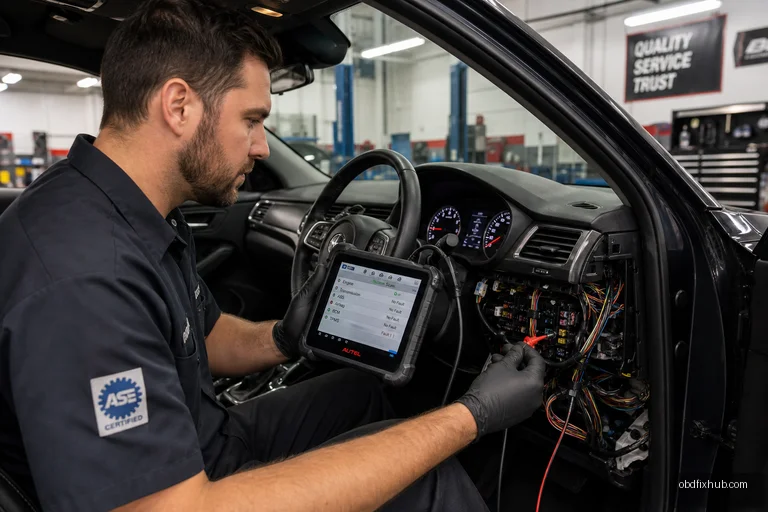
The P0650 code means the engine computer has detected a fault in the Malfunction Indicator Lamp (MIL) control circuit. In practical terms, the check engine light may be unable to turn on, may stay on incorrectly, or may have an electrical problem in its power, ground, wiring, fuse, instrument cluster, or control circuit. You can often drive a short distance if the engine runs normally, but ignoring the fault can prevent you from seeing important warning codes later.
What Does the P0650 Code Mean?
P0650 is a generic OBD-II diagnostic trouble code defined as Malfunction Indicator Lamp Control Circuit/Open. The powertrain control module (PCM) monitors the circuit that commands the check engine light in the instrument panel. When the expected voltage or circuit response is missing, inconsistent, or outside the manufacturer’s specification, the PCM stores P0650.
This code does not necessarily mean the engine has a mechanical problem. It often points to an electrical fault between the PCM and the instrument cluster. However, it is important because the MIL is the driver’s primary warning that the vehicle’s emissions system or engine management system needs attention.
P0650 Symptoms
The symptoms depend on whether the circuit has failed completely or is only operating intermittently. Some vehicles drive normally while others show several dashboard-related problems at the same time.
- The check engine light does not illuminate during the ignition-on bulb check.
- The check engine light remains on even after a repair or code clear.
- The MIL flickers or works intermittently over bumps.
- P0650 returns shortly after being cleared.
- Other instrument-cluster warning lights or gauges behave abnormally.
- Additional communication or voltage-related trouble codes are stored.
- The vehicle may fail an emissions inspection because the warning-light system is not functioning correctly.
A useful practical check is the key-on bulb test. Before starting the engine, most vehicles briefly illuminate the check engine light. If the light never appears, do not assume the bulb is simply burned out; many modern clusters use LEDs, and the actual issue may be a fuse, circuit board, wiring fault, or missing command from the PCM.
Common Causes of a P0650 Code
The fault can occur on many makes and models, so the exact circuit design varies. These are the causes most frequently found during diagnosis:
- Blown fuse: A fuse supplying the instrument cluster, PCM, ignition circuit, or MIL may be open.
- Open or shorted wiring: Damaged insulation, a broken wire, or a wire shorted to ground or voltage can disrupt the control signal.
- Loose or corroded connectors: Moisture around the PCM, cluster, or fuse box can create high resistance and intermittent faults.
- Instrument cluster failure: A failed LED, damaged printed circuit board, or internal cluster driver can prevent the MIL from responding.
- PCM or ECM fault: The module may have an internal driver failure, although this should be considered only after the circuit has been tested.
- Low system voltage: A weak battery, poor ground, or alternator problem can trigger misleading electrical codes.
- Aftermarket modifications: Remote starters, alarms, performance tuners, and poorly installed accessories can interfere with ignition or data wiring.
- Previous cluster repair: Incorrectly installed parts or a replacement cluster with compatibility issues may cause a persistent P0650.
How to Diagnose P0650 Correctly
Replacing the PCM immediately is one of the most expensive mistakes associated with this code. A skilled technician first proves whether the fault is in the power supply, the MIL circuit, the cluster, or the control module.
- Scan all modules, not just the engine computer. Record every stored, pending, and history code. Network, low-voltage, and instrument-cluster codes may reveal the real cause.
- Check the MIL operation. Turn the ignition on without starting the engine and confirm whether the check engine light performs its normal bulb check.
- Inspect related fuses. Test both sides of each fuse with a test light or multimeter while the circuit is powered. A visual inspection alone can miss a poor fuse connection.
- Test battery voltage and grounds. A healthy battery is normally near 12.6 volts with the engine off. Running voltage is commonly around 13.5 to 14.8 volts, although the vehicle’s charging strategy must be considered.
- Inspect connectors and wiring. Look for pulled terminals, green corrosion, water intrusion, rodent damage, and harness sections rubbing against brackets or the engine.
- Compare the circuit with the wiring diagram. The technician should identify whether the PCM switches the MIL circuit to ground, supplies voltage, or communicates with the cluster over a network.
- Perform continuity and voltage-drop tests. Testing under load is more reliable than checking resistance on a disconnected wire. A circuit may show continuity but fail when current flows.
- Use a scan tool to command the light when supported. If the PCM can command the MIL but the cluster does not respond, the cluster or its wiring becomes more likely. If the PCM cannot command it despite correct inputs and powers, module testing may be necessary.
Do not install a resistor or permanently wire the check engine light just to make P0650 disappear. That can hide future emissions and engine faults, create additional electrical problems, and cause an inspection failure.
How to Fix the P0650 Fault Code
The correct repair depends on the failed part identified during testing. Common repairs include:
- Replacing a blown fuse after finding and repairing the short that caused it.
- Repairing an open, shorted, or chafed wire with an automotive-grade splice and correct insulation.
- Cleaning or replacing corroded terminals and securing loose connectors.
- Repairing or replacing the instrument cluster, then programming or configuring it when required.
- Repairing a poor PCM ground or power feed.
- Updating, reprogramming, or replacing the PCM only after circuit tests confirm that the module is defective.
After the repair, clear the code and perform a complete drive cycle. Confirm that the MIL illuminates during the ignition-on check, turns off after the engine starts when no fault is present, and returns correctly if a known diagnostic condition is detected. Some vehicles require several warm-up cycles before the monitor status becomes ready.
Can You Drive With a P0650 Code?
Usually, you can drive cautiously for a short time if the engine is running smoothly and no red warning lights are on. P0650 itself often affects warning-light operation rather than engine performance. Nevertheless, the vehicle may not alert you to a new misfire, fuel-system problem, or emissions fault while the MIL circuit is defective.
Stop driving and seek immediate diagnosis if the check engine light is flashing, the engine is shaking, power is reduced, the oil-pressure or temperature warning is illuminated, or the vehicle is overheating. If the check engine light is not working at all, treat that as a safety and inspection issue rather than a minor dashboard inconvenience.
How Much Does It Cost to Fix P0650?
Repair prices vary significantly by vehicle design and the failed component. Typical independent-shop ranges are:
- Diagnostic testing: $80–$180
- Fuse, terminal, or minor wiring repair: $50–$250
- Extensive harness repair: $200–$700 or more
- Instrument-cluster repair or replacement: $250–$1,200
- PCM repair, programming, or replacement: $500–$1,800 or more
Dealer labor rates and immobilizer or cluster programming can increase the total. Ask for a diagnostic fee and a written explanation of the failed circuit before approving an expensive control-module replacement.
What Are the Common Causes of a Malfunction Indicator Light?
A functioning MIL can illuminate for hundreds of reasons, including an engine misfire, loose fuel cap, oxygen-sensor fault, catalytic-converter efficiency problem, evaporative-emissions leak, fuel-trim issue, or sensor failure. P0650 is different: it concerns the circuit that operates or monitors the warning lamp itself. The light may be on because of another engine code, while P0650 explains why the lamp’s control circuit is malfunctioning.
Key Takeaway
P0650 is an electrical warning-light circuit fault, not a diagnosis that automatically condemns the PCM. Start with a full scan, fuse and voltage checks, connector inspection, and a wiring-diagram-based circuit test. Drive only as necessary if the vehicle runs normally, and repair the fault promptly so the check engine light can warn you about future problems.
Frequently Asked Questions
Is P0650 a serious code?
It can be serious from a warning-system perspective because the check engine light may not operate correctly. The vehicle may still run normally, but other engine or emissions problems could go unnoticed.
Can a bad battery cause P0650?
Yes. Low voltage, charging faults, and poor battery or engine grounds can disrupt the MIL circuit or create related communication codes. Voltage should be tested before replacing major components.
Will clearing P0650 fix the problem?
No. Clearing the code only erases the stored information temporarily. If the electrical fault remains, P0650 will return after the PCM completes its monitoring checks.
Does P0650 mean I need a new PCM?
Not usually. Wiring, fuses, connectors, grounds, and the instrument cluster are common causes and should be tested first. A PCM should be replaced only when power, ground, inputs, and the output circuit have been proven good.
Can P0650 cause an emissions-test failure?
Yes. A malfunctioning MIL circuit or an incomplete diagnostic monitor can prevent the vehicle from meeting inspection requirements, even if the engine appears to run normally.




