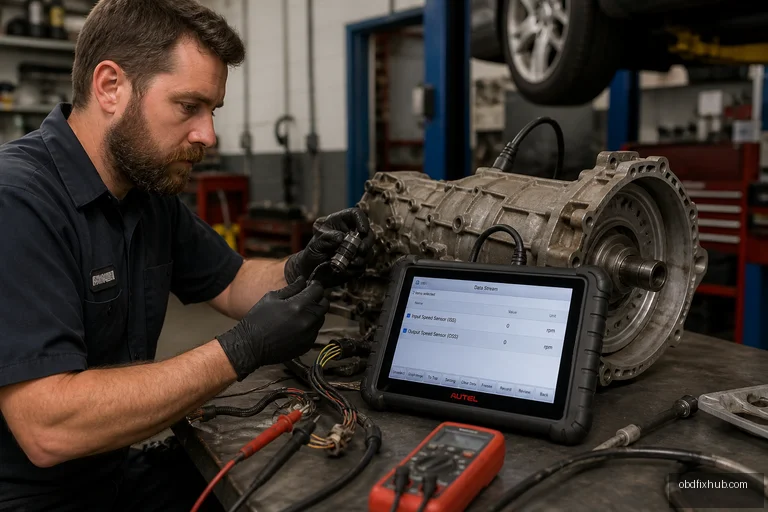
P0715 Input/Turbine Shaft Speed Sensor Circuit means the transmission control system has detected an electrical problem or implausible signal from the sensor that reports transmission input speed. The usual fix is repairing damaged wiring, cleaning a corroded connector, or replacing the input/turbine speed sensor—but the sensor should be tested before parts are installed. A failed sensor can cause harsh shifting, limp mode, incorrect gear selection, or a vehicle that will not shift normally.
What Does the P0715 Code Mean?
The input or turbine speed sensor measures how quickly the transmission’s input shaft, often called the turbine shaft, is rotating. The PCM or TCM compares this speed with engine RPM, output shaft speed, vehicle speed, and commanded gear. That information helps the transmission determine clutch slip, shift timing, and whether the selected gear is actually engaged.
When the module receives a missing, erratic, shorted, or implausible signal, it stores P0715. The exact wording may vary by manufacturer, such as “Input/Turbine Speed Sensor A Circuit,” but the code generally points to the sensor circuit rather than automatically proving that the sensor itself has failed.
Common Symptoms of P0715
Some vehicles continue to drive almost normally with P0715, while others immediately enter a protective transmission strategy. Symptoms depend on the transmission design and whether the module has a reliable backup speed signal.
- Check Engine Light or transmission warning light
- Harsh, delayed, or unpredictable shifting
- Transmission stuck in one gear or limp mode
- Failure to upshift, downshift, or engage overdrive
- Speedometer problems on vehicles that use related speed data
- Engine flare during a shift or noticeable clutch slipping
- Reduced fuel economy and higher engine RPM at highway speed
- Intermittent stalling or poor drivability in some applications
A useful diagnostic clue is whether the problem changes with temperature or vibration. A sensor that works when cold but fails after 20 minutes may have an internal thermal fault, while a code triggered over bumps often points to a loose terminal or broken wire near the transmission.
What Causes the P0715 Input/Turbine Shaft Speed Sensor Circuit Code?
- Failed input/turbine speed sensor: The internal magnetic pickup, Hall-effect circuit, or signal electronics can fail.
- Damaged wiring: Wires may rub against the transmission case, exhaust, brackets, or driveshaft.
- Corroded or loose connector terminals: Transmission connectors are exposed to heat, fluid, water, and road contamination.
- Incorrect air gap or installation: On some designs, sensor position or an O-ring installation problem affects the signal.
- Metal debris on a magnetic sensor: Fine particles can weaken or distort the reading, although debris may also indicate internal transmission wear.
- Low system voltage or poor grounds: A weak battery, charging problem, or shared ground fault can create misleading sensor codes.
- Transmission mechanical damage: A damaged reluctor, input shaft, bearing, or internal component can make the sensor signal genuinely erratic.
- Faulty PCM or TCM: Possible, but much less common than a wiring or sensor problem.
Where Is the Turbine Shaft Speed Sensor Located?
There is no universal location. On many automatic transmissions, the sensor is mounted on the transmission case near the bellhousing or input shaft. Other designs place it inside the transmission, beneath the valve body or transmission pan, where replacing it requires significant disassembly.
Some vehicles have an externally accessible sensor with a two- or three-wire connector. Others use an integrated speed sensor assembly connected to the internal transmission wiring harness. The most reliable way to identify the location is to use the vehicle’s service manual or a manufacturer-specific repair diagram; a generic internet image can easily show the wrong component.
How to Diagnose P0715 Correctly
Replacing the sensor immediately is a common mistake. In shop diagnostics, the first step is to determine whether the module is seeing no signal, an electrically shorted signal, or a signal that does not agree with other speed inputs.
- Scan all modules: Record P0715, related transmission codes, freeze-frame data, and whether the code is stored, pending, or permanent. Codes for low voltage, communication, or output speed can change the diagnostic direction.
- Check the live data: Monitor input/turbine RPM while raising engine speed in Park or during a careful road test. A reading stuck at zero, dropping out, or jumping unrealistically is important evidence. Compare it with engine RPM and output speed.
- Inspect the connector: Look for transmission fluid inside the plug, green corrosion, pushed-back terminals, broken locks, and poor pin tension. Do not rely on a visual inspection alone; lightly tug each wire near the connector.
- Trace the harness: Follow the wiring from the sensor to the PCM or TCM. Pay particular attention to sharp brackets, hot exhaust components, recent transmission work, and areas where the harness is stretched.
- Test power, ground, and reference circuits: Use the wiring diagram and the manufacturer’s specifications. A Hall-effect sensor may need a power supply and ground, while a variable-reluctance sensor can generate an alternating-current signal without a conventional reference voltage.
- Test the waveform when necessary: An oscilloscope can reveal a weak, distorted, or intermittent signal that a basic multimeter misses. The signal should change smoothly as shaft speed rises.
- Check mechanical conditions: If the electrical circuit is healthy, inspect for a damaged reluctor, excessive metal debris, incorrect sensor seating, or internal transmission damage.
Do not apply a generic resistance specification to every vehicle. Sensor resistance varies widely, and some modern sensors cannot be judged accurately with an ohmmeter. Always use the service information for the exact transmission and sensor type.
How Do You Fix Error Code P0715?
The repair depends on the failed part identified during testing. Common repairs include replacing the input/turbine speed sensor, repairing an open or shorted wire, replacing damaged terminals, cleaning and securing the connector, repairing a power or ground circuit, or replacing an internal transmission harness.
If the sensor is located inside the transmission, the repair may require draining the fluid and removing the pan or valve body. Use the correct fluid and replace any required seals. After the repair, clear the code, perform a road test across the affected shift points, and verify that input speed follows engine and transmission behavior in live data.
If the code returns immediately after a sensor replacement, stop replacing sensors. Confirm the connector pin fit, sensor power supply, ground voltage drop, signal continuity under movement, and module wiring. A damaged reluctor or internal transmission fault can produce the same symptom as a defective sensor.
Can a Bad PCM Cause a P0715 Code?
Yes, a defective PCM or TCM can cause P0715, but it should be considered only after the sensor, wiring, power, grounds, and transmission mechanics have been verified. Module failures are relatively uncommon compared with connector corrosion, harness damage, and failed sensors.
Before condemning a control module, check for water intrusion, poor grounds, low charging voltage, and other communication or sensor codes. A proper module diagnosis may require a wiring diagram, back-probing with a scope, and confirmation that the correct signal reaches the module connector. Replacing or programming a PCM without this evidence is an expensive gamble.
Can You Drive With P0715?
A short drive to a repair facility may be possible if the transmission shifts normally and the warning light is steady. However, driving for weeks with harsh shifts, slipping, or limp mode can increase clutch and transmission damage. Stop driving if the vehicle loses drive, repeatedly bangs into gear, overheats, or shows a flashing warning light.
Practical Repair Advice
Ask the technician to show you the sensor signal or live-data fault rather than accepting “replace the sensor” as the entire diagnosis. If the transmission was recently serviced, inspect the harness and connector first; disturbed wiring is a frequent cause of immediate P0715 faults. Also scan for companion codes, because a low-voltage or output-speed problem may be the primary issue.
Summary
P0715 identifies a problem with the input/turbine speed sensor circuit, not necessarily a bad transmission. Start with a complete scan, live-data comparison, connector inspection, and circuit testing. Repair the verified fault, then confirm the fix with a road test and stable turbine-speed data. If you cannot access the transmission wiring safely, professional diagnosis is usually cheaper than guessing with expensive sensors or control modules.
Frequently Asked Questions
What happens when a turbine speed sensor goes bad?
The transmission may shift harshly, stay in one gear, delay shifts, disable overdrive, or enter limp mode. Some vehicles show only a warning light because the control module can estimate speed from other sensors.
Where is the turbine shaft speed sensor located?
It is commonly mounted on the transmission case near the bellhousing, but some vehicles place it inside the transmission beneath the valve body or pan. The exact location depends on the transmission model.
How do I fix error code P0715?
Diagnose the circuit first, then repair damaged wiring or terminals, replace the failed sensor, correct power or ground faults, or address an internal transmission problem. Clear the code and verify the signal during a road test.
Can a bad PCM cause a P0715 code?
It can, but PCM or TCM failure is uncommon. The sensor, connector, harness, power supply, grounds, and reluctor should be proven good before replacing or programming a control module.




