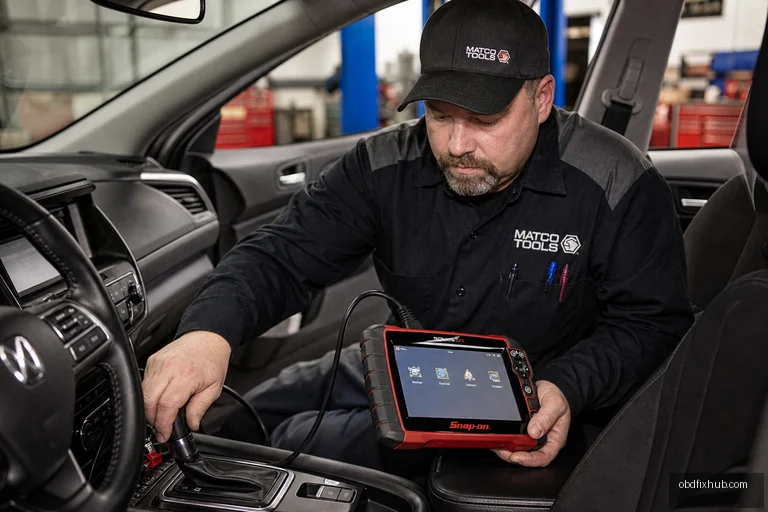
P07E4 Transmission Unable to Engage Park means the transmission control system commanded Park, but the vehicle could not confirm that the parking mechanism engaged. The most common causes are a misadjusted shift cable, a faulty transmission range sensor, low battery voltage, damaged wiring, or an internal Park-lock problem. Do not assume the transmission itself needs replacement until the command, sensor feedback, and mechanical linkage have been tested.
This is an information-focused fault code, but it can become a serious safety issue. If the vehicle rolls when the selector is in Park, apply the parking brake, keep the vehicle on level ground, and arrange a professional inspection rather than continuing to drive it normally.
What Does P07E4 Mean?
P07E4 is a powertrain diagnostic trouble code associated with the transmission’s inability to engage the Park position. In a conventional automatic transmission, Park mechanically locks the output shaft through a parking pawl. In electronically controlled transmissions, the transmission control module may also use a range sensor, shift actuator, or park-position switch to verify that the requested position was actually reached.
The precise wording and test procedure can vary by manufacturer. Some vehicles use a cable-operated shifter, while others use an electronic rotary selector or a fully electronic shift-by-wire system. For that reason, the factory service information and the vehicle’s exact model year are important; a generic code description alone is not enough to identify the failed component.
Common Symptoms of P07E4
A vehicle with this code may show obvious Park-related behavior, or the fault may appear only intermittently. In workshop diagnosis, the most useful clue is whether the mechanical selector position and the data reported to the control module agree.
- The transmission will not shift into Park.
- The vehicle remains in Neutral or another gear after Park is selected.
- A message such as “Shift to Park,” “Park Not Available,” or “Transmission Fault” appears on the instrument cluster.
- The engine may not shut off normally because the vehicle does not recognize Park.
- The starter may be disabled because the neutral-safety logic cannot confirm Park or Neutral.
- The vehicle may roll unless the parking brake is applied.
- The selector display may show a different gear than the shifter position.
- Additional transmission, range-sensor, or communication codes may be stored.
Most Likely Causes of P07E4
1. Shift cable or linkage problem
On cable-operated systems, a stretched, bent, disconnected, or incorrectly adjusted shift cable can prevent the transmission lever from reaching its Park detent. A worn bushing at the shifter or transmission end can create enough free play to cause an intermittent failure. The cabin selector may appear to move normally while the transmission lever travels only part of the required distance.
2. Faulty transmission range sensor
The range sensor, also called the transmission position sensor or neutral-safety switch on some vehicles, tells the control module which gear is selected. If it is misadjusted, contaminated, internally worn, or exposed to moisture, the module may not recognize Park even when the mechanical mechanism is engaged.
3. Shift-by-wire actuator failure
Electronic shifters use an actuator and control electronics to move or command the transmission position. A failed actuator motor, seized mechanism, blown fuse, or software-related control fault can leave the system unable to reach Park. Some systems also use a separate park-lock actuator that must be tested with a bidirectional scan tool.
4. Low battery voltage or power supply faults
Low system voltage is an overlooked cause, especially after a weak battery, jump-start, or battery replacement. A control module may set P07E4 if voltage drops during the shift request or if an actuator cannot complete its movement. Check battery state of charge, charging voltage, fuses, grounds, and relevant power feeds before condemning a transmission component.
5. Damaged wiring or poor electrical connections
Water intrusion, corrosion, rodent damage, and harness chafing can interrupt the signal between the range sensor, actuator, transmission control module, and body control module. Inspect connectors for green corrosion, pushed-back terminals, oil contamination, and broken locking tabs. Wiggling a suspect harness while monitoring live data can sometimes reproduce an intermittent fault, but it should be done carefully and safely.
6. Internal transmission or parking mechanism damage
A damaged parking pawl, broken spring, worn manual valve linkage, or internal range mechanism can prevent Park from engaging. This becomes more likely when the shifter and sensor are correctly adjusted, the actuator moves as commanded, and the transmission lever still cannot reach or hold the Park position. Internal damage should be confirmed with mechanical tests before authorizing a costly transmission repair.
How to Diagnose P07E4 Correctly
- Secure the vehicle first. Apply the parking brake, use wheel chocks, and do not rely on Park alone. Never work underneath a vehicle that is supported only by a jack.
- Scan all modules. Record P07E4, related transmission codes, voltage codes, communication codes, and freeze-frame data before clearing anything.
- Check the battery and charging system. A healthy battery should not be judged only by open-circuit voltage; perform a load test and verify charging output under realistic electrical load.
- Compare selector position with live data. Move slowly through each gear while watching the transmission range, commanded gear, and actual gear parameters. A mismatch helps separate a sensor or wiring fault from a mechanical fault.
- Inspect the linkage or actuator. Confirm that the external transmission lever reaches its full Park stop. On electronic systems, use the manufacturer-approved actuator test rather than repeatedly forcing the selector.
- Test circuits, not just components. Verify reference voltage, ground quality, continuity, and signal changes under load. A sensor can appear functional with a basic resistance check but fail when vibration or temperature changes.
- Check service bulletins and software updates. Some vehicles have known range-sensor, shifter, harness, or control-module calibration issues that require a specific repair procedure.
How Is P07E4 Fixed?
The repair depends on the failed point in the system. A cable may need adjustment or replacement, while a damaged linkage bushing can be an inexpensive repair. Other fixes include replacing the transmission range sensor, repairing a corroded connector, restoring a power or ground circuit, replacing a shift-by-wire actuator, performing a software update, or repairing the internal Park mechanism.
After the repair, the technician should clear the code, operate the selector through every position, confirm Park engagement on level ground, and rescan for returning faults. On many vehicles, a range-sensor or actuator replacement also requires initialization, relearn, or calibration with a professional scan tool. Skipping that procedure can leave the original symptom unchanged even after installing a new part.
Can You Drive With P07E4?
Driving is not recommended if the vehicle cannot reliably engage Park, the gear display is incorrect, or the vehicle rolls after the selector is placed in Park. Even if the transmission still moves normally, a faulty range signal can affect starting, shifting strategy, reverse lamps, and other safety interlocks. If the fault is intermittent, treat it as a real failure rather than waiting for it to become permanent.
If the vehicle is safely secured and the code appeared only after a low-voltage event, a battery and charging-system check may be a reasonable first step. Do not repeatedly cycle the shifter on a slope or attempt to force an electronic selector into position. Towing may be the safest option when Park cannot be confirmed.
Repair Cost Expectations
Costs vary widely by vehicle design and the confirmed cause. A basic diagnosis or shift-cable adjustment is usually far less expensive than an actuator, control module, or internal transmission repair. Labor can also increase when the battery, console, underbody shields, or transmission pan must be removed.
- Lower-cost repairs: battery service, fuse replacement, connector repair, or cable adjustment.
- Moderate repairs: range-sensor, shift-cable, shifter-bushing, or actuator replacement.
- Higher-cost repairs: module programming, extensive harness repair, or internal transmission and Park-mechanism work.
A trustworthy estimate should identify the failed test result, not simply list “transmission replacement” based on the code description.
Key Takeaway
P07E4 means the vehicle cannot confirm that Park has engaged, not automatically that the transmission is ruined. Start with safety, battery voltage, linkage or actuator movement, range-sensor data, and wiring. Have the code diagnosed with a scan tool that can display live transmission data and perform actuator or calibration functions before replacing expensive parts.
Frequently Asked Questions
Can a weak battery cause P07E4?
Yes. Low voltage can prevent a shift actuator from completing its movement or interrupt the position signal. Test the battery, charging system, grounds, and stored voltage-related codes before replacing transmission components.
Is P07E4 the same as a bad transmission?
No. P07E4 identifies a Park-engagement problem. The cause may be an adjustment, sensor, actuator, wiring fault, software issue, or internal mechanism, and many cases do not require a complete transmission replacement.
Why does my vehicle say “Shift to Park” when it is already in Park?
The transmission may be mechanically in Park but the range sensor, park switch, or control module is not receiving the expected confirmation. A sensor adjustment, connector fault, actuator issue, or calibration problem can create this mismatch.
Can I clear P07E4 myself?
You can erase the code with a compatible scan tool, but clearing it does not repair the fault. If Park engagement is unreliable, the code will return and the vehicle may remain unsafe to park or start.




