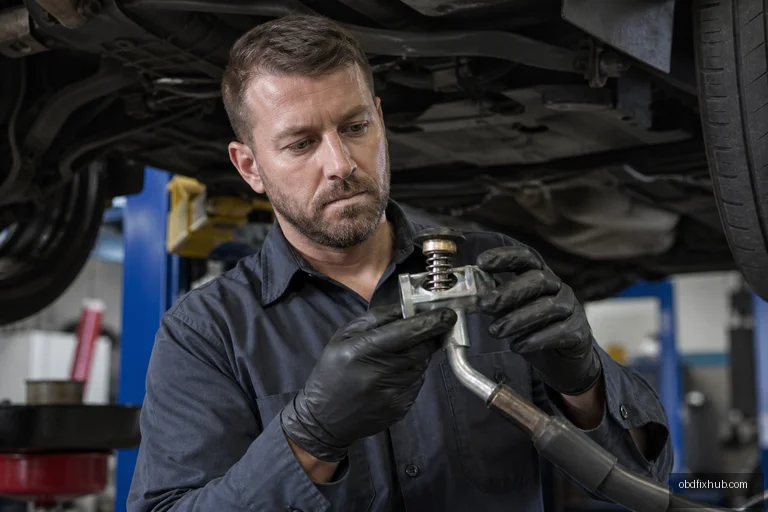
P07CB Transmission Fluid Thermostat Performance: Meaning, Causes, Symptoms & Fix
P07CB Transmission Fluid Thermostat Performance means the powertrain control module has detected that the transmission fluid thermostat is not controlling fluid temperature as expected. The valve may be stuck open, stuck closed, restricted, incorrectly installed, or reporting a temperature behavior that does not match the vehicle’s operating conditions. The exact wording can vary by manufacturer, so always confirm the code definition in the factory service information for your specific vehicle.
This is an informational search: most drivers want to understand whether the fault is serious, what caused it, and whether they need a thermostat, a fluid service, or a larger transmission repair. In practice, P07CB should be diagnosed through fluid temperature data and cooler-circuit testing—not by replacing parts based only on the code.
What Does P07CB Mean?
A transmission fluid thermostat regulates when transmission fluid is routed through the cooler or heat exchanger. When the fluid is cold, the thermostat can restrict cooler flow so the transmission reaches its intended operating temperature more quickly. Once the fluid becomes hot, it opens or changes position to increase cooling.
The control module looks for a believable temperature pattern after startup, warm-up, and driving. If the fluid warms too slowly, overheats despite normal driving, or fails to respond when the thermostat should change state, it can store P07CB. The code does not automatically prove that the transmission itself is damaged.
Common Causes of P07CB
- A sticking, jammed, or failed transmission fluid thermostat
- Debris, varnish, or incorrect sealant restricting the thermostat or cooler passage
- Low, overfilled, contaminated, or incorrect transmission fluid
- A restricted transmission cooler, kinked line, or blocked heat exchanger
- Damaged wiring, poor connector contact, or a faulty temperature sensor
- Cooling-system problems on designs that use engine coolant to regulate transmission temperature
- Recent transmission or cooler work performed with the wrong gasket, O-ring, hose routing, or thermostat orientation
- Calibration or software issues in the transmission or powertrain control module
P07CB Symptoms to Watch For
Some vehicles show only a check-engine light, while others enter a transmission protection strategy. A thermostat stuck open commonly causes slow warm-up, delayed torque-converter lockup, poor fuel economy, or a transmission that remains unusually cool in cold weather.
A thermostat stuck closed is more concerning. It can produce rising transmission temperatures during towing, hill climbing, stop-and-go traffic, or extended highway driving. The driver may notice harsh shifts, delayed engagement, reduced power, a transmission-temperature warning, or limp mode.
- Check-engine light or transmission warning message
- Delayed or unusually firm gear changes
- Transmission slipping or torque-converter clutch complaints
- Overheating under load
- Slow warm-up and reduced fuel economy
- Stored transmission temperature or cooler-flow codes
How to Diagnose P07CB Correctly
1. Check related codes and freeze-frame data
Begin with a complete scan, not just a generic code read. Look for transmission temperature sensor, cooling fan, coolant-flow, pressure, solenoid, and communication codes. Freeze-frame data can show whether the fault occurred during a cold start, heavy load, or high-temperature event.
2. Verify fluid level and condition
Check the level using the manufacturer’s procedure, because some transmissions must be checked at a specific temperature with the engine running. Inspect the fluid for the correct color and odor, but do not treat appearance alone as a final diagnosis. A low level can reduce cooler flow, while overfilling can aerate the fluid and create abnormal hydraulic behavior.
3. Compare live temperature data
Use a scan tool to monitor transmission fluid temperature from a cold start. Compare the reading with ambient temperature and, where available, compare the transmission sensor to an infrared measurement at the cooler lines. An implausible sensor reading can imitate a thermostat problem, so test the sensor and wiring before condemning the valve.
4. Inspect the cooler circuit
Look for crushed lines, leaking fittings, blocked passages, and incorrect hose routing. On coolant-to-fluid heat exchangers, verify engine coolant level, air pockets, thermostat operation, and flow through the heat exchanger. A professional technician may measure line temperature before and after the cooler or perform a controlled flow test according to the service manual.
5. Confirm the thermostat’s mechanical operation
If the electrical and temperature data point to the valve, remove and inspect the thermostat when the design allows it. Check for a damaged seal, metal debris, sticky movement, or a thermostat installed backward. Do not apply force or heat unless the manufacturer specifies a bench-test procedure; many modern units are integrated into a cooler assembly.
How Is P07CB Fixed?
The correct repair depends on the failed component. A sticking thermostat may require replacement of the thermostat, cooler module, valve body component, or complete thermal-management assembly. If contamination caused the restriction, the cooler circuit may need cleaning or replacement, followed by the exact manufacturer-approved transmission fluid.
Electrical faults require connector repair, wiring replacement, sensor testing, or module diagnosis. If a software update is listed in a technical service bulletin, programming may resolve a false performance judgment, but software should not be used to hide a genuine overheating or flow problem.
- Repair leaks and correct the fluid level using the specified procedure.
- Replace the failed thermostat, sensor, cooler, seal, or damaged line.
- Use only the correct fluid specification; universal fluid is not automatically suitable.
- Clear the code and perform the required adaptive reset or relearn procedure.
- Road-test the vehicle while monitoring transmission temperature and shift quality.
- Rescan for returning codes and confirm that the temperature responds normally under load.
Can You Keep Driving With P07CB?
Short, gentle driving may be possible when the transmission temperature is normal and the vehicle shifts normally. Continued driving is risky if the transmission is overheating, slipping, entering limp mode, or showing a temperature warning. Heat damages fluid, clutch friction material, seals, and electronic components, so towing or heavy-load use should be avoided until the fault is diagnosed.
A useful real-world clue is when the code appears only during towing or mountain driving. That pattern points toward restricted cooler flow, insufficient cooling capacity, or a thermostat that fails under load—not necessarily an internal transmission failure. Conversely, a code appearing immediately after a cooler replacement makes hose routing, connector installation, and trapped air especially important.
Frequently Asked Questions
Is P07CB a serious transmission code?
It can be. A thermostat stuck open may mainly affect warm-up and efficiency, while one stuck closed can cause damaging overheating. The actual risk depends on measured fluid temperature, shift behavior, and related codes.
Can low transmission fluid cause P07CB?
Yes. Low fluid can reduce cooler flow and create abnormal temperature behavior, although it is not the only possible cause. Always locate and repair the leak rather than simply topping up the fluid.
Will changing the transmission fluid fix P07CB?
Only if contaminated or incorrect fluid contributed to the problem. A fluid change will not repair a mechanically stuck thermostat, blocked cooler, damaged sensor, or wiring fault.
Does P07CB mean I need a new transmission?
No. P07CB identifies a temperature-control performance problem, not automatic transmission failure. Diagnose the thermostat, sensor, cooler circuit, fluid condition, and related codes before considering major transmission work.
Bottom Line
P07CB Transmission Fluid Thermostat Performance is a temperature-management fault that deserves timely diagnosis, especially if the vehicle overheats or shifts poorly. Start with a full scan, verify fluid level and temperature data, inspect cooler flow, and follow the vehicle-specific test procedure. Replacing the thermostat without proving the fault can waste money; ignoring an overheating transmission can cost far more.




