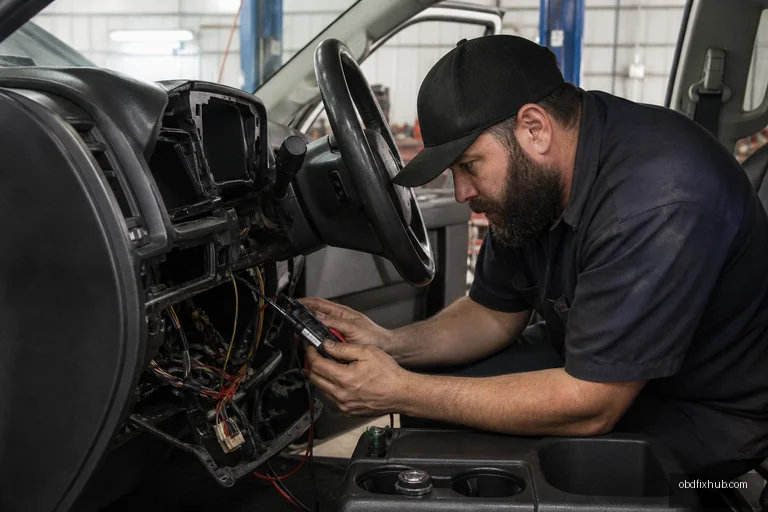
P0836 Four-Wheel Drive Switch Circuit means the vehicle’s powertrain control module has detected an electrical problem in the 4WD selector switch circuit. The fault may be a failed dash switch, damaged wiring, poor ground, connector corrosion, or—on some vehicles—a problem with the transfer-case range input circuit. It does not automatically mean the four-wheel-drive actuator or transfer case must be replaced.
This is an informational search query: most drivers want to understand the code, identify whether the vehicle is safe to drive, and avoid paying for unnecessary parts. The correct repair begins with testing the switch circuit and confirming how the vehicle’s control module interprets the 2WD, 4HI, 4LO, and neutral positions.
What Does P0836 Mean?
P0836 is a generic OBD-II diagnostic trouble code for a fault in the four-wheel-drive switch circuit. The switch may be mounted on the instrument panel, incorporated into a rotary selector, or located near the transfer-case shifter. Depending on the manufacturer, it can send a simple voltage signal, a resistance value, or a network message to the 4WD control module.
When the reported signal is outside the expected range, does not agree with the selected mode, or changes intermittently, the module stores P0836. The exact circuit design varies substantially between vehicles, so the factory wiring diagram and service information are more reliable than a generic resistance chart found online.
Common Symptoms of a P0836 Four-Wheel Drive Switch Circuit Fault
The symptoms depend on whether the fault is constant or intermittent and whether the vehicle has a separate 4WD control module. A truck may still move normally in two-wheel drive while refusing to engage four-wheel drive.
- Check Engine, Service 4WD, or 4WD warning light
- 4WD indicator lamps that flash, remain illuminated, or show the wrong mode
- Four-wheel drive will not engage or disengage
- Transfer case is stuck in 2HI, 4HI, or another range
- Selector changes have no visible response on the instrument cluster
- Intermittent 4WD operation after driving through water or mud
- Additional communication, actuator, or transfer-case position codes
A particularly useful clue is a switch that works when pressed or rotated slowly but fails when the dashboard or steering column is moved. That pattern often points to a broken conductor inside the harness rather than a defective selector.
Most Common Causes of Code P0836
1. Faulty 4WD selector switch
Internal contacts can wear, become contaminated, or develop dead spots. Rotary switches may produce the correct voltage in some positions but an unstable signal in one specific range. A switch can feel mechanically normal and still fail electrically.
2. Damaged or corroded wiring
Wiring near the transfer case is exposed to water, road salt, heat, and debris. Look for chafing against the frame, stretched wires, green corrosion inside terminals, and repairs made with poorly sealed crimp connectors. A circuit may pass a quick continuity check yet fail under vibration or load.
3. Poor power supply or ground
A weak ground, blown fuse, low system voltage, or loose battery connection can create misleading switch-circuit codes. Before condemning the selector, verify battery voltage and inspect the relevant fuse and ground points. Many intermittent 4WD complaints begin after battery replacement or underbody work.
4. Transfer-case range sensor or control-module issue
Some vehicles use a separate range sensor to confirm the transfer-case position. If the selected switch position and actual transfer-case feedback disagree, P0836 may appear alongside a position-sensor or actuator code. In that situation, replacing the dashboard switch alone will not solve the problem.
5. Water intrusion or software-related faults
Moisture in a connector, especially at a low-mounted transfer-case plug, can create high resistance and intermittent signals. Some models also require a control-module software update or a 4WD system relearn after component replacement. Check manufacturer service bulletins before installing expensive parts.
How to Diagnose P0836 Correctly
A professional diagnosis should identify where the signal is lost, not simply clear the code and replace the most visible component. The following workflow is effective on most switch-based 4WD systems, although the test points and expected readings must come from the vehicle-specific service manual.
- Record all stored codes and freeze-frame data. Scan every relevant module, not just the engine computer. Note whether P0836 is current, pending, or intermittent, and look for U-codes, actuator codes, or range-sensor codes.
- Confirm the customer complaint. Test each selector position and observe the 4WD indicator, scan-tool data, and actual transfer-case response. Do not force a 4LO shift unless the manufacturer’s conditions are met, such as transmission in neutral and vehicle stopped.
- Inspect the switch and connector. Look for loose terminals, bent pins, moisture, drink spills near a console-mounted switch, and a connector that is not fully latched. Gently wiggle the harness while watching the live data.
- Verify power, ground, and reference circuits. Use a multimeter to check the appropriate supply and ground under the specified test conditions. A ground may show continuity with no load but fail when the circuit is operating, so a voltage-drop test is more useful than continuity alone.
- Measure the switch signal. Compare the voltage, resistance, or data value in every selector position with the service-manual specification. Do not install a jumper wire unless the diagnostic procedure specifically authorizes it; an incorrect jumper can damage the module.
- Test the harness end to end. Check for shorts to ground, shorts to voltage, open circuits, and excessive resistance. Perform a wiggle test at the transfer-case connector, frame clips, and locations where the harness bends.
- Check transfer-case feedback. If the switch input is correct but the module reports an incorrect range, test the range sensor, actuator, mechanical linkage, and module communication circuits before replacing the switch.
How to Fix P0836
The repair depends on the failed part. A worn selector switch should be replaced with the correct vehicle-specific component, followed by a functional test in every available 4WD mode. If the problem is corrosion, clean only terminals that can be safely restored; terminals with lost tension or heavy corrosion should be replaced rather than coated and reused.
- Repair chafed or broken wires using the correct automotive wire, sealed splices, and proper loom protection.
- Replace damaged terminals and secure the connector against water intrusion.
- Repair faulty grounds, fuse feeds, or low-voltage supply problems.
- Replace a failed transfer-case range sensor or actuator only after its power, ground, signal, and mechanical operation have been verified.
- Perform the required 4WD relearn, calibration, or module programming procedure where applicable.
- Clear the codes and road-test the vehicle under the manufacturer’s safe engagement conditions.
After the repair, verify both the electrical command and the mechanical result. A scan tool may show 4HI selected even while the transfer case remains in 2HI, so indicator lights alone are not proof that the system is working.
Can You Drive With P0836?
If the vehicle remains in two-wheel drive and there are no grinding noises, binding symptoms, or transmission warning signs, a short drive to a repair facility is often possible. However, the 4WD system may be unavailable or stuck in a range, which can be dangerous on snow, mud, steep terrain, or loose surfaces.
Avoid extended driving if the transfer case is stuck in 4HI on dry pavement, if the vehicle binds during tight turns, or if the warning light is accompanied by unusual noises. Four-wheel-drive engagement should be diagnosed promptly rather than repeatedly cycling the selector in an attempt to force it to work.
Practical Diagnostic Tips That Save Time
- Compare live data with the physical selector position; this quickly separates an input problem from a mechanical transfer-case problem.
- Inspect underbody connectors before removing interior trim when the fault appeared after rain, deep water, or off-road driving.
- Do not trust a generic “good” switch resistance value. Different manufacturers use different resistor ladders and voltage windows.
- If the code returns only when the harness is moved, perform a loaded voltage-drop test rather than relying on an ohms reading.
- Check whether the battery was recently disconnected; some systems lose learned position information and require a relearn procedure.
Summary
P0836 identifies a fault in the four-wheel-drive selector input circuit, not a guaranteed transfer-case failure. Start with a complete module scan, battery and fuse checks, connector inspection, and vehicle-specific signal testing. Repair the actual failed circuit or component, then confirm that the selected mode matches the transfer case’s real position before returning the vehicle to service.
Frequently Asked Questions
Is P0836 a serious code?
It can disable four-wheel drive or leave the transfer case in an unsuitable range. The vehicle may still drive normally in 2WD, but the fault should be repaired before relying on 4WD for severe weather or off-road use.
Can a bad 4WD switch cause P0836?
Yes. A worn or internally contaminated selector is a common cause, but the wiring, power supply, ground, range sensor, and control module must be tested before the switch is replaced.
Will disconnecting the battery clear P0836?
It may temporarily erase the stored code, but it does not repair the fault. If the abnormal signal remains, P0836 will return, and disconnecting the battery may also erase useful diagnostic information or learned settings.
Can I fix P0836 myself?
Basic inspection, fuse checks, and connector cleaning may be suitable for a skilled DIY owner. Accurate diagnosis usually requires a wiring diagram, a multimeter, and preferably a scan tool that can display 4WD module data.




