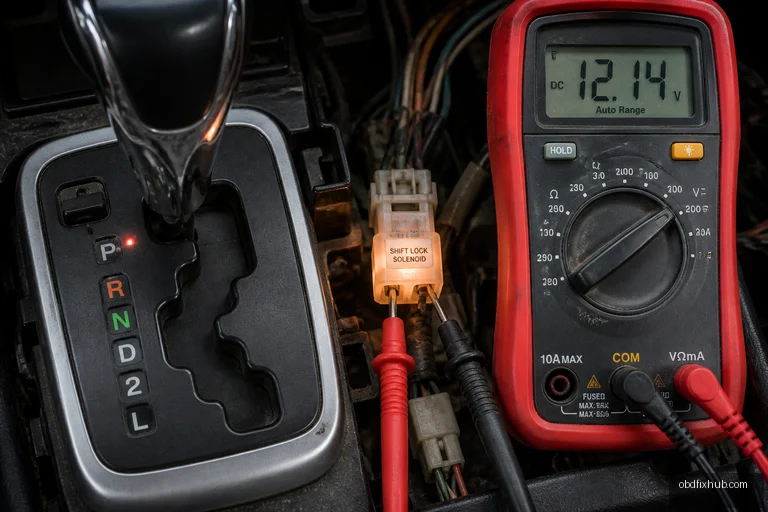
P0928 means the transmission control module has detected an open or interrupted electrical circuit in the gear shift lock solenoid control system. The fault may be caused by a blown fuse, damaged wiring, a poor connector, a failed brake-light switch, or the solenoid itself. Because this system prevents the shifter from moving out of Park unless the brake pedal is applied, the vehicle may be stuck in Park or require the manual shift-lock release.
What Does P0928 Mean?
The gear shift lock solenoid, also called the shift interlock solenoid, is an electrically controlled safety device fitted near the automatic transmission selector. When the ignition is on and the brake pedal is pressed, the vehicle control system energizes the solenoid and releases the shifter.
With code P0928, the module sees an open circuit or an electrical path that is not behaving as expected. In practical terms, current cannot reach the solenoid correctly, cannot return through the ground circuit, or the solenoid coil has an internal break.
This code is not the same as a mechanical transmission failure. However, it can appear alongside other codes if a shared fuse, ignition feed, body-control module, or wiring harness is damaged.
Common Symptoms of a Bad Shift Lock Solenoid
The most recognizable symptom is a shifter that will not move from Park even when the brake pedal is pressed. Some vehicles also display a warning message such as Shift Lock, Check Transmission, or Service Transmission.
- The gear selector is locked in Park.
- The brake lights do not operate, or they remain on.
- The shifter releases only after using the emergency shift-lock override.
- P0928 returns immediately after clearing the code.
- A clicking sound from the console is absent when the brake pedal is pressed.
- The vehicle may enter a restricted operating mode, depending on its design.
A useful real-world clue is the combination of a stuck shifter and dead brake lights. Since many vehicles use the brake-pedal switch as the release signal, both symptoms can be produced by one failed switch or its fuse rather than by a bad solenoid.
What Causes P0928?
Do not replace the solenoid solely because the code description mentions it. The fault is in the control circuit, so the cause can be anywhere between the power supply, control module, wiring, connector, and actuator.
- Open, broken, or stretched wiring near the center console or shifter assembly.
- Corroded, loose, or partially backed-out electrical connector terminals.
- Blown fuse or missing ignition-switched power.
- Failed brake-light or brake-pedal position switch.
- Defective shift interlock solenoid with an open internal coil.
- Poor ground connection or damaged body-control-module circuit.
- Liquid spilled into the shifter assembly.
- Aftermarket remote-start, alarm, or console wiring installed incorrectly.
On older vehicles, wiring commonly breaks where the harness flexes beneath the console. On newer vehicles, the solenoid may be integrated into the complete shifter assembly, making connector inspection and manufacturer-specific service information especially important.
How to Diagnose P0928 Before Replacing Parts
1. Confirm the code and check related faults
Use a scan tool to record P0928 and any accompanying codes before clearing anything. Save the freeze-frame data, including battery voltage, ignition status, and gear position. Codes related to brake-pedal input, body control, communication, or low system voltage can change the diagnostic direction.
2. Check the simple interlock functions
Turn the ignition on and press the brake pedal. Confirm that the brake lights illuminate immediately. Listen near the shifter for a click, but do not treat the absence of a click as conclusive because some solenoids are quiet or enclosed.
Inspect the relevant fuse with a test light or meter on both test points. A fuse that looks intact can still fail electrically. If a replacement fuse blows again, stop testing and locate the short instead of installing a larger fuse.
3. Inspect the connector and harness
Disconnect the battery if the service procedure requires it, then inspect the solenoid connector for green corrosion, moisture, pushed-back terminals, or loose locking tabs. Follow the harness toward the body-control module and look for pinched insulation under the console.
A particularly effective workshop check is a gentle wiggle test while monitoring circuit voltage or continuity. If the reading changes when the harness moves, the fault is likely an intermittent wire or terminal rather than the solenoid.
How to Test the Shift Interlock Solenoid With a Multimeter
The exact resistance specification varies by vehicle, so use the service manual for the correct value. The following procedure is a general electrical test, not a substitute for the wiring diagram.
- Park on level ground, apply the parking brake, and keep the wheels secured.
- Switch the ignition off and disconnect the solenoid connector. Never measure resistance on a powered circuit.
- Set the multimeter to ohms and measure across the two solenoid terminals.
- A stable reading within the manufacturer’s specification usually indicates that the coil is not open. OL, infinite resistance, or no continuity strongly suggests a broken internal coil.
- A reading close to zero ohms may indicate a shorted coil, but compare it with the specification rather than judging by appearance alone.
- Check each solenoid terminal to chassis ground. Unless the design specifically uses a grounded case, there should normally be no unwanted continuity to ground.
- Reconnect the solenoid and back-probe the power and control wires with the ignition on, following the wiring diagram. Verify that the supply voltage appears when the brake pedal is pressed.
Use a fused test lead and avoid shorting adjacent terminals. Some systems use a pulsed ground controlled by a module, so a simple voltage test can be misleading. A test light or oscilloscope may be needed to confirm a command that a digital meter averages out.
What Does Shift Solenoid Control Circuit Low Mean?
A control-circuit-low fault means the module is detecting voltage below the expected level on that circuit. It can result from a short to ground, a weak power supply, excessive resistance in a connector, or a solenoid coil drawing abnormal current.
That is different from P0928, which generally points to an open or interrupted shift-lock circuit. However, code definitions can vary slightly by manufacturer and scan-tool software. Always compare the exact code description with the vehicle’s factory wiring diagram and diagnostic procedure.
Can You Drive Without a Shift Interlock Solenoid?
You should not permanently bypass the shift interlock solenoid. The vehicle may still drive if the shifter can be moved with the manual override, but the safety feature is designed to prevent accidental selection of Drive or Reverse when the brake pedal is not pressed.
The emergency release is intended for moving the vehicle to a safe location or repair facility. Keep your foot firmly on the brake, use the parking brake, and do not continue driving if the brake lights are inoperative. A car that can be shifted without the proper interlock may move unexpectedly, creating a serious injury risk.
How Is P0928 Fixed?
The correct repair depends on the failed part identified during testing. Common repairs include replacing a blown fuse after correcting the underlying short, repairing a broken wire, tightening connector terminals, replacing the brake switch, or installing a new shift-lock solenoid or shifter assembly.
After the repair, clear the code and perform a complete functional test. Confirm that the brake lights work, the selector remains locked with the brake released, the selector releases with the brake applied, and the code does not return during a short road test. If P0928 returns immediately, recheck the circuit under load rather than replacing another component.
Final Takeaway
P0928 is primarily an electrical-circuit diagnosis, not proof of a failed transmission. Start with brake-light operation, fuses, battery voltage, connectors, and wiring before condemning the shift-lock solenoid. If you are uncomfortable testing live circuits around the shifter, use the emergency release only to move the vehicle safely and have the system diagnosed professionally.
Frequently Asked Questions
What are the symptoms of a bad shift lock solenoid?
The usual symptoms are a shifter stuck in Park, no release click, a shift-lock warning, and the need to use the manual override. A failed brake switch can create nearly identical symptoms.
Can a bad shift interlock solenoid prevent the car from starting?
Usually it does not directly stop the engine from cranking, but some vehicles use the selector position and interlock signals as part of their start authorization logic. Related wiring or range-sensor faults may prevent starting.
How do I test a shift interlock solenoid with a multimeter?
Disconnect the connector, measure the solenoid coil resistance, and compare it with the factory specification. Then check for power, control voltage, and unwanted ground faults using the correct wiring diagram.
Is P0928 safe to ignore?
No. The vehicle may be difficult to move or may lose an important protection against unintended gear selection. Repair the fault promptly, especially if the brake lights are not working.




