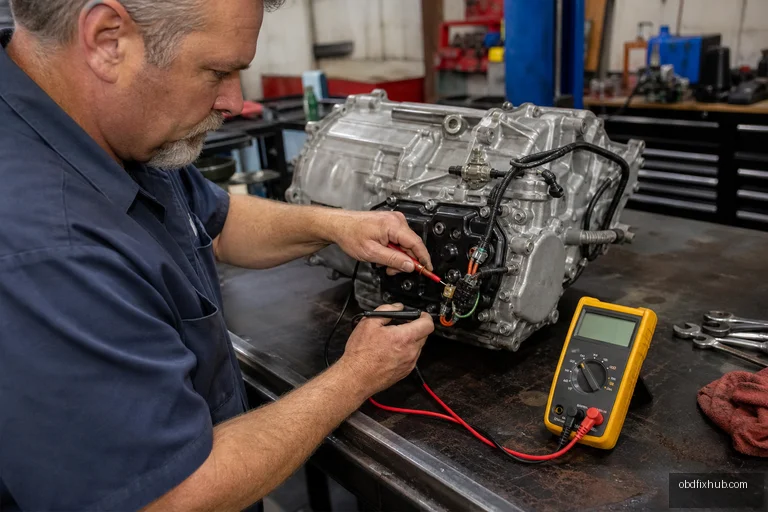
P0920 Gear Shift Forward Actuator Circuit/Open means the transmission control module (TCM) has detected an open, interrupted, or electrically invalid circuit for the actuator that commands forward gear selection. The most common causes are damaged wiring, loose or corroded connectors, a failed shift actuator, poor power or ground, or—less often—a faulty TCM. Because the exact actuator design varies by vehicle, the correct fix starts with circuit testing and the manufacturer’s wiring diagram, not an immediate transmission replacement.
What Does the P0920 Code Mean?
On vehicles that use electronically controlled manual, automated manual, dual-clutch, or certain advanced automatic transmissions, an electric or electro-hydraulic actuator physically helps select a gear. The “forward actuator” is responsible for moving the shift mechanism toward the forward-gear position. When the TCM commands that movement but sees no expected electrical response, it stores P0920.
The word “open” is important. It usually indicates a break in the electrical path, such as an open wire, a terminal pushed out of a connector, a blown power feed, or an actuator coil with excessive resistance. However, some vehicles set P0920 when the circuit voltage or actuator feedback is outside the expected range, so the code definition should always be confirmed with vehicle-specific service information.
Common Symptoms of P0920
The vehicle may still start and move if the transmission can select a fallback gear, but drivability is often affected. Symptoms depend on the transmission strategy and whether the TCM can complete its shift position checks.
- Transmission warning light or check engine light
- Failure to engage Drive or another forward gear
- Neutral-only operation or a transmission limp-home mode
- Delayed, harsh, or incomplete gear changes
- “Transmission fault” or “Limited function” message on the dashboard
- Engine revving without normal vehicle movement
- Repeated clicking from the actuator without a completed shift
- Intermittent operation that changes with temperature, vibration, or harness movement
An intermittent P0920 is particularly useful diagnostically. If the code appears after driving over rough roads or disappears when the harness is moved, suspect a poor terminal fit, internal wire break, or connector contamination before condemning the actuator.
Most Likely Causes of P0920
- Open or damaged wiring: The harness may be rubbed through against the transmission case, stretched near a bracket, or broken internally beneath intact insulation.
- Corroded or loose connector terminals: Water intrusion and transmission fluid contamination can increase resistance or interrupt the actuator feed.
- Failed forward shift actuator: The actuator motor, solenoid coil, position sensor, or internal gear mechanism may be defective.
- Blown fuse or missing relay output: A shorted actuator can damage its fuse, while a poor relay contact can remove power under load.
- Weak power or ground: A corroded ground strap or voltage drop in the supply circuit can make a healthy actuator appear faulty.
- Mechanical binding: A seized selector shaft, damaged shift fork, or transmission mechanism that cannot move may cause an electrical plausibility fault.
- Low system voltage: A weak battery, poor charging system, or voltage drop during cranking can trigger actuator-related codes.
- TCM or software fault: This is possible, but it should be considered only after the circuit, actuator, power, ground, and mechanical movement have been verified.
How to Diagnose P0920 Properly
A professional diagnosis begins by identifying which transmission and actuator the code refers to. Scan tools often show additional codes such as actuator position, low voltage, CAN communication, or gear-ratio faults. Record all codes and freeze-frame data before clearing anything; a related power or communication code may explain why P0920 was set.
1. Check the battery, fuses, and related codes
Measure battery voltage rather than relying on dashboard brightness. A fully charged battery is normally around 12.6 volts with the engine off, while charging voltage commonly falls near 13.5–14.8 volts with the engine running, depending on the vehicle. Then inspect actuator and TCM fuses with a test light or meter on both sides of the fuse. Visual inspection alone can miss a fuse that fails under load.
2. Inspect the actuator harness and connectors
Raise the vehicle safely and follow the wiring from the transmission actuator to the main harness. Look for crushed loom, oil-soaked insulation, sharp-edge contact, and repairs made with household twist connectors. Disconnect the connector only with the ignition off and follow the manufacturer’s precautions; some systems require a wait period before unplugging transmission components.
Check for bent pins, pushed-back terminals, green corrosion, moisture, and terminals that do not grip correctly. A connector can look clean yet fail when vibration separates a weak contact. A useful workshop technique is a controlled wiggle test while monitoring actuator voltage or scan-tool data, but never short terminals with a test probe.
3. Test continuity and voltage drop
With the circuit isolated according to the service manual, check continuity from the TCM or transmission connector to the actuator. Do not rely solely on a low-resistance reading from a disconnected harness. A wire can show continuity with no load but fail when current flows through it.
Use a load test or voltage-drop test where appropriate. With the actuator commanded on, compare voltage at the actuator with voltage at the power source. More than a small, vehicle-specific voltage loss indicates resistance in the wire, fuse holder, relay, ground, or connector. Never apply battery voltage directly to an actuator unless the service procedure explicitly permits it; some units contain electronics that can be damaged instantly.
4. Test the actuator and mechanical movement
Measure actuator resistance only against the specification for that exact transmission. A generic resistance value found online can lead to a wrong diagnosis because some actuators use motors, some use solenoids, and others integrate position electronics. If bidirectional controls are available, command the actuator while watching position feedback, current draw, and the actual selector movement.
If the electrical readings are correct but the actuator does not move, inspect for mechanical binding. A shift mechanism that is physically jammed can overload a motor and create a circuit code even though the harness is intact. At this stage, transmission-specific mechanical checks are more valuable than replacing another electrical component.
Common Repair Solutions
- Repair or replace damaged wiring using sealed, properly crimped automotive terminals and heat-shrink protection.
- Clean or replace corroded connectors and repair terminals with poor tension.
- Replace the forward shift actuator if it fails resistance, current, position, or functional testing.
- Restore battery, charging, fuse, relay, or ground problems that cause low actuator voltage.
- Repair a binding selector mechanism before installing a new actuator.
- Update or replace the TCM only after power, ground, communication, wiring, and actuator tests pass.
After the repair, clear the code and perform the required actuator initialization, clutch touch-point learning, or transmission adaptation procedure. Many automated transmissions will not shift correctly until this calibration is completed. Carry out a road test that includes cold operation, normal acceleration, reverse selection, and repeated forward shifts, then rescan for returning codes.
Can You Drive With P0920?
Driving should be limited if the vehicle will not reliably select Drive, suddenly drops into neutral, or shifts harshly. Loss of forward engagement can leave you stranded or create a dangerous situation in traffic. If the vehicle still operates normally, drive only a short distance for diagnosis and avoid towing, steep hills, and heavy loads until the fault is repaired.
Summary: The Fastest Path to a Correct Fix
P0920 does not automatically mean the transmission is internally damaged. Start with system voltage, fuses, connector condition, harness continuity, voltage drop, and actuator command tests. Use the exact wiring diagram and specifications for the vehicle, complete any required actuator relearn, and replace the TCM only after simpler causes have been ruled out. If you do not have a wiring diagram, bidirectional scan tool, or safe access to the transmission connector, a qualified transmission or automotive electrical technician can prevent an expensive parts-swapping diagnosis.
Frequently Asked Questions
What is the most common cause of P0920?
Wiring or connector problems are common, especially near the transmission where heat, fluid, vibration, and road debris are present. A failed actuator is also possible, but it should be confirmed with electrical and functional tests.
Does P0920 mean I need a new transmission?
No. P0920 often comes from an external harness, connector, fuse, power supply, ground, or actuator. Internal transmission repair is considered only when the selector mechanism is mechanically damaged or binding.
Can a weak battery cause P0920?
Yes. Low cranking voltage or poor charging performance can disrupt actuator operation and TCM self-checks. Battery and charging voltage should be tested before replacing transmission parts.
Will clearing P0920 fix the problem?
Clearing the code may turn the warning light off temporarily, but it cannot repair an open circuit or failed actuator. If the fault remains, P0920 will return when the TCM performs the relevant shift test again.
What should I check first on an intermittent P0920?
Inspect the actuator connector, harness routing, grounds, and battery voltage. A careful wiggle test while monitoring live data can reveal a loose terminal or broken wire that a static visual inspection misses.




