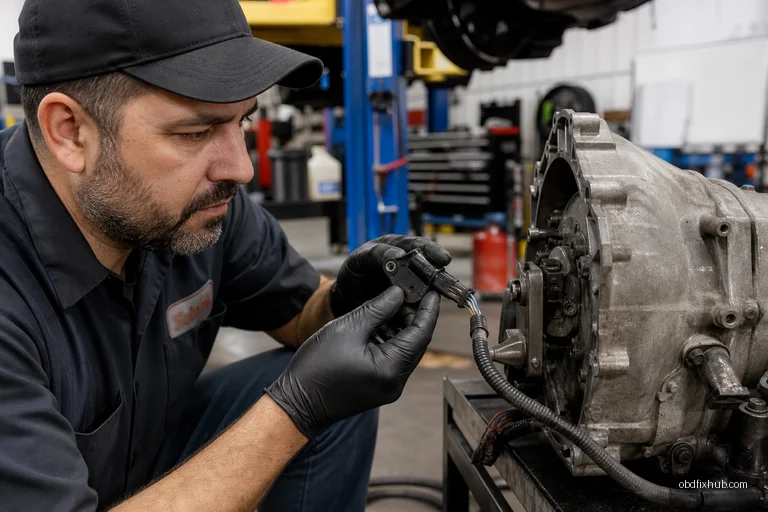
The P0914 gear shift position circuit code means the transmission control module (TCM) has detected a fault in the electrical circuit that reports the gear selector’s position. In practical terms, the vehicle may not reliably know whether the driver selected Park, Reverse, Neutral, or a forward gear. The fault can be caused by a failed range sensor, damaged wiring, poor adjustment, connector corrosion, or—less commonly—a TCM problem.
This is primarily an informational and diagnostic issue, not a code that should be ignored. A vehicle with P0914 may still drive normally at first, but incorrect gear-position data can eventually cause harsh shifting, limp mode, starting problems, or an unexpected gear selection.
What Does the P0914 Code Mean?
P0914 is a generic OBD-II transmission code associated with the gear shift position circuit. The circuit typically includes the gear range sensor, selector-position switch, transmission wiring harness, connectors, power supply, ground, and the TCM input circuit.
Depending on the vehicle, the sensor may be mounted on the transmission case, integrated into the transmission valve body, or incorporated into the electronic gear selector. Some systems use several switch signals, while others use a variable voltage or digital network message to identify the selected position. That is why the exact test values must come from the vehicle’s factory service information.
A useful diagnostic clue is that P0914 describes a circuit fault, not necessarily a mechanically damaged transmission. Replacing the transmission immediately is usually a poor first step.
Common Symptoms of P0914 Gear Shift Position Circuit
The symptoms depend on whether the signal is intermittent, stuck, out of range, or completely missing. A vehicle that shows P0914 may display one or more of the following:
- Check Engine Light or transmission warning light
- Gear position indicator showing the wrong gear or flashing
- Vehicle starts only in Neutral, or will not start in Park
- Reverse lights fail to operate or remain on
- Harsh, delayed, or abnormal automatic transmission shifts
- Transmission stuck in one gear or limp-home mode
- Difficulty selecting Reverse, Drive, or Park
- Intermittent no-crank condition after moving the selector
One real-world pattern is a vehicle that starts normally in the morning but refuses to crank after rain or a car wash. Moisture entering a range-sensor connector can temporarily change the signal enough to prevent the starting interlock from recognizing Park or Neutral.
What Causes P0914?
Before condemning an expensive transmission component, inspect the external parts of the circuit. The most frequent causes include:
- Failed transmission range sensor or gear-position sensor
- Sensor out of adjustment after transmission or cable work
- Broken, stretched, or chafed wiring near the transmission
- Loose, corroded, oil-contaminated, or water-damaged connector pins
- Blown fuse or missing sensor power supply
- Weak ground connection or excessive circuit resistance
- Damaged shift cable or selector mechanism
- Incorrectly installed aftermarket shifter or remote-start wiring
- Software or internal TCM fault
Heat and vibration are especially important. Wires routed close to the exhaust or transmission mount can rub through their insulation, creating an intermittent fault that disappears when the vehicle is stationary in a workshop.
How to Diagnose P0914 Correctly
A professional diagnosis should confirm whether the fault is electrical, mechanical, or communication-related. A basic code reader can retrieve P0914, but a scan tool that displays live transmission data is far more useful.
- Record all codes and freeze-frame data. Other transmission, communication, or voltage codes may explain why P0914 appeared. Save the data before clearing anything.
- Check the selector display against the actual lever position. With the ignition on, move slowly through Park, Reverse, Neutral, and Drive. If the display skips positions or shows two positions at once, suspect the range signal or adjustment.
- Inspect the external harness and connector. Look for fluid intrusion, green corrosion, bent terminals, loose locking tabs, damaged insulation, and wiring pulled tight around the transmission.
- Verify battery voltage, fuses, power, and ground. Low system voltage can create misleading transmission codes. Test voltage under load rather than relying only on a visual fuse inspection.
- Compare live data with the selector position. The scan tool should show a stable and correct Park, Reverse, Neutral, and Drive status. A reading that flickers while the lever is stationary indicates an unstable signal.
- Test the sensor circuits using the wiring diagram. Check reference voltage, ground integrity, signal voltage, and continuity. Do not apply random voltage to a transmission module circuit; use the manufacturer’s specified test procedure.
- Check mechanical adjustment. A stretched shift cable, loose sensor mounting, or misaligned selector shaft can make a good sensor report the wrong position.
A useful workshop tip is to perform a gentle wiggle test while watching the live gear-position data. If the displayed position changes when the harness is moved, the problem is probably in the connector, terminal tension, or wiring rather than inside the transmission.
How to Fix P0914
The correct repair depends on the test results. Common fixes include cleaning and tightening connector terminals, repairing damaged wiring, restoring a proper ground, replacing a blown fuse after finding its cause, or adjusting the transmission range sensor and shift cable.
If the sensor fails its resistance or signal test, replace it according to the manufacturer’s procedure. Some sensors require precise alignment in Neutral or a dedicated adjustment tool. After installation, confirm every selector position on the scan tool and verify that the vehicle starts only in Park or Neutral.
When the sensor is integrated into the valve body or transmission assembly, diagnosis becomes more involved. At that point, follow the manufacturer’s pinout and hydraulic or electronic testing instructions. A TCM should be considered only after power, ground, wiring, sensor operation, and software updates have been verified.
After the repair, clear the code, perform a complete key cycle, and road-test the vehicle through all gears. Recheck for stored and pending codes. If P0914 returns immediately with the selector stationary, the circuit still has a hard fault; if it returns only over bumps or when hot, concentrate on harness movement, terminal fit, and heat-related resistance.
P0914 vs. P0915, P0916, and P0917
These codes belong to the same gear-position circuit family, but their descriptions point toward different electrical behaviors. The exact wording can vary by manufacturer, so always confirm it with a vehicle-specific service manual.
- P0914: Gear Shift Position Circuit. This is a general circuit malfunction and does not identify one specific voltage condition.
- P0915: Gear Shift Position Circuit Range/Performance. The signal is present but does not behave within the expected range or does not match the selected gear.
- P0916: Gear Shift Position Circuit Low. The module sees a signal voltage or circuit value lower than the permitted threshold.
- P0917: Gear Shift Position Circuit High. The module sees a signal voltage or circuit value higher than the permitted threshold.
For example, an open signal wire may produce a high-voltage code on one vehicle and a general circuit code on another, depending on how the manufacturer biases the circuit. The code description is a direction for testing—not permission to replace a sensor without measurements.
Can You Drive With P0914?
Short, cautious driving may be possible if the vehicle selects gears correctly, the indicator is accurate, and there is no harsh engagement or limp mode. However, avoid driving if the displayed gear does not match the actual gear, Reverse or Park behaves unpredictably, or the transmission shifts violently.
Because the gear-position signal is linked to starting safety and shift control, arrange diagnosis promptly. Use the parking brake every time, especially if the vehicle’s Park indication is unreliable.
Frequently Asked Questions
What does the P0915 fault code mean?
P0915 means the gear shift position circuit has a range or performance problem. The TCM is receiving a signal, but it is incorrect, unstable, or inconsistent with the selected gear. Sensor misadjustment, wiring resistance, and a failing range sensor are common causes.
What does the OBD code P0916 mean?
P0916 indicates a low signal in the gear shift position circuit. Possible causes include a short to ground, weak sensor supply, poor ground, damaged wiring, or a sensor producing a voltage below specification.
What does the P0917 code mean?
P0917 indicates a high signal in the gear shift position circuit. An open signal wire, disconnected sensor, short to voltage, faulty sensor, or connector problem can cause it. Test the circuit against the manufacturer’s voltage specifications.
Is P0914 caused by a bad transmission?
Not necessarily. External wiring, connector corrosion, range-sensor adjustment, and a damaged shift cable are often easier and more likely causes. Internal transmission work should follow, not precede, electrical testing.
Can clearing P0914 fix the problem?
Clearing the code only resets the stored fault. If the circuit problem remains, P0914 will return—often as soon as the TCM performs its next gear-position check. Diagnose the circuit before replacing parts.
Bottom Line
P0914 identifies a problem with the electrical signal that tells the vehicle which gear has been selected. Start with the battery, fuses, connector, wiring, live data, and sensor adjustment before considering a TCM or internal transmission repair. If the selector indication is wrong or the car will not reliably recognize Park and Neutral, stop driving and have the circuit tested with a wiring diagram and a transmission-capable scan tool.




