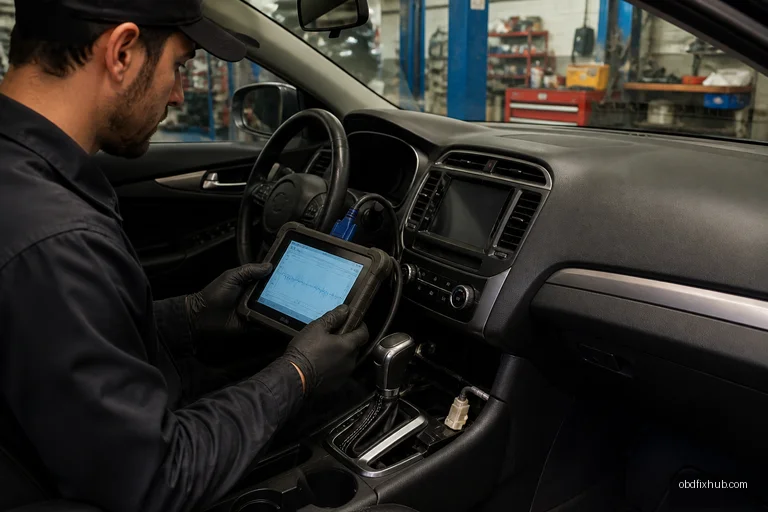
P0904 Gate Select Position Circuit means the transmission control system cannot reliably determine which gear-selection gate the driver has chosen. The problem is usually found in the shift lever position sensor, selector assembly, wiring, or its power and ground circuits—not necessarily inside the transmission itself. Because an incorrect gate signal can affect starting, shifting, and reverse selection, the fault should be diagnosed before replacing expensive transmission parts.
What the P0904 Code Means
Modern automatic, automated-manual, and dual-clutch transmissions often use a position sensor to report the shifter’s movement across the selector gate. This signal tells the transmission control module whether the lever is in Park, Reverse, Neutral, Drive, or a manual-shift position.
When the module receives a signal that is missing, implausible, or outside the expected voltage range, it stores P0904. “Gate select” refers to the direction or path of selector movement, while a separate sensor may monitor the actual gear position. A vehicle can therefore show P0904 even when the transmission has no mechanical failure.
P0904 Symptoms You May Notice
The symptoms depend on whether the fault is intermittent or permanent. A loose connector may cause an occasional warning light, while a failed sensor can leave the vehicle unable to recognize Park or Neutral.
- Check Engine Light or transmission warning message
- Gear position displayed incorrectly or flashing on the dashboard
- Vehicle starts only intermittently, or will not start in Park
- Transmission stuck in Neutral, one gear, or limp-home mode
- Harsh, delayed, or unexpected gear changes
- Reverse or Drive not engaging consistently
- Manual shift mode becoming unavailable
A useful real-world clue is a fault that appears after moving the shifter through its full range, driving over rough roads, or cleaning the center console. Those conditions can expose a worn selector mechanism or a connector that is not fully locked.
Common Causes of P0904
1. Failed gate select position sensor
The sensor may use potentiometers, Hall-effect elements, or switch contacts to report selector movement. Internal wear, contamination, or an open circuit can produce a signal that jumps rather than changes smoothly. On some vehicles, the sensor is integrated into the complete shift selector assembly.
2. Damaged wiring or connector corrosion
Wiring beneath the center console is frequently disturbed during stereo, cup-holder, or interior repairs. A pinched wire, stretched harness, loose terminal, or moisture-corroded connector can interrupt the sensor’s reference voltage or signal return. Do not dismiss a connector simply because it looks connected; terminal tension and corrosion inside the plug matter.
3. Incorrect adjustment or calibration
A selector cable, range sensor, or shifter assembly that has been removed and refitted may be slightly misaligned. The lever can feel normal to the driver while the control module sees a position between two valid gates. Some vehicles require a scan-tool adaptation or selector calibration after the component is replaced.
4. Low voltage or poor ground
Weak battery voltage, a failing charging system, or a poor transmission-control-module ground can distort sensor readings. If several unrelated communication or voltage codes appeared at the same time, test the battery and charging system before condemning the selector sensor.
5. Transmission control module or software issue
This is less common than a wiring or sensor problem, but it is possible. Manufacturer service bulletins may identify software updates or revised calibration for false gate-position faults. A module should be considered only after the input signal, wiring, power, ground, and calibration have been proven correct.
How to Diagnose P0904 Correctly
Replacing the shifter immediately is a common and costly mistake. The best diagnosis compares the position reported by the scan tool with the physical movement of the selector and the electrical signal at the sensor.
- Record all stored and pending codes. Note whether P0904 appeared with battery, communication, range-sensor, or gear-ratio codes. Freeze-frame data can show the selected position and vehicle voltage when the fault occurred.
- Check the battery and grounds. A healthy battery should not show a major voltage drop during starting. Inspect transmission grounds, body grounds, and module connectors for looseness or corrosion.
- Inspect the selector assembly. Look for spilled liquid, broken plastic guides, excessive side-to-side play, missing fasteners, and a shifter that does not return cleanly to each detent.
- Inspect the harness and connector. Gently tug each wire near the connector, check for pushed-back terminals, and look for damaged insulation where the harness bends with the console or transmission movement.
- Read live data while moving the shifter. The gate position should change predictably and remain stable at each selection. A value that flickers, skips, or disagrees with the lever position points toward the sensor, wiring, or adjustment.
- Perform electrical tests. Using the vehicle’s wiring diagram, verify reference voltage, ground quality, and signal voltage. Resistance checks are useful only when performed according to the manufacturer’s specifications; blindly measuring a powered sensor can lead to incorrect conclusions.
- Calibrate after repair when required. Clear the code and complete the selector or transmission adaptation procedure. A code that returns immediately after clearing usually indicates an active electrical or alignment fault.
Before testing, identify the exact transmission and model year. The same P0904 definition can use different sensor logic across manufacturers, so a universal assumption such as “the signal must be exactly 5 volts” is unsafe.
P0904 Fixes and Repair Options
The correct repair depends on the failed part identified during testing. Common solutions include:
- Repairing an open, shorted, or chafed wire
- Cleaning corrosion and repairing loose connector terminals
- Replacing the gate select position sensor or complete selector assembly
- Adjusting the shift cable or selector mechanism
- Performing a transmission or gear-selector relearn procedure
- Updating control-module software when a manufacturer bulletin applies
- Replacing a control module only after confirming its power, ground, inputs, and programming requirements
After the repair, move the selector through every position with the engine off, then test starting in Park and Neutral, reverse engagement, drive engagement, and manual mode if equipped. A road test should include gentle and normal shifts while monitoring live data for a repeated dropout.
Can You Drive With P0904?
Short-distance driving may be possible if the vehicle selects gears normally and the warning is intermittent, but caution is appropriate. If the display shows the wrong gear, the vehicle refuses to start, shifts harshly, or enters limp mode, avoid continued driving. An incorrect gate signal can create an unexpected engagement or prevent the transmission from selecting the gear you requested.
If the vehicle is stuck in Park, do not repeatedly force the shifter. Check the owner’s manual for the emergency shift-lock release and arrange proper diagnosis or towing.
P0915 and P0917: How They Relate to P0904
What does the P0915 fault code mean?
P0915 generally means Gate Select Position Circuit Range/Performance. The module is receiving a signal, but the signal does not match the expected position, movement pattern, or operating range. A misadjusted selector, worn sensor track, poor connection, or mechanical binding can cause P0915.
What does the P0917 code mean?
P0917 generally means Gate Select Position Circuit High. The control module is seeing a voltage or signal level higher than expected. Possible causes include a short to voltage, an incorrectly connected circuit, a failed sensor, or a damaged module input. The exact voltage threshold varies by vehicle.
These codes are related but should not be treated as interchangeable. P0904 is the general gate-select circuit fault, P0915 emphasizes an implausible range or performance problem, and P0917 identifies a high signal condition. If several are stored together, diagnose the shared reference, ground, and signal wiring first.
Repair Cost and What Affects It
Cost varies widely because a connector repair may take less than an hour, while an integrated selector assembly or transmission adaptation can require considerably more labor. Access under the console, the vehicle’s transmission design, parts availability, and whether programming is needed all affect the final price.
Ask the repair shop to provide the test result that justifies the part replacement. A professional diagnosis should identify the sensor signal, power and ground condition, connector status, and calibration requirement—not merely state that P0904 was found.
Final Takeaway
P0904 indicates that the transmission control system cannot trust the gate-select position signal. Start with battery voltage, grounds, selector movement, connectors, and live-data readings before replacing a sensor or transmission module. If P0915 or P0917 is also present, use the code description to narrow the fault toward an implausible range or an excessively high signal.
Next step: scan all modules, record freeze-frame data, inspect the selector wiring, and follow the manufacturer’s circuit diagram and calibration procedure. That approach is faster, safer, and far less expensive than guessing at parts.
Frequently Asked Questions
Is P0904 a serious transmission code?
It can be serious because the vehicle may select the wrong operating mode, fail to start, or enter limp mode. The code does not automatically mean the internal transmission is damaged, but it should be diagnosed promptly.
Can a weak battery cause P0904?
Yes. Low system voltage or a poor ground can distort the selector sensor signal. Check battery voltage, charging output, and module grounds before replacing the gate-select sensor.
Will clearing P0904 fix the problem?
Clearing the code only removes the stored warning temporarily. If the electrical or mechanical fault remains, P0904 will return, often as soon as the selector is moved through the affected position.
Does P0904 mean I need a new transmission?
Usually not. The most common repairs involve the selector sensor, wiring, connector, adjustment, or calibration. Internal transmission repairs should be considered only when separate testing identifies a mechanical fault.




