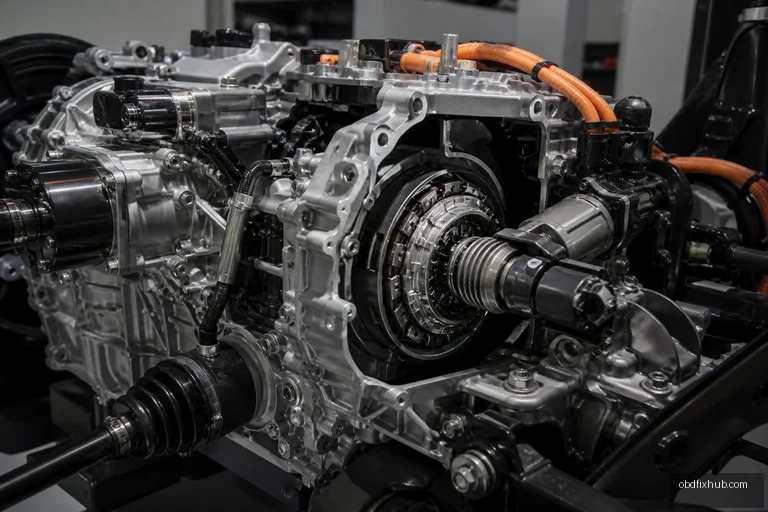
P08E7 means the vehicle has detected a problem in the drive motor clutch enable circuit. On a hybrid or plug-in vehicle, this circuit helps command and confirm the clutch that connects or disconnects the electric drive motor from the drivetrain. The fault may come from wiring, a fuse, the clutch actuator, a control module, or a mechanical clutch problem. Because the exact strategy is manufacturer-specific, the code should be diagnosed with the factory service information rather than cleared and ignored.
What Does the P08E7 Code Mean?
The P08E7 Drive Motor Clutch Enable Circuit code is a powertrain diagnostic trouble code associated with the electrical enable signal for a drive motor clutch. In different hybrid systems, this clutch may be used to isolate an electric motor at certain speeds, disconnect the motor during engine operation, or connect the motor during electric propulsion and regenerative braking.
The word “enable” is important. The vehicle is not necessarily saying that the clutch itself is broken. It may be reporting that the command signal is missing, implausible, outside its expected voltage range, or not followed by the correct feedback from the actuator. Some manufacturers define P08E7 slightly differently, so the vehicle-specific code description and wiring diagram always take priority.
P08E7 Symptoms You May Notice
A vehicle can store P08E7 with very few noticeable symptoms, especially when the hybrid control system can temporarily operate in a fallback mode. In other cases, the control module disables electric propulsion to protect the transmission and high-voltage system.
- Check Engine Light, hybrid system warning, or drivetrain warning message
- Reduced electric-only driving or loss of regenerative braking
- Limited power, reduced acceleration, or a “drive motor unavailable” message
- Harsh engagement, hesitation, grinding, or a clunk during operating-mode changes
- Engine running more often than normal and lower fuel economy
- Vehicle refusing to enter Ready mode or entering a reduced-power mode
- Additional communication, actuator, position-sensor, or high-voltage system codes
A useful real-world clue is a change in behavior after a 12-volt battery replacement or jump-start. Low system voltage can interrupt an actuator calibration or create a false-looking clutch circuit code. That does not prove the clutch is healthy, but it makes battery and power-supply testing an early priority.
Common Causes of P08E7
Electrical and wiring faults
Open circuits, shorted wires, loose terminals, corrosion, and damaged harnesses are among the most common causes. Hybrid drivetrain harnesses may run near heat sources, splash areas, moving components, or transmission mounts. A wire can look intact but fail when the harness is flexed, so a visual inspection alone is not enough.
- Blown fuse or poor power feed to the clutch actuator
- Corroded connector pins or water intrusion
- Short to ground, short to voltage, or high resistance in the control wire
- Damaged harness near the transaxle, inverter, or motor assembly
- Weak 12-volt battery or unstable low-voltage supply
Actuator or clutch problems
The clutch actuator may have an internal motor, solenoid, position sensor, or gear mechanism. If it binds, overheats, loses calibration, or cannot reach the commanded position, the control module may set P08E7 even though the external wiring tests correctly. Mechanical wear, contamination, incorrect fluid, or a damaged clutch fork can also prevent proper engagement.
Control module and software issues
A hybrid control module, transmission control module, or powertrain control module may set the code because of an internal driver fault or a software error. Some vehicles have technical service bulletins for calibration updates, clutch relearn procedures, or revised diagnostic instructions. Checking for applicable updates before replacing expensive hardware can prevent an unnecessary repair.
How to Diagnose the P08E7 Drive Motor Clutch Enable Circuit
Professional diagnosis starts with the entire fault pattern, not just the first code displayed by a basic scanner. P08E7 may be secondary to a low-voltage, communication, position-sensor, or hybrid isolation problem.
- Scan every module. Record stored, pending, and history codes from the engine, hybrid control, transmission, battery, and body modules. Save freeze-frame data, including battery voltage, vehicle speed, temperature, and operating mode.
- Verify the 12-volt supply. Test the battery at rest and under load, then inspect the battery terminals, grounds, and relevant fuses. A scan-tool voltage reading that drops sharply during startup is a valuable clue.
- Check the manufacturer’s service information. Confirm the exact definition of P08E7, connector locations, expected pin voltages, actuator resistance specifications, and whether a clutch initialization procedure is required.
- Inspect the circuit carefully. Look for rubbed insulation, bent terminals, corrosion, fluid contamination, and connectors that are not fully locked. Perform a wiggle test while monitoring the circuit, but do not force high-voltage connectors.
- Use live data and active tests. A capable scan tool may show clutch command, enable status, actual position, and actuator current. If the command changes but the feedback does not, the actuator or mechanical mechanism becomes more suspect.
- Test the actuator only as specified. Resistance, continuity, voltage-drop, and circuit-load tests must follow the service manual. Applying battery power directly to an actuator can damage it or create a serious safety hazard.
- Complete calibration or relearn procedures. After wiring or actuator repairs, many systems require a clutch position learn, transmission initialization, or drive-cycle verification. Clearing the code without completing this step may cause an immediate return.
Repair Options for P08E7
The correct repair depends on the failed part. A damaged terminal may require a proper terminal repair rather than simply tightening the connector. A rubbed harness should be repaired with automotive-grade wiring and protected from the original source of abrasion, not just wrapped in tape.
- Replace a blown fuse only after finding why it failed.
- Repair corroded terminals, damaged wiring, poor grounds, or water leaks.
- Replace the clutch actuator if its motor, sensor, or internal mechanism fails testing.
- Perform clutch or transmission calibration after actuator installation.
- Update or reprogram the relevant control module when supported by a service bulletin.
- Repair internal clutch or transaxle damage when electrical tests pass but the mechanism cannot move or hold position.
On many hybrids, access to the actuator or transaxle requires high-voltage shutdown procedures. The service plug must be handled according to the manufacturer’s instructions, and the system must be verified de-energized with the correct equipment. If you are not trained to work around high-voltage components, leave this repair to a qualified hybrid technician.
Can You Drive With a P08E7 Code?
Sometimes the vehicle will continue driving, but that does not make the fault harmless. If the warning is accompanied by reduced power, unusual clutch noises, inability to enter Ready mode, overheating, or a strong electrical smell, stop driving and arrange professional diagnosis. Continued operation with a slipping or partially engaged clutch can increase drivetrain damage.
If the vehicle drives normally and only the warning light is present, a short trip to a repair facility may be reasonable. Avoid towing, steep climbs, aggressive acceleration, and repeated attempts to force electric mode until the system has been checked.
How Much Does P08E7 Repair Cost?
Cost varies widely because the code can be caused by a fuse or connector on one vehicle and require actuator or transaxle work on another. Diagnosis is usually far less expensive than replacing a clutch assembly based on the code alone. Ask the repair shop whether the estimate includes high-voltage safety procedures, calibration, software updates, and post-repair verification.
Final Takeaway
P08E7 identifies a fault in the electrical enable circuit for a drive motor clutch, but it does not automatically condemn the clutch assembly. Begin with all module codes, 12-volt power, fuses, grounds, wiring, and connector condition. Then use live data and manufacturer-specific active tests to separate an electrical command problem from an actuator or mechanical failure. A proper relearn and road-test verification are part of the repair, not optional extras.
Frequently Asked Questions
What is the most common cause of P08E7?
There is no universal single cause, but low 12-volt voltage, connector damage, wiring faults, and a failed clutch actuator are frequent possibilities. The exact pattern depends on the vehicle manufacturer and hybrid drivetrain design.
Will disconnecting the battery clear P08E7?
It may erase temporary fault data, but it will not repair the underlying problem. The code commonly returns after the clutch enable test runs again, and disconnecting power can also erase useful diagnostic information.
Can a weak 12-volt battery cause this code?
Yes. Low voltage can prevent the actuator from completing its command or interrupt calibration. Test the battery and charging system, but do not assume a new battery fixes P08E7 without confirming that the code stays away.
Is P08E7 safe to diagnose at home?
Basic scanning and inspection of the 12-volt system are generally reasonable. Testing hybrid clutch wiring, opening high-voltage connectors, or commanding the actuator requires appropriate training, safety equipment, and factory procedures.




