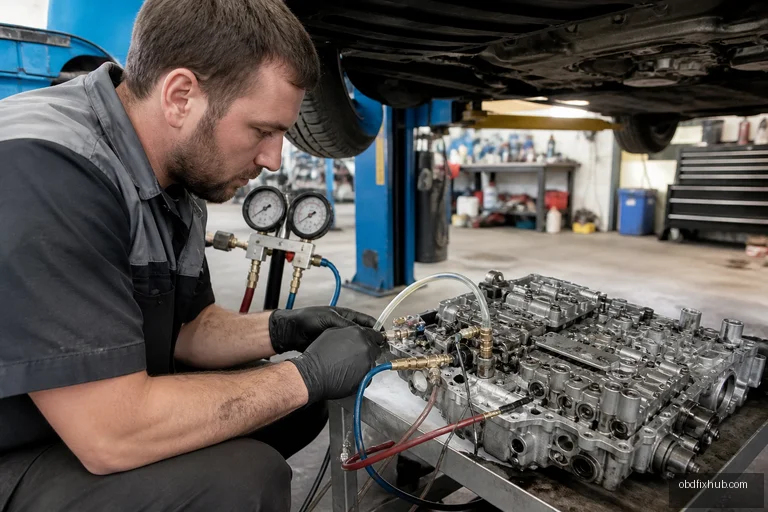
P0942 hydraulic pressure unit fault means the transmission control system has detected a problem with the hydraulic unit that creates or regulates gearbox pressure. In practice, the fault may come from low fluid, a failing electric pump, restricted filtration, a pressure sensor, damaged wiring, or an internal mechatronic problem. Do not replace the pressure sensor immediately: correct diagnosis must separate an electrical signal fault from genuinely low hydraulic pressure.
This is an informational search query, but it can involve a serious drivability problem. If the transmission is slipping, stuck in one gear, refusing to select Drive or Reverse, or making a loud pump noise, limit driving and arrange a professional inspection.
What Does the P0942 Code Mean?
P0942 is a powertrain diagnostic trouble code associated with a hydraulic pressure unit malfunction. The exact wording and test strategy vary by vehicle manufacturer, transmission design, and software calibration. Some systems use an electric hydraulic pump and accumulator, while others rely on a mechanically driven pump inside the transmission.
The hydraulic unit supplies the pressure needed to operate clutch packs, shift forks, valves, or automatic transmission bands. When pressure does not build quickly enough, drops below the commanded value, or appears implausible compared with the pressure sensor signal, the transmission control module can store P0942.
A code reader alone cannot tell you whether the unit has a failed pump or only a poor electrical connection. The freeze-frame data, commanded pressure, actual pressure, pump duty cycle, fluid level, and related transmission codes are all important.
Common P0942 Symptoms
The symptoms depend on whether the fault is intermittent, electrical, or a true loss of hydraulic pressure. A vehicle may still drive normally at first, particularly when the code is caused by a loose connector or a sensor reading that briefly falls outside its expected range.
- Harsh, delayed, or missing gear changes
- Transmission slipping under acceleration
- Failure to engage Drive or Reverse
- Transmission stuck in one gear or limp-home mode
- Flashing gear indicator or transmission warning lamp
- Whining, buzzing, or repeated pump operation
- Engine speed rising without a matching increase in road speed
- Low-voltage or transmission communication codes stored at the same time
A useful real-world clue is timing. If the transmission works when cold but loses pressure after warming up, worn pump components, fluid aeration, an internal leak, or a marginal electrical connection become more likely. A fault that appears immediately after battery replacement or transmission work points more strongly toward voltage supply, wiring, connector damage, or an incorrectly installed seal.
Most Likely Causes of P0942
Low, contaminated, or incorrect transmission fluid
Hydraulic systems cannot maintain pressure when the fluid level is low. Foamy fluid can be equally problematic because the pump compresses air instead of moving a solid column of fluid. A recent service using the wrong fluid type can alter clutch operation and pressure control, even when the level appears correct.
Check the level using the manufacturer’s specified temperature and procedure. Some transmissions have no conventional dipstick and require a level tube, scan-tool temperature reading, or a special fill adapter. Guessing the level while the fluid is cold can produce a misleading result.
Failed hydraulic pump or accumulator
An electric pump may have worn brushes, damaged bearings, a seized motor, or excessive current draw. A weak accumulator or leaking pressure reservoir can also cause the pump to run too often and fail to reach the required pressure within the programmed time.
Blocked filter, valve body, or pressure passage
A restricted filter limits pump supply. Debris in the valve body can make a pressure-control valve stick, while clutch material may block a small hydraulic passage. In these cases, replacing a sensor without inspecting the fluid and filter usually wastes money.
Pressure sensor or wiring fault
The pressure sensor may produce an implausible signal because of an internal failure, a damaged connector, fluid intrusion, a broken reference wire, or poor ground. Rodent damage and harness chafing near the transmission are surprisingly common, especially after underbody repairs.
Low system voltage or control-module issues
Hydraulic pumps are sensitive to voltage. A weak battery, poor ground strap, blown fuse, corroded relay, or charging fault can prevent the pump from generating adequate pressure. Diagnose the power supply before condemning an expensive mechatronic assembly.
How to Diagnose a P0942 Hydraulic Pressure Unit Fault
- Record all codes and freeze-frame data. Do not clear the codes before noting transmission temperature, battery voltage, vehicle speed, and whether the fault occurred during a shift or startup.
- Check the battery and charging system. Measure voltage during the hydraulic pump activation. A large voltage drop under load can mimic a failed pump.
- Inspect the fuse, relay, connector, and harness. Look for pushed-back terminals, green corrosion, oil contamination, broken locking tabs, and wiring rubbed through against the transmission case.
- Verify fluid level and condition. Check for a burnt odor, metallic particles, clutch debris, or foam. Follow the exact temperature and fill instructions for that transmission.
- Use scan-tool live data. Compare commanded pressure with actual pressure and observe pump current, pump run time, and pressure recovery after the pump stops.
- Test pressure mechanically when specified. A suitable pressure gauge connected to the manufacturer’s test port can confirm whether the sensor is lying or the hydraulic system is genuinely under pressure.
- Inspect internal components if required. If electrical tests pass but pressure remains low, the pump, filter, accumulator, valve body, seals, or mechatronic unit may need removal and inspection.
Do not apply battery power directly to a pump or solenoid unless the service information specifically allows it. Some units require a controlled duty cycle, and an incorrect test can damage the component or the control module.
How Do I Know If the Transmission Fluid Pressure Sensor Is Bad?
A bad pressure sensor often produces a fixed, erratic, or implausible reading rather than a simple low-pressure condition. For example, live data may show maximum pressure with the pump off, zero pressure while the transmission shifts normally, or a signal that jumps sharply without any corresponding change in pump operation.
Confirm the sensor’s reference voltage, ground quality, and signal voltage against the manufacturer’s wiring diagram. A pressure sensor commonly uses a 5-volt reference, sensor ground, and variable signal, but the exact circuit differs. A scope can reveal intermittent dropouts that a basic multimeter misses.
The strongest diagnosis comes from comparison: if a mechanical gauge shows stable pressure but scan data is implausible, the sensor or its circuit is suspect. If both the gauge and scan data show low pressure, replacing the sensor will not solve the underlying hydraulic failure.
Where Is the Hydraulic Pressure Sensor for P0934?
P0934 generally refers to a hydraulic pressure sensor circuit that is low, but the sensor location is not universal. On many dual-clutch and electronically controlled transmissions, it is mounted inside or directly on the mechatronic or hydraulic control unit, close to the valve body. On other designs, it may be threaded into the transmission case or installed in an external hydraulic line.
The most reliable way to locate it is to use the vehicle-specific wiring diagram and transmission parts illustration. Do not assume that a component visible on the outside of the gearbox is the pressure sensor; some external units are temperature sensors, solenoids, or electrical connectors for an internal sensor.
If P0934 is present with P0942, inspect the sensor connector and shared 5-volt reference circuit first. Multiple sensor codes can be caused by one shorted reference wire rather than several failed sensors.
What Causes a P0944 Code?
P0944 is commonly associated with a hydraulic pressure unit loss-of-pressure condition. It can occur when pressure falls rapidly after the pump stops, when the system cannot build pressure within the expected time, or when the control module detects an abnormal pressure drop during operation.
- Low or aerated transmission fluid
- Internal hydraulic leakage from seals or valve-body passages
- Weak electric or mechanical pump
- Leaking accumulator or pressure regulator
- Blocked filter or damaged suction seal
- Incorrect pump power supply or ground
- Pressure sensor data that falsely reports a pressure loss
P0944 and P0942 can therefore share the same root cause, but they are not interchangeable diagnoses. P0942 points to a hydraulic pressure unit fault in general, while P0944 places more emphasis on pressure loss or failure to retain pressure.
Repair Options and Typical Next Steps
The correct repair depends on the test results. A low fluid level, corroded terminal, blown fuse, or damaged harness may be inexpensive to correct. A failed pump, internal filter, valve body, or complete mechatronic unit is more involved and may require fluid adaptation, clutch calibration, or software procedures after installation.
After repair, clear the codes only after recording the original data. Perform the manufacturer’s hydraulic pressure test and adaptation procedure, then road-test the vehicle through cold and fully warm operating conditions. Recheck for leaks and scan for returning codes; a short stationary idle test may not reproduce a heat-related pressure failure.
Is P0942 Serious?
Yes, it can be. Continuing to drive with genuinely low hydraulic pressure may cause clutch slip, overheated friction material, pump damage, and contamination throughout the valve body. If the vehicle still shifts normally and the code is intermittent, drive only as far as necessary for diagnosis and avoid towing, steep hills, and aggressive acceleration.
Key Takeaway
P0942 does not automatically mean the pressure sensor or entire transmission must be replaced. Start with voltage, fluid level, wiring, connector condition, and live pressure data. A mechanical pressure test is often the decisive step: it tells you whether the transmission is truly losing hydraulic pressure or the electronic signal is misleading the control module.
Next step: Have the vehicle scanned with a transmission-capable diagnostic tool, and ask the technician to compare commanded pressure, measured pressure, pump operation, and mechanical gauge pressure before approving major parts replacement.
Frequently Asked Questions
Can I drive with a P0942 code?
Only for a short distance if the transmission operates normally and no severe symptoms are present. Stop driving if it slips, will not engage, becomes stuck in gear, or produces a loud hydraulic pump noise.
Does P0942 always mean the hydraulic pump is bad?
No. Low fluid, a poor electrical connection, low battery voltage, a restricted filter, a leaking valve body, or a faulty pressure sensor can all trigger the code.
Can changing the transmission fluid fix P0942?
It can help when the fluid is low, contaminated, aerated, or incorrect, but fluid service will not repair a failed pump, damaged wiring, or an internal hydraulic leak.
Is P0934 the same as P0942?
No. P0934 usually identifies a low pressure-sensor circuit condition, while P0942 describes a hydraulic pressure unit fault. They may appear together when one wiring or sensor problem affects pressure reporting.
Why does P0944 return after replacing the pressure sensor?
If P0944 returns, the system may be losing real pressure through a weak pump, leaking accumulator, blocked filter, valve-body fault, or internal seal problem. Verify pressure with a mechanical gauge before installing another sensor.




