P0945 means the transmission control system has detected an open or incomplete circuit in the hydraulic pump relay control circuit. In most vehicles, this does not refer to the engine fuel pump. It usually concerns an electrically operated hydraulic pump used to build transmission pressure for gear engagement, clutch operation, or an automated manual transmission system. The first repair step is testing the fuse, relay, wiring, connectors, and power supply—not replacing the pump immediately.
What Does P0945 Mean?
The exact definition of P0945 varies slightly by manufacturer, but the core meaning is consistent: the transmission control module (TCM) or powertrain control module (PCM) cannot operate or electrically verify the hydraulic pump relay circuit.
An “open” circuit means that electrical current cannot complete its intended path. The interruption may be caused by a blown fuse, failed relay, broken wire, loose connector terminal, corroded ground, or an internal open circuit in the pump motor. A pump that is mechanically worn can also trigger related transmission pressure codes, but it is not automatically the cause of P0945.
What Happens When the Hydraulic Pump Relay Circuit Is Open?
When the relay circuit is open, the hydraulic pump may not run when the vehicle needs transmission pressure. Without sufficient pressure, the transmission may fail to engage a gear, enter limp mode, or remain in neutral. Some vehicles will still move, but shifting may be harsh, delayed, or limited to one or two gears.
The vehicle may also disable automatic start-stop, refuse to select reverse, or display messages such as “Transmission Fault,” “Gearbox Fault,” or “Service Transmission.” Driving may be possible for a short distance, but continued use can create additional clutch and transmission damage if the system repeatedly attempts to engage gears without adequate hydraulic pressure.
Common Causes of P0945
- Blown hydraulic pump fuse: A shorted pump motor or damaged wiring can overload the circuit and open the fuse.
- Failed pump relay: The relay may have burned contacts, an open coil, or internal heat damage.
- Broken or damaged wiring: Harnesses routed near the transmission, battery tray, exhaust, or suspension can suffer from vibration, chafing, and heat.
- Corroded connectors: Water intrusion or transmission-fluid contamination can increase resistance or interrupt the relay signal.
- Poor ground connection: A loose transmission ground strap can make the pump appear to have an open power circuit.
- Defective hydraulic pump motor: An internal open winding, seized armature, or worn brushes may prevent the pump from operating.
- TCM or control-side fault: This is less common, but a failed driver circuit or software issue can prevent proper relay control.
- Low or contaminated hydraulic fluid: Fluid problems do not always create an electrical open, but they can overheat or overload the pump and lead to relay or fuse failure.
P0945 Symptoms to Look For
The symptoms depend on the vehicle design and whether the pump is used as the primary pressure source or as an auxiliary unit. Typical signs include:
- Check Engine Light or transmission warning light
- Delayed gear engagement after selecting Drive or Reverse
- Harsh, slipping, or erratic shifts
- Transmission stuck in neutral or limp-home mode
- Electric pump running continuously or not running at all
- Unusual clicking from the relay or buzzing from the pump area
- Low hydraulic pressure or related transmission solenoid codes
- A vehicle that starts but will not move
A useful field clue is the pump sound during an ignition-on self-test. On some systems, the pump runs briefly and then stops. If there is no sound, check the circuit before condemning the pump. However, do not assume a silent pump is bad until power and ground are measured directly at the pump connector.
How to Diagnose P0945 Correctly
A professional diagnosis should separate an electrical open from a genuine hydraulic or mechanical failure. Replacing the pump without testing the relay feed is a common and expensive mistake.
- Scan all modules: Record P0945 and any related codes before clearing them. Transmission pressure, voltage, or communication codes can change the diagnostic direction.
- Check the battery voltage: Low system voltage can cause unreliable relay operation. A healthy battery should generally show about 12.4–12.7 volts with the engine off and approximately 13.5–14.8 volts while charging.
- Inspect the fuse: Do not only look at the fuse. Test for voltage on both sides with the circuit loaded. If the replacement fuse blows immediately, find the short instead of installing a larger fuse.
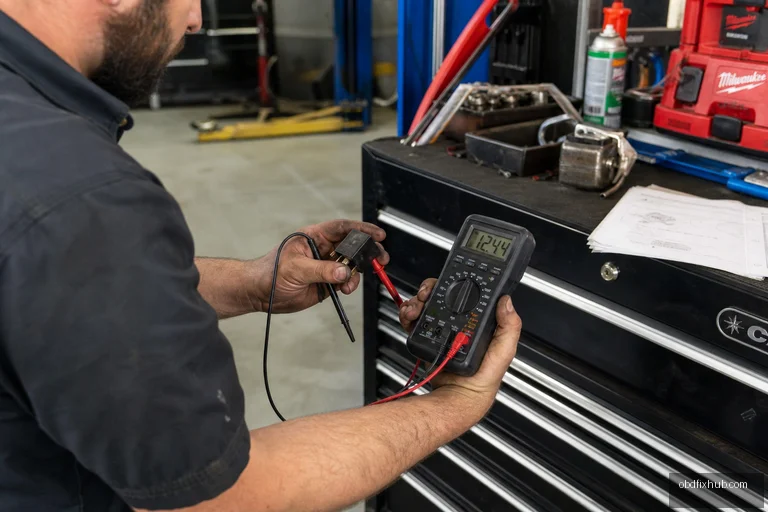
- Test the relay: Compare the relay with an identical known-good relay only if the terminals and specifications match. Check coil resistance and verify that the switched contacts receive and deliver voltage.
- Test power and ground at the pump: With the system commanded on, measure voltage at the pump connector and perform a voltage-drop test on the ground. A test light or multimeter reading with no load can be misleading.
- Check continuity under movement: Wiggle the harness while monitoring resistance. A wire broken inside its insulation may test correctly when stationary and fail when the transmission moves or the harness flexes.
- Measure pump current draw: Excessive current suggests a seized or mechanically overloaded pump. No current with confirmed power and ground suggests an open motor winding or internal connection.
- Verify hydraulic pressure: If the electrical circuit passes, use the manufacturer’s specified pressure test procedure. Low pressure may point to a worn pump, restricted filter, internal leak, or incorrect fluid level.
What Is the Most Common Cause of Hydraulic Pump Failure?
For the pump itself, the most common long-term causes are fluid starvation, contaminated fluid, overheating, and mechanical wear. Low fluid can cause the pump to draw air, run noisily, and overheat. Metal particles or clutch debris can damage clearances and restrict the pump inlet or filter.
For P0945 specifically, however, an open fuse, failed relay, corroded connector, or damaged wiring is often more likely than a completely failed hydraulic pump. This distinction matters: a pump replacement will not repair a missing ground or a broken relay-control wire.
How Can You Tell If a Hydraulic Pump Is Bad?
A hydraulic pump becomes more likely to be defective when it has confirmed power and ground, the relay operates correctly, the wiring has low resistance, and the pump still draws no current or produces no pressure. A pump that draws unusually high current, becomes extremely hot, or blows the fuse repeatedly may be seized or internally damaged.
Listen for the operating pattern as well. A healthy pump normally runs for a limited period and then switches off after pressure is achieved. Continuous operation, rapid cycling, grinding, or a high-pitched whining noise can indicate an internal leak, blocked filter, worn pump, or pressure-control problem. Noise alone is not proof, so compare it with actual pressure and current measurements.
Repair Options for P0945
The correct repair depends on the failed part. Replace a blown fuse only after identifying why it opened. A defective relay should be replaced with the correct part number, while damaged wiring must be repaired with sealed automotive-grade connections and properly supported away from heat and moving components.
Clean light connector corrosion only when the terminals are not burned or loosened. Terminals that have lost tension should be replaced, not simply sprayed with contact cleaner. If the pump fails a power, ground, current, or pressure test, replacement may be necessary; the system should then be primed and pressure-tested according to the service manual.
Can You Drive With P0945?
Driving is not recommended if the transmission slips, refuses to engage, remains in neutral, or repeatedly enters limp mode. Continuing to drive can leave you stranded and may turn an electrical repair into a transmission rebuild. If the vehicle still shifts normally and the warning is intermittent, drive only far enough to reach a qualified repair facility, avoiding towing, steep hills, and heavy traffic.
Key Takeaway
P0945 identifies an open hydraulic pump relay control circuit, not an automatic diagnosis of a failed pump. Start with the fuse, relay, wiring, connector, ground, and pump voltage. Only condemn the hydraulic pump after confirming that the electrical supply is correct and that the pump fails a current or pressure test. If the vehicle cannot select a gear or is slipping, stop driving and have the transmission system diagnosed professionally.
Frequently Asked Questions
Is P0945 related to the fuel pump relay?
Usually, no. P0945 normally refers to a transmission hydraulic pump relay circuit. Fuel pump relay faults typically use different manufacturer-specific codes and affect engine starting or fuel delivery rather than gear engagement.
Can a bad battery cause P0945?
Low battery voltage can contribute to relay and TCM faults, especially during startup, but it is not the most common cause of a true open circuit. Test battery voltage, charging voltage, and the relevant fuse and relay before replacing transmission components.
Will clearing P0945 fix the problem?
No. Clearing the code may turn off the warning temporarily, but it will return if the circuit remains open. The fault should be repaired and then verified with a road test and another full-module scan.
How much does a P0945 repair cost?
The cost ranges widely. A fuse, relay, connector, or wiring repair may be relatively inexpensive, while an electro-hydraulic pump or transmission control module can cost substantially more. Accurate testing is the best way to avoid replacing an expensive part unnecessarily.




