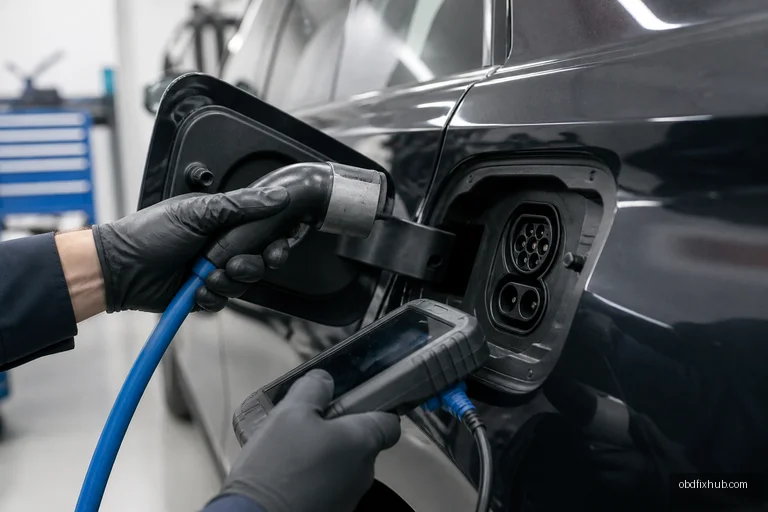
P0CF3 means the vehicle has detected an open control pilot circuit in the EV charging system. In practical terms, the onboard charger or charging control module cannot reliably communicate with the charging equipment through the control pilot (CP) signal. The result may be a refused charging session, interrupted charging, or a “Service Charging System” warning. The fault is usually caused by a damaged charging cable, connector, CP terminal, wiring, or charging-port component—not automatically by a failed high-voltage battery.
What Does P0CF3 Mean?
The control pilot is a low-voltage communication and safety circuit used between the vehicle and an EVSE, commonly called the charging station or wall box. It tells the vehicle that charging equipment is connected and helps confirm whether current can be supplied safely. On systems based on SAE J1772 or IEC 61851 principles, the pilot signal uses a defined voltage state and a pulse-width-modulated signal.
When the vehicle reports an “open” control pilot circuit, its control module is seeing an interruption or an implausible electrical condition. That interruption can exist at the vehicle charging inlet, inside the charging cable, at a connector terminal, in a harness, or within the charging control electronics. The exact test strategy varies by manufacturer, so the factory service information should be used before replacing parts.
P0CF3 Symptoms You May Notice
- The vehicle will not begin AC charging.
- Charging starts and stops after a few seconds or minutes.
- A charging-station fault light or “Unable to Charge” message appears.
- The instrument cluster displays “Service Charging System” or a similar warning.
- The portable charging cable shows a red fault indicator.
- DC fast charging may still work, or it may also be disabled depending on how the vehicle shares charging-control circuits.
- The battery may show a low state of charge even though the vehicle appears connected.
A useful clue is whether the problem follows the charging equipment. If the vehicle charges normally at a different known-good AC station, the original EVSE or cable becomes the leading suspect. If the same fault occurs with multiple chargers, concentrate on the vehicle-side inlet, CP wiring, connectors, and charging module.
Common Causes of a P0CF3 Control Pilot Circuit Open
1. Damaged or contaminated charging connector
Water, road salt, dirt, or corrosion inside the inlet can prevent the CP terminal from making a dependable connection. A bent terminal may look acceptable from outside but fail when the plug is inserted. Look for moisture, pushed-back pins, discoloration, melted plastic, or signs that the connector has overheated.
2. Broken control-pilot wire
The CP conductor runs through the charging cable and the vehicle’s charge-port harness. Repeated bending near the plug, a tight cable bend, rodent damage, or impact near the inlet can break the conductor internally. A cable may pass a basic visual inspection while failing a continuity or wiggle test.
3. Faulty EVSE or portable charging cable
A wall box or portable EVSE generates and monitors the pilot signal. Internal relay, circuit-board, pilot-driver, or cable faults can make the vehicle interpret the circuit as open. Before condemning vehicle hardware, test with a compatible, certified charger known to work on another vehicle.
4. Loose harness connector or terminal tension problem
Charging-inlet connectors can suffer from poor terminal tension after previous repairs or accidental pulling on the harness. Vibration may produce an intermittent open that disappears when the vehicle is stationary. A technician should inspect terminal retention rather than merely spraying cleaner into the connector.
5. Failed charging control module or onboard charger
The onboard charger, charge-port control unit, or vehicle communication module may be unable to generate or interpret the CP signal. This is less attractive as a first diagnosis because module replacement is expensive and many P0CF3 cases are caused by wiring or connector faults. A module should be replaced only after power, ground, network communication, and CP circuit tests pass or the manufacturer’s diagnostic procedure identifies it directly.
6. Software, 12-volt supply, or related charging faults
Low 12-volt voltage, a failed fuse, poor ground, or outdated control-module software can disrupt charging logic and create misleading symptoms. Check for other diagnostic trouble codes before treating P0CF3 as an isolated fault. A vehicle with multiple low-voltage or communication codes may need its 12-volt battery and charging system tested first.
How to Diagnose P0CF3 Safely
The control pilot is not the same as the high-voltage traction circuit, but the charging inlet is located beside high-voltage components. Do not open the onboard charger, dismantle a wall box, or probe unknown terminals unless you are trained and equipped for EV service. Disconnecting the vehicle’s high-voltage battery is not a substitute for following the manufacturer’s isolation procedure.
- Record all codes and freeze-frame data. Note whether P0CF3 is current, pending, or history, and record battery state of charge, outside temperature, charging mode, and the EVSE used.
- Confirm the complaint with a known-good charger. Try another compatible AC station and, if available, another cable. Do not repeatedly force a plug that feels mechanically abnormal.
- Inspect the vehicle inlet. Look for bent or recessed pins, moisture, corrosion, debris, heat damage, and a loose locking mechanism. Compare the CP terminal position with the connector diagram; do not guess based on appearance alone.
- Inspect the charging cable and EVSE. Examine the plug, strain relief, cable jacket, and indicator lights. A cable that only fails when flexed near the handle is a strong sign of internal conductor damage.
- Check fuses, grounds, and 12-volt voltage. Follow the service manual’s test conditions. A weak 12-volt battery can cause charging modules to shut down before a session begins.
- Test the CP circuit with approved equipment. A technician may use a wiring diagram, digital multimeter, oscilloscope, EVSE tester, or manufacturer-specific scan tool to verify continuity, resistance, signal amplitude, and the expected pilot waveform. A simple resistance check alone may miss a signal-driver or intermittent fault.
- Clear the code and retest under the original conditions. The repair is not confirmed until the vehicle completes an AC charging session without returning P0CF3.
P0CF3 Fixes: What Usually Repairs the Fault?
- Drying and cleaning a contaminated charging inlet using the manufacturer-approved method.
- Repairing an open or damaged CP wire with the correct automotive high-voltage-environment repair procedure.
- Replacing a damaged charging cable or portable EVSE.
- Repairing a loose terminal, connector lock, or charge-port harness.
- Replacing the vehicle charging inlet when its internal CP terminal or circuitry has failed.
- Updating or replacing a charging control module after circuit and power tests prove the module is defective.
Avoid using improvised jumpers, household contact cleaner, or a replacement connector with the wrong terminal plating. The pilot circuit is part of the charging safety interlock; bypassing it can allow unsafe charging conditions and may damage the vehicle or EVSE.
How Much Does a P0CF3 Repair Cost?
Cost depends heavily on the failure point and vehicle design. A basic diagnosis may cost less than replacing a complete charge-port assembly, while a damaged portable cable or wall box may be cheaper to replace than repair. Typical expenses can range from a diagnostic fee and minor connector repair to several hundred dollars for an inlet or cable, with charging-module replacement potentially reaching well above that range.
Ask the repair shop for a written breakdown separating diagnosis, wiring repair, parts, programming, and charging verification. A quote that immediately recommends an onboard charger without documenting CP voltage or continuity tests deserves a second opinion.
Can You Drive With P0CF3?
Often, the vehicle can still be driven if it has enough battery charge and no separate high-voltage isolation, overheating, or propulsion warning is present. However, the car may not recharge from AC equipment, so range planning becomes critical. Stop using the vehicle and arrange professional inspection if you notice burning smells, heat damage, visible arcing, melted connectors, smoke, or a red high-voltage system warning.
Final Takeaway
P0CF3 identifies an open or unavailable EV control pilot circuit, not proof that the traction battery has failed. Start with a different known-good charger, inspect the inlet and cable carefully, check 12-volt power and related codes, then have the CP signal tested with the correct wiring diagram and EV diagnostic equipment. Repair the confirmed fault rather than bypassing the pilot circuit or replacing expensive modules by guesswork.
Frequently Asked Questions
Can a bad charging cable cause P0CF3?
Yes. A broken control-pilot conductor, damaged plug terminal, or failed EVSE electronics can make the vehicle see an open pilot circuit. Testing with a known-good compatible charger is one of the fastest ways to separate a cable problem from a vehicle problem.
Does P0CF3 mean the EV battery is bad?
Usually, no. P0CF3 concerns communication and safety signaling between the vehicle and charging equipment. The high-voltage battery may be healthy, although additional codes or charging symptoms can point to a separate battery or battery-management fault.
Can I clear P0CF3 and keep charging?
You can clear a stored code with a suitable scan tool, but it will return if the open circuit remains. Repeatedly clearing it without repairing the cause will not restore safe charging and may hide useful diagnostic information.
Why does my EV charge at one station but not another?
The station that fails may have a damaged cable, incompatible configuration, grounding issue, or pilot-signal fault. If the vehicle works consistently at multiple other stations, have the original EVSE inspected before replacing vehicle components.




