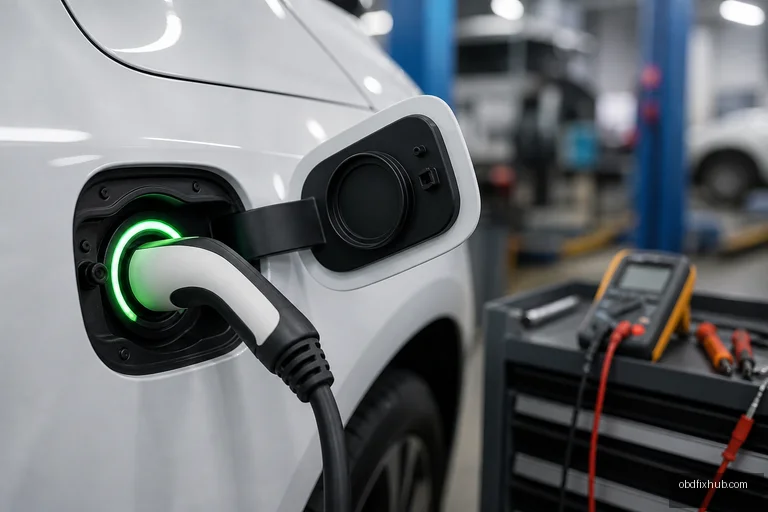
P0D2C means the vehicle has detected an open or malfunction in the Charge Status Indicator A control circuit. On an electric vehicle or plug-in hybrid, this circuit controls the lamp, LED, display message, or charging-status signal that tells you whether the vehicle is charging, fully charged, delayed, or unable to charge. The code does not automatically mean the high-voltage battery or onboard charger has failed; a broken low-voltage wire or faulty indicator can set it by itself.
What Does the P0D2C Code Mean?
P0D2C is a manufacturer-defined OBD-II powertrain code used primarily on EVs and plug-in hybrid vehicles. “Charge Status Indicator A” identifies a particular indicator circuit, while “control circuit/open” means the control module cannot see the expected electrical path or feedback signal.
The exact indicator and controlling module vary by vehicle. Depending on the model, the circuit may be managed by the battery energy control module, onboard charger, powertrain control module, body control module, or a dedicated charging controller. Always confirm the factory service information before replacing a part.
Symptoms of P0D2C
Some vehicles continue to charge normally even though the dashboard or charge-port indicator is not working. Others disable charging as a precaution if the control module cannot verify the status circuit. Common symptoms include:
- The charge-port light stays off or remains stuck on one color.
- The instrument cluster shows an incorrect or missing charging status.
- A warning message such as “Check EV System” or “Charging System Fault” appears.
- The vehicle charges intermittently or refuses to begin a scheduled charge.
- The battery reaches full charge, but the indicator does not change to the expected state.
- P0D2C returns immediately after clearing the code.
A useful field clue is whether the vehicle actually accepts charge. If charging is normal but the indicator is dark, the fault is more likely in the indicator, connector, wiring, or low-voltage driver circuit. If charging also fails, the indicator code may be secondary to a power, communication, pilot-signal, or onboard-charger problem.
Most Common Causes of the P0D2C Charge Status Indicator Fault
- An open, broken, or corroded wire between the control module and indicator.
- A loose terminal or water intrusion at the charge-port connector.
- A failed LED assembly, charge-port lamp, or instrument-cluster indicator.
- A blown fuse or missing low-voltage supply.
- A damaged driver transistor inside the charging or body control module.
- Incorrect terminal tension after previous charge-port or bumper repairs.
- Low 12-volt battery voltage causing abnormal module operation.
- Software calibration or communication problems after module replacement.
- Rodent damage, especially near the front charge port and wheel-well harness.
In practice, connector damage is often overlooked. A charge-port assembly can appear clean from the outside while moisture has migrated behind the seal and created high resistance or an open circuit at a small signal terminal.
How to Diagnose P0D2C Correctly
Diagnosis should begin with the low-voltage control side, not by dismantling the high-voltage battery. Use the vehicle-specific wiring diagram and a scan tool that can communicate with the EV or hybrid charging modules.
- Record all codes and freeze-frame data. Scan every module, not just the generic engine controller. Codes for low 12-volt voltage, lost communication, charging pilot faults, or onboard-charger failure may explain why P0D2C appeared.
- Check the 12-volt battery first. A weak auxiliary battery can create misleading EV faults. With the vehicle resting, compare the measured voltage with the manufacturer specification; do not rely on a visual battery inspection.
- Confirm the symptom. Test the charge indicator in several states if possible: vehicle off, connected to the EVSE, actively charging, and fully charged. Note whether the indicator is dark, fixed, or changing incorrectly.
- Inspect the charge-port area. Look for bent terminals, pushed-back pins, green corrosion, water tracks, damaged seals, and harness strain. Gently moving the harness while monitoring the indicator can reveal an intermittent open.
- Test power, ground, and continuity. With the circuit disabled as specified by the service manual, check for the required supply, ground quality, and continuity from the indicator to its control module. A continuity test alone is not enough; a wire can pass a basic test yet fail under load.
- Use scan-tool active tests. Many factory-level tools can command the charge-status lamp through different colors or states. If the module commands the lamp but the lamp does not respond, focus on the lamp and wiring. If the command is unavailable or the module reports an internal fault, follow the module diagnostic procedure.
- Clear and verify. After repair, clear the code and repeat a complete charging session. A brief key cycle is not a reliable confirmation because some controllers run the circuit test only when the vehicle is connected to an EVSE.
Important Safety Note for EV and Hybrid Owners
The charge-status indicator is usually a low-voltage circuit, but it is located beside high-voltage charging equipment. Do not unplug orange high-voltage connectors, open the onboard charger, or probe unknown terminals while the vehicle is connected to a charger. Follow the manufacturer’s disable procedure, wear the required personal protective equipment, and leave high-voltage isolation work to a qualified technician.
How Is P0D2C Repaired?
The repair depends on the failed part. A corroded terminal may require connector repair rather than a complete charge-port replacement. A broken harness should be repaired using the manufacturer-approved wire size, splice method, sealing materials, and terminal locations. If the LED or charge-port indicator has failed, replacing the indicator assembly may restore the system.
When the circuit tests correctly but the output remains absent, the charging control module or body module may be defective. Module replacement often requires software programming, configuration, immobilizer-related procedures, or calibration. Replacing an expensive onboard charger without testing the indicator circuit first is a common and costly misdiagnosis.
Can You Drive With P0D2C?
It may be possible to drive if the vehicle starts normally and the high-voltage system has not entered a safety shutdown. However, do not assume that charging is working simply because the vehicle drives. Verify the battery state through the instrument cluster and confirm that the vehicle completes a charging session before relying on it for longer travel.
If you see a red EV-system warning, charging is unavailable, the vehicle reports high-voltage isolation trouble, or the 12-volt system is failing, stop using the vehicle and arrange professional diagnosis. The indicator code itself may be minor, but it can coexist with a more serious charging fault.
Key Takeaway
P0D2C points to an open or malfunctioning Charge Status Indicator A control circuit, not automatically to a failed battery. Start with the 12-volt supply, stored module codes, connector condition, wiring continuity under load, and scan-tool output tests. Repair the verified fault, then confirm the result with a complete EV charging cycle. Because charging systems combine sensitive electronics with high voltage, a qualified EV technician is the safest choice when testing goes beyond the accessible low-voltage circuit.
Frequently Asked Questions
Is P0D2C a serious code?
It can be a simple indicator or wiring fault, but it may also appear with a charging-system or control-module problem. Its seriousness depends on whether the vehicle still charges correctly and whether other codes are present.
Will P0D2C stop my EV from charging?
Not always. Some vehicles continue charging with only the status lamp affected, while others disable charging when the controller cannot verify the circuit. Test the vehicle with the correct EVSE and check for related codes.
Can a weak 12-volt battery cause P0D2C?
Yes. EV and hybrid control modules depend on the 12-volt system for startup and communication. Low voltage can create false or secondary circuit codes, so the auxiliary battery and charging system should be tested before replacing the indicator.
Can I fix P0D2C by replacing the charge-port light?
Only if testing proves the light or LED assembly is defective. A damaged terminal, broken wire, fuse, control-module output, or software issue can produce the same code, so parts should not be replaced without circuit testing.
Do I need a special scan tool to diagnose P0D2C?
A basic code reader may display P0D2C, but a capable EV or hybrid scan tool is usually needed to access manufacturer-specific data, active tests, charging-module codes, and indicator commands.




