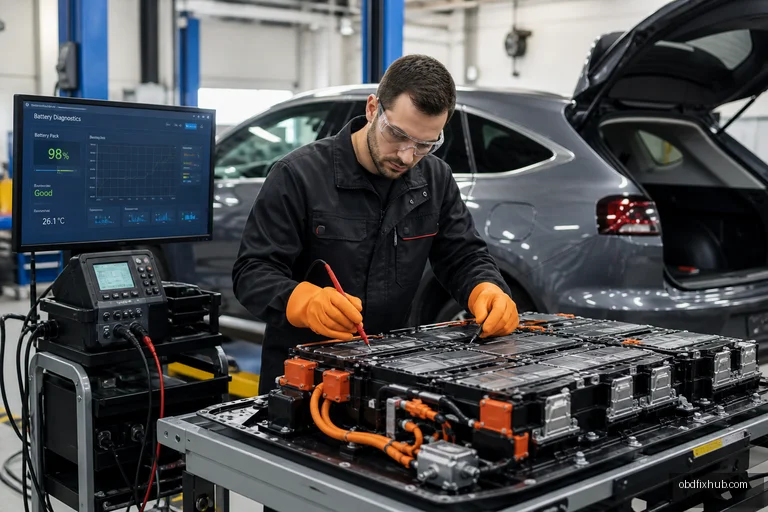
P0DAB Hybrid/EV Battery Cell Balancing Performance means the vehicle has detected that one or more high-voltage battery cells or cell groups are not balancing within the expected limits. The code does not automatically prove that the entire battery pack is bad. A weak cell group, inaccurate voltage sensing, wiring resistance, temperature problems, or a failed battery management component can all produce the same fault.
This is an informational troubleshooting guide, but high-voltage hybrid and EV batteries are not suitable for casual DIY testing. Proper diagnosis requires a capable scan tool, battery-specific data, and training in high-voltage safety.
What Does P0DAB Mean?
P0DAB is an OBD-II diagnostic trouble code associated with hybrid or electric vehicle battery cell balancing performance. The battery management system, commonly called the BMS, continuously compares the voltage of individual cells or monitored cell groups. If the difference remains outside the manufacturer’s permitted range during charging, driving, or balancing, the control module stores P0DAB.
Exact thresholds and test conditions vary by manufacturer. One vehicle may set the code after detecting a persistent voltage difference under load, while another may evaluate the pack during a controlled charging or balancing routine. For that reason, the factory service information and freeze-frame data are more useful than a universal voltage rule.
What Is EV Battery Balancing?
EV battery balancing is the process of keeping the cells in a high-voltage battery at closely matched states of charge. A battery pack contains many cells connected in series, yet the vehicle must treat them as one dependable energy source. The usable capacity of the entire pack is limited by the weakest or most-charged cell group, not by the average cell voltage.
For example, imagine a pack in which most cell groups are at 3.85 volts while one group reaches 4.08 volts during charging. The BMS may reduce or stop charging to protect that high cell group, even though the rest of the pack still has room. During acceleration, the reverse problem can occur: a weak group drops sharply in voltage and forces reduced power or a shutdown.
Passive and active balancing
- Passive balancing: small resistors bleed energy from higher-voltage cells, usually during charging or when the vehicle is parked.
- Active balancing: electronic circuits transfer energy from stronger cells to weaker ones. This is more complex and is used on some newer battery systems.
Balancing can correct a modest state-of-charge difference. It cannot restore lost capacity to a chemically degraded cell or repair a damaged busbar, sensor wire, or battery module.
Common Causes of P0DAB
A genuine weak cell group is one of the most common causes, especially in a pack with high mileage, repeated deep discharge, or long periods at extreme temperatures. Age-related capacity loss causes one group to charge and discharge differently from the others. The voltage may look normal at rest but separate dramatically under load.
- Cell or module capacity deterioration
- Incorrect state-of-charge estimation after a battery replacement or software event
- Loose, corroded, contaminated, or heat-damaged busbar connections
- Open or high-resistance voltage-sense wiring
- Faulty cell voltage monitoring board or battery junction electronics
- Uneven battery temperature caused by a blocked fan, duct, filter, or cooling circuit
- Failed balancing resistors or balancing control circuitry
- Battery software calibration issues or an uncompleted control-module update
- Moisture intrusion or internal battery damage
P0DAB Symptoms You May Notice
The first symptom is often a warning message such as Check Hybrid System, Service EV System, or Reduced Power. Some vehicles continue to drive normally at first, while others limit regenerative braking or engine assistance as soon as the BMS detects a persistent imbalance.
- Hybrid or EV warning light
- Reduced acceleration or limited EV-only operation
- Shorter electric driving range
- Unusually rapid state-of-charge changes on the dashboard
- Charging that stops early or takes longer than expected
- Cooling fan running loudly or more frequently
- Additional battery, isolation, temperature, or voltage-sensor codes
A single stored code with no symptom does not justify immediate battery replacement. The fault may have occurred during an abnormal temperature event, a low 12-volt battery condition, or a temporary communication failure. Always check whether the code is current, pending, or history, and review when it first appeared.
How to Diagnose P0DAB Correctly
- Scan every relevant module. Use a professional scan tool that can access the BMS, battery energy control module, inverter, charger, and hybrid control system. A basic engine-code reader may show P0DAB but hide the data needed to diagnose it.
- Record freeze-frame information. Note battery state of charge, pack current, cell-group voltage spread, temperatures, vehicle speed, and whether the event happened during charging, acceleration, or regeneration.
- Compare cell groups under different conditions. A weak group often looks acceptable at rest, then drops farther than the others during acceleration. A high group that rises quickly during charging points toward reduced capacity or increased internal resistance.
- Inspect the cooling system and connections. Check battery air inlets, filters, fans, ducts, connectors, and evidence of moisture or corrosion. Inspection of an opened high-voltage pack must be performed by a qualified technician.
- Verify the sensing circuit. If scan data shows one cell group behaving impossibly or jumping suddenly, test the sense harness, terminals, monitoring board, and reference grounds according to the service procedure.
- Perform the manufacturer’s balancing or capacity test. Many vehicles have a guided routine that charges, rests, discharges, and rechecks the battery. This test is more reliable than trying to infer pack health from one voltage reading.
One practical diagnostic clue is repeatability. If the same cell group is consistently the highest during charging and the lowest under load, suspect that module or cell group. If the reported high or low group changes randomly, investigate wiring, connectors, monitoring electronics, and temperature data before condemning the battery.
How to Balance Hybrid Battery Cells Safely
So, how do you balance hybrid battery cells? In a vehicle, balancing is normally commanded and monitored by the BMS. The safe repair process is to identify the imbalance, correct the underlying electrical or thermal fault, and then use the manufacturer’s charging or balancing procedure to confirm the result.
Do not connect a household charger directly to individual high-voltage cells, bypass the BMS, short busbars, or mix modules solely because their resting voltages appear similar. A cell can show a normal voltage with almost no usable capacity. Improvised balancing can cause arcing, thermal runaway, severe injury, or damage to the inverter and charger.
Typical repair paths
- Minor state-of-charge difference: complete a controlled balancing cycle with the correct charger and diagnostic equipment, then retest after a rest period.
- Cooling problem: clean or repair the fan, ducting, filter, temperature sensor, or cooling circuit before evaluating the pack again.
- Sense or connection fault: repair the approved harness, terminal, busbar, or monitoring component and verify readings under load.
- Weak module or cell group: replace it only when the manufacturer’s procedure permits module-level service, then balance, code, and capacity-test the pack.
- Multiple degraded groups: a professionally rebuilt or replacement battery may be more reliable than replacing one module at a time.
Can You Keep Driving With P0DAB?
That depends on the vehicle’s warning level and the other stored codes. If the vehicle displays a red high-voltage warning, severe power limitation, overheating message, smoke, unusual odor, or physical battery damage, stop driving and arrange professional recovery. Continuing to operate a battery with a rapidly deteriorating cell group can increase heat and leave the vehicle unable to restart.
For a mild, intermittent fault with no warning escalation, drive only as necessary and schedule diagnosis promptly. Avoid heavy acceleration, long high-load climbs, and charging in extreme heat until the battery has been tested.
Key Takeaway
P0DAB identifies a battery cell-balancing performance problem, not a guaranteed complete battery failure. The correct fix depends on whether the cause is a weak cell group, a sensing fault, poor cooling, failed balancing hardware, or a software and state-of-charge issue. Have the pack evaluated with manufacturer-level data before approving an expensive replacement, and never open or manually balance a high-voltage battery without the proper training and protective equipment.
Frequently Asked Questions
Is P0DAB always caused by a bad hybrid battery?
No. A deteriorated cell group is common, but wiring, voltage sensors, battery cooling, balancing circuits, software, and connector corrosion can create the same code. Diagnosis should compare live cell data and test the sensing system before replacing the pack.
Can a 12-volt battery cause P0DAB?
A weak 12-volt battery can create communication or initialization faults that complicate diagnosis, but it usually does not explain a repeatable cell-voltage imbalance by itself. Test the 12-volt battery and charging voltage, clear the codes, and confirm whether P0DAB returns under the specified conditions.
How long does hybrid battery balancing take?
A controlled balancing procedure may take several hours because the pack may need charging, resting, and repeated measurements. The total time depends on the vehicle, battery condition, charger, and whether a module or sensor fault must be repaired first.
Can I fix P0DAB by clearing the code?
Clearing the code only removes the stored record. If the cell voltage difference remains outside the permitted range, the BMS will set P0DAB again, often during the next charge or high-load event. Use clearing only after the cause has been tested and corrected.
Should I replace one battery module or the entire pack?
That decision requires capacity and resistance testing, not just a voltage comparison. One replaceable module may be appropriate in a serviceable pack, while several aged modules or a damaged monitoring system may make a professionally rebuilt or complete replacement pack the better long-term option.




