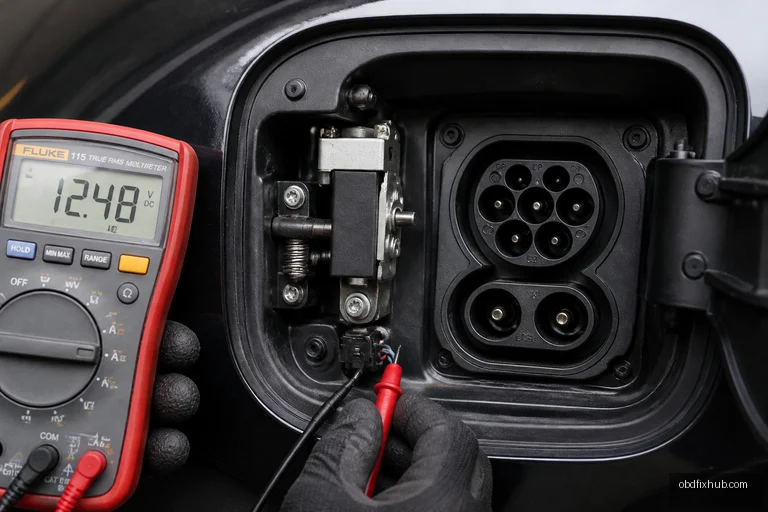
P0D91 Battery Charger Coupler Lock Control Circuit usually means the vehicle cannot verify that the charging connector lock is operating correctly. The fault may be an open wire, failed lock actuator, poor connector contact, blown fuse, or a missing lock-position signal. Charging may be refused because the vehicle must prevent the plug from being removed while high voltage is present.
This is primarily an informational and diagnostic search query: the code does not identify one universal replacement part. P0D91 is a manufacturer-defined powertrain code, so the exact test values and connector layout must come from the vehicle’s service information.
What Does P0D91 Mean?
The battery charger coupler is the charging inlet and connector assembly that links an external EV charger to the vehicle. A small electric actuator, solenoid, or motor locks the coupler in place, while one or more switches or position sensors tell the charging control module whether the lock is fully engaged.
P0D91 is set when the control module commands the coupler lock but detects an open or electrically implausible control circuit. In practical terms, the vehicle may see an interrupted power or ground path, excessive resistance, or no valid locked-position feedback.
- Control circuit: wiring, fuse, relay, driver circuit, actuator power and ground.
- Position feedback: lock or unlock switch, Hall sensor, or integrated position sensor.
- Charging logic: the onboard charger and charging control module that authorize current flow.
Do not confuse P0D91 with every charger-related trouble code. Codes such as P0D94 may refer to a different coupler-lock electrical condition, and the description can vary slightly by manufacturer. Always record the full scan-tool text, freeze-frame data, vehicle model, and charging system involved.
Common Symptoms of a P0D91 Fault
The most obvious symptom is a charging session that will not start. Some vehicles display a message such as Check charging system, Charging cable fault, or Unable to lock connector. Others appear to begin charging, then stop after the vehicle performs its connector-lock verification.
- The charge indicator stays amber or flashes red.
- AC charging is refused, while DC fast charging may also be disabled.
- The connector can be inserted but does not lock or release normally.
- The vehicle reports a charging fault immediately after the cable is connected.
- P0D91 returns shortly after being cleared.
- The 12-volt battery becomes weak because repeated charging attempts wake the control modules.
A connector that appears physically inserted is not necessarily electrically locked. Dirt, ice, a misaligned inlet, or a bent guide can prevent the actuator from reaching its expected position even when the plug looks correct from outside.
What Causes P0D91?
1. Damaged wiring or terminals
Wiring near the charging inlet is exposed to water, road salt, vibration, and repeated movement. A broken conductor inside the insulation can create an intermittent open circuit, particularly when the cable harness moves as the charging door opens. Loose, pushed-back, corroded, or overheated terminals can produce the same result.
2. Failed coupler-lock actuator
The lock motor or solenoid can seize mechanically or develop an internal open winding. A common field clue is a faint click without full engagement, or no sound at all when the vehicle attempts to lock the connector. Replacing the actuator without checking the harness can waste time because both failures produce similar symptoms.
3. Faulty lock-position sensor
Some inlet assemblies use a separate microswitch; others integrate the position sensor into the lock mechanism. If the switch remains stuck in the unlocked state, the control module may set P0D91 even though the actuator moves.
4. Fuse, power, ground, or control-module problem
A blown fuse, poor ground, damaged low-voltage supply, or failed output driver can stop the lock from operating. A low 12-volt battery can also cause misleading charging faults, especially after the vehicle has been parked for a long period.
5. Mechanical obstruction or environmental damage
Ice in the inlet, debris around the locking pin, a damaged charge-port door, or a connector that is not fully seated can prevent correct lock confirmation. Never force the plug or use metal tools to remove an obstruction from a live charging inlet.
How to Diagnose P0D91 Safely
High-voltage EV systems can cause fatal injury. The checks below concern the low-voltage control side and external inspection only. Do not open the battery pack, onboard charger, or high-voltage junction box unless you are trained, properly equipped, and following the manufacturer’s isolation procedure.
- Confirm the code. Use a scan tool that can access the EV charging and body control modules, not only generic engine data. Record current, pending, and history codes.
- Inspect the inlet. Look for moisture, corrosion, bent terminals, broken plastic guides, dirt, and a locking pin that is visibly out of position.
- Check the 12-volt battery. Low voltage can make an actuator and its feedback signal unreliable. Test battery condition and charging voltage rather than relying only on a dashboard warning.
- Test the lock command. With a suitable scan tool, command lock and unlock while listening for actuator operation and observing the lock-position data.
- Check the circuit under load. A continuity test alone may pass through a weak connection. Follow the wiring diagram and measure supply, ground voltage drop, and actuator resistance under the specified conditions.
- Inspect harness movement points. Gently flex the harness near the inlet while monitoring the signal. A reading that changes during movement strongly suggests an intermittent wire or terminal.
- Check service information. Manufacturer procedures may require a connector-lock initialization, inlet replacement, or software update after the physical repair.
A professional diagnosis should compare the commanded lock state with the actual feedback state. If the command is present but the actuator has no movement, investigate the actuator, power, and ground. If the actuator moves but the scan tool still shows unlocked, concentrate on the position sensor, alignment, and signal circuit.
How to Fix and Reset a P0D91 Fault
The correct repair depends on the failed part. Typical fixes include repairing a corroded terminal, replacing a damaged pigtail, restoring a ground, replacing the coupler-lock actuator, correcting inlet alignment, or replacing the complete charging inlet assembly. Some vehicles require a relearn procedure after an inlet or lock assembly is installed.
To reset the charger or charging system, stop the charging session, switch off the vehicle, disconnect the cable using the normal release procedure, and unplug the charging station from its AC supply if its instructions permit it. Wait several minutes for the control modules to shut down, reconnect the 12-volt supply only if the manufacturer procedure specifically allows it, and then attempt one fresh charging session.
That reset may clear a temporary communication or low-voltage event, but it will not repair an open circuit. Clear P0D91 with a capable scan tool only after testing and repairing the cause. If the code returns immediately, repeated resets are unlikely to help and may leave the vehicle unable to charge when its battery is low.
Why Does My LiPo Charger Say Connection Break?
A LiPo charger message such as connection break is usually unrelated to automotive DTC P0D91. It normally means the charger lost electrical contact with the battery or balance connector. Common causes include a loose main lead, damaged balance plug, wrong charging port, broken solder joint, incompatible battery mode, or a battery voltage outside the charger’s expected range.
- Disconnect power before inspecting the battery leads.
- Check the main connector and every balance-cell connection.
- Confirm the selected cell count and chemistry, such as LiPo rather than Li-ion or LiFe.
- Do not bypass a charger safety warning or continue with a swollen, punctured, hot, or damaged pack.
How Long Does a Battery Tender Take to Turn Green?
A Battery Tender or similar maintainer may turn green in a few minutes if the battery is already nearly full, but a deeply discharged battery can take several hours or longer. The indicator typically changes when the charger reaches its target voltage and switches from bulk charging to maintenance or float mode.
If it turns green immediately on a battery that should be discharged, the battery may have an internal fault, a poor terminal connection, or insufficient capacity. If it never turns green, check the polarity, clamps, fuse, 12-volt battery condition, and charger output. A maintainer is not a substitute for diagnosing a vehicle’s EV coupler-lock circuit.
When Should You Stop Driving and Seek Professional Help?
Do not continue charging attempts if the inlet smells burnt, becomes unusually hot, shows melted plastic, or has visible arcing damage. Arrange qualified EV service if the connector cannot be released, the vehicle repeatedly disables charging, or P0D91 appears with high-voltage isolation, battery, or onboard-charger codes.
Bottom line: P0D91 points to a failure in the low-voltage control or position-feedback circuit for the charging coupler lock. Inspect the inlet, verify the 12-volt supply, test the actuator and feedback circuit with the correct wiring diagram, repair the underlying fault, and then clear and retest the code.
Frequently Asked Questions
How do I reset my battery charger?
End the charging session, disconnect the cable normally, remove AC power according to the charger instructions, wait several minutes, and reconnect it. If the same fault returns, the system needs diagnosis rather than another reset.
What is the fault in the battery charging circuit?
With P0D91, the fault is specifically associated with the charging coupler-lock control or its position feedback. It may be an open wire, poor terminal, failed actuator, sensor, fuse, ground, or control-module output.
Why does my LiPo charger keep saying connection break?
The charger is losing contact with the battery or balance connector. Inspect the leads, balance plug, solder joints, cell-count setting, and battery condition, and never bypass the safety warning.
How long does it take for a Battery Tender to turn green?
It can take minutes for a nearly full battery and several hours for a deeply discharged one. An immediate green light on a weak battery can indicate a bad connection or a failing battery.




