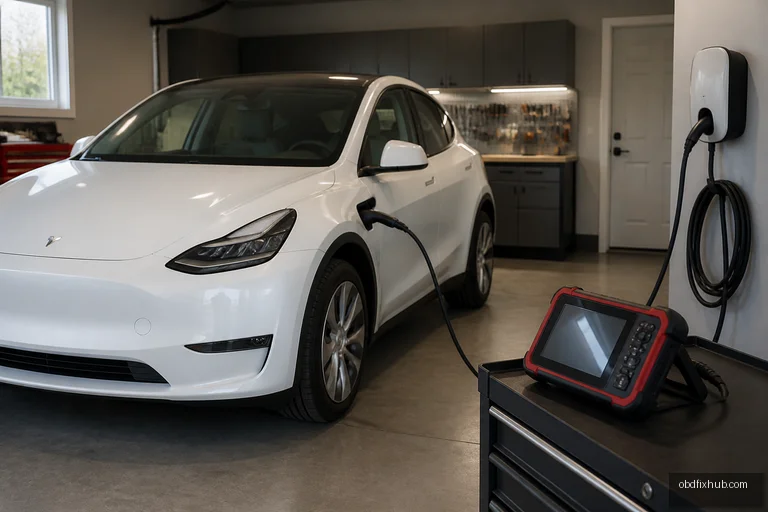
P0D90 Battery Charger Input Frequency Incorrect: Meaning, Causes, Symptoms & Fix
P0D90 means the vehicle’s onboard battery charger has detected an AC input frequency outside the range it expects. In most cases, the problem is related to unstable household power, an unsuitable charging supply, a failed charging cable or EVSE, or a fault inside the onboard charger. It is not normally caused by a weak 12-volt battery alone, and simply clearing the code will not repair the underlying problem.
What Does P0D90 Mean?
The P0D90 diagnostic trouble code translates to Battery Charger Input Frequency Incorrect. An electric or plug-in hybrid vehicle monitors the alternating-current power entering its onboard charger. That charger must receive a stable waveform at the expected frequency, usually 50 Hz or 60 Hz depending on the country and vehicle configuration.
If the charger sees a frequency that is too high, too low, intermittently missing, or badly distorted, it may stop charging and store P0D90. The vehicle can also disable charging as a safety measure because the onboard charger cannot reliably convert the incoming AC power into controlled DC power for the high-voltage battery.
Common Causes of P0D90
- Unstable mains electricity: A generator, poor-quality inverter, overloaded circuit, or damaged utility supply can produce incorrect frequency or waveform distortion.
- Incorrect charging equipment: A portable EVSE, extension lead, adapter, or wall-box installation may not be compatible with the vehicle or local electrical system.
- Damaged charging cable or connector: Heat damage, corrosion, loose terminals, and water intrusion can interrupt the charging pilot or power conductors.
- Faulty onboard charger: Its input filter, frequency-sensing circuit, relay, control board, or power electronics may be malfunctioning.
- Wiring or grounding problems: Loose neutral connections, poor grounding, reversed wiring, or an undersized circuit can make the charger reject otherwise normal power.
- Software or control-module errors: A charger-control module may incorrectly interpret valid input because of a calibration or communication problem.
Symptoms You May Notice
P0D90 often appears when the vehicle is connected to an AC charger rather than while driving. The most useful clue is whether the fault occurs at one charging location or everywhere. A vehicle that charges normally at a public station but fails at home points more strongly toward the home circuit, EVSE, or supply quality than toward the vehicle itself.
- AC charging stops shortly after it begins.
- The instrument cluster displays a charging-system or high-voltage warning.
- The charging indicator flashes or changes color.
- Charging starts and stops repeatedly.
- The vehicle refuses to schedule or initiate charging.
- P0D90 returns immediately after being cleared.
- The EVSE displays an input-power, grounding, or fault message.
How to Diagnose P0D90 Safely
High-voltage systems can cause severe injury or death. Do not open the onboard charger, dismantle the wall connector, or probe orange high-voltage wiring unless you are trained and properly equipped. The checks below are limited to external, low-risk observations.
- Record the conditions when the code set. Use a capable scan tool to save the freeze-frame data, charging voltage, battery temperature, and related codes. Codes concerning ground faults, pilot signals, isolation, or charger temperature may be more important than P0D90 itself.
- Try a known-good charging location. Use a properly installed public AC station or another verified EVSE. Avoid extension cords and inexpensive adapters during testing.
- Inspect the charging equipment. Look for melted plastic, bent pins, moisture, cracked insulation, unusual heat, or a loose connector. Stop using the equipment if it smells burnt or shows thermal damage.
- Check the electrical supply professionally. An electrician can verify voltage, frequency, neutral-to-ground conditions, grounding integrity, and the quality of the circuit under load. A basic voltage reading may look normal while the waveform is still unsuitable.
- Compare the result across chargers. Failure with several known-good EVSE units makes an onboard charger or vehicle-side wiring fault more likely. Failure with only one unit points toward that unit or its circuit.
- Re-scan after testing. If P0D90 returns immediately with a stable supply, the onboard charger’s sensing or control hardware requires manufacturer-level diagnosis.
How Do You Reset a Battery Charger?
For an EV, the safest basic reset is to stop the charging session, unlock and remove the connector, switch the vehicle off, wait several minutes, and reconnect it. Some EVSE units also have a dedicated reset procedure or circuit breaker reset described in their manual. Do not repeatedly cycle a breaker if it trips, becomes hot, or smells burnt.
A scan tool can clear P0D90 after the cause has been corrected. However, clearing the code before repairing unstable power or a defective charger usually provides only a temporary result. If the fault is active, the code may return as soon as AC charging begins.
Could an EGO Charger Be Bad?
EGO lawn-equipment chargers are separate from an EV’s onboard charger, so an EGO charger issue does not automatically explain P0D90 in a car. To assess an EGO charger, test it with a known-good, compatible EGO battery and try the battery in a known-good EGO charger. Clean and dry the contacts, confirm the outlet works, and check whether the cooling fan operates when charging starts.
A charger that fails with multiple compatible batteries, shows physical damage, overheats, or produces the same fault indication on a verified outlet may be defective. Do not bypass its temperature or battery-detection controls; use EGO service or warranty support instead.
Why Does My Schumacher Battery Charger Keep Turning On and Off?
A Schumacher charger that repeatedly starts and stops is often reacting to a condition it considers unsafe, rather than simply losing power. Common causes include a deeply discharged or sulfated battery, loose or corroded clamps, incorrect voltage-mode selection, reverse polarity, overheating, or a weak AC outlet.
- Confirm the charger is set for the correct battery voltage and chemistry.
- Clamp directly to clean battery terminals, not painted or heavily corroded surfaces.
- Try a known-good battery of the correct type.
- Allow the charger to cool and ensure its vents are unobstructed.
- Stop using it if the cable, plug, clamps, or case becomes excessively hot.
This behavior on a 12-volt Schumacher charger is not, by itself, evidence of an automotive P0D90 fault. P0D90 concerns the AC input-frequency monitoring of a vehicle charging system, while a Schumacher portable charger commonly cycles because of battery detection or protection logic.
What Does a Red and Green Blinking Charger Light Mean?
A red-and-green blinking light usually indicates a fault, battery-temperature issue, charging interruption, incompatible battery, or a communication problem between the charger and battery. The exact meaning is model-specific; color patterns are not standardized across EGO, Schumacher, and EV charging equipment.
Disconnect the battery or vehicle, inspect the contacts and connector for moisture or damage, and allow a hot battery to return to room temperature. Then consult the exact charger manual for the flash pattern. If the same pattern appears with a known-good battery or at a verified outlet, professional testing is more appropriate than repeatedly resetting the charger.
When Is P0D90 a Vehicle Repair?
If the car rejects charging at multiple reliable AC stations while DC fast charging still works, the onboard AC charger, its input filter, wiring, or control software becomes the primary suspect. A dealer or EV-qualified technician may need to perform live-data checks, insulation and ground tests, module software updates, and charger component testing.
Do not replace the high-voltage battery simply because P0D90 is present. In many cases, the battery is capable of charging and the fault is located upstream in the AC supply or onboard charger. The location-based comparison test is one of the fastest ways to avoid an unnecessary battery diagnosis.
Key Takeaway
P0D90 indicates that the onboard battery charger does not trust the frequency or quality of the incoming AC power. Start by comparing charging locations, inspecting the EVSE and connector, and having the supply tested under load. Clear the code only after the cause is corrected; if it returns on several known-good chargers, arrange an EV-qualified inspection of the vehicle’s onboard charger.
Frequently Asked Questions
Can a bad wall outlet cause P0D90?
Yes. A loose neutral, unstable supply, poor grounding, overloaded circuit, or generator with incorrect frequency can cause the onboard charger to reject the input. Have the circuit tested by a qualified electrician rather than relying only on a plug-in voltage tester.
Will disconnecting the 12-volt battery reset P0D90?
It may temporarily erase some module memory, but it is not a reliable repair and can create new warning lights or reset vehicle settings. Use the manufacturer’s reset procedure or a suitable scan tool after correcting the charging fault.
Can P0D90 prevent the vehicle from charging?
Yes. The vehicle may stop or refuse AC charging to protect the onboard charger and high-voltage battery. Charging may resume when a clean, correctly configured AC supply is detected.
Is P0D90 caused by a weak car battery?
Usually not directly. A weak 12-volt battery can create several unrelated communication or startup codes, but P0D90 specifically concerns the AC input detected by the high-voltage battery charger.
Should I keep using a charger that blinks red and green?
No. Treat the indication as a possible fault until the equipment manual identifies it. Stop charging if there is heat, odor, arcing, moisture, or visible damage, and test with approved equipment or contact the manufacturer.




