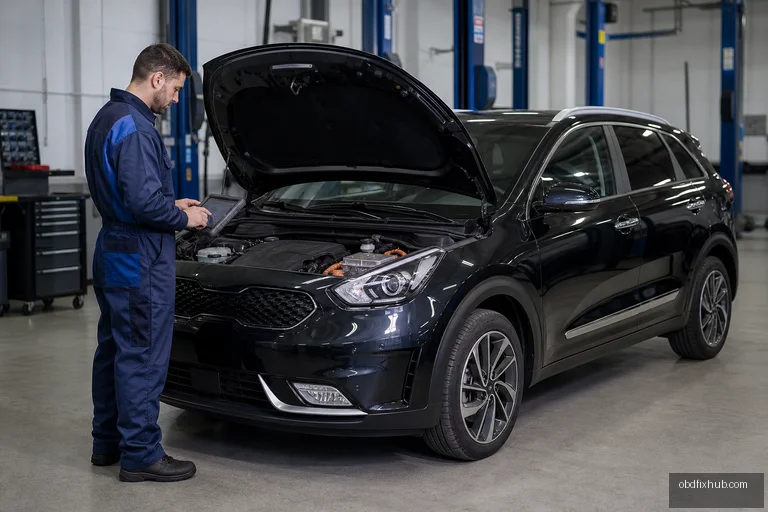
P0DFB Generator Position Exceeding Learn Limit means the hybrid control system cannot teach or calibrate the generator motor position within its permitted range. On Kia and Hyundai hybrids, this usually points to a generator position sensor, wiring, rotor/shaft alignment, actuator, software, or hybrid transmission problem—not a fault that should be ignored or cleared repeatedly.
This is an informational diagnostic guide for vehicles such as the Kia Niro Hybrid, Niro PHEV, Hyundai Ioniq Hybrid, and Sonata Hybrid. The exact repair depends on the vehicle’s model year, powertrain design, stored companion codes, and the results of a proper scan with manufacturer-level equipment.
What Does the P0DFB Code Mean?
The generator in a hybrid powertrain is an electric machine that can help start the engine, charge the high-voltage battery, and control engine speed. The hybrid control unit needs an accurate rotor-position signal to operate it safely and efficiently.
During a learn or calibration procedure, the control module compares the expected generator position with the actual feedback signal. P0DFB is stored when the measured position goes beyond the allowed learning limit. In practical terms, the module is saying: “I cannot reliably identify where the generator rotor is.”
The code does not automatically prove that the complete generator or hybrid transmission must be replaced. A damaged connector, weak 12-volt supply, incorrect assembly, metal debris, or a failed position sensor can create the same result.
Common Causes of P0DFB Generator Position Exceeding Learn Limit
- Generator position sensor or resolver fault: The sensor may produce an erratic, incomplete, or implausible signal.
- Damaged wiring or connector pins: Moisture, corrosion, loose terminals, or wiring rubbed against the transmission case can interrupt the low-voltage signal.
- Low or unstable 12-volt voltage: Hybrid calibration routines are sensitive to voltage drops. A weak auxiliary battery can cause failed learning even when the high-voltage battery is healthy.
- Generator or rotor mechanical damage: Bearing wear, shaft movement, internal damage, or foreign material can make the actual position differ from the learned value.
- Recent transmission, engine, or hybrid-system work: Incorrect installation, an unplugged connector, poor grounding, or a missed initialization procedure can trigger the code.
- Control-module software or calibration issue: A technical service update may be required in some model-year applications.
- High-voltage system isolation or inverter problems: Companion faults in the inverter, motor control unit, or high-voltage wiring may prevent the generator from completing its position test.
Symptoms You May Notice
P0DFB can appear with different symptoms depending on whether the failure is intermittent or permanent. Some vehicles still drive normally for a short time, while others immediately disable hybrid operation.
- Check Engine, Hybrid System, or “Check Hybrid System” warning
- Engine refusing to start or starting roughly
- Reduced acceleration and limited-power mode
- Higher fuel consumption because the vehicle cannot use electric assistance correctly
- Unusual whirring, grinding, or rattling from the hybrid transmission area
- Repeated 12-volt battery discharge caused by failed start-up attempts
- Inability to select READY mode or intermittent READY operation
A vehicle that displays a red hybrid warning, loses propulsion, smells of overheated electronics, or makes severe mechanical noise should be parked safely and recovered rather than driven to a workshop.
How to Diagnose P0DFB Correctly
Start by recording every code, not just P0DFB. Hybrid faults often appear as a chain: a low-voltage event or sensor problem may set several codes in the engine, hybrid control, inverter, and battery modules. Freeze-frame data can show whether the code occurred during engine starting, regenerative braking, charging, or a calibration attempt.
- Test the 12-volt battery under load. Resting voltage alone is not enough. Check voltage during ignition-on and READY-mode transitions, and inspect the battery terminals and body ground.
- Inspect the generator and hybrid transmission connectors. Look for oil contamination, water intrusion, bent pins, pushed-back terminals, and harness damage near brackets or sharp edges.
- Check service information and software updates. Use the correct procedure for the exact VIN; generic code descriptions cannot replace Kia or Hyundai service data.
- Review live data. Compare commanded generator position with actual position while performing the manufacturer’s active test or learn procedure.
- Perform insulation and circuit tests only as specified. High-voltage components can retain dangerous energy. Technicians need appropriate PPE, training, and a properly rated meter.
- Inspect mechanical components if electrical tests pass. If the position signal remains outside range, the generator, rotor, resolver, or hybrid transmission may need internal inspection.
One useful workshop clue is whether P0DFB returns immediately after clearing or only during the learn procedure. An instant return often favors a hard circuit or sensor fault. A code that appears after a warm-up, vibration, or repeated starting event may require a closer look at wiring, connector tension, or mechanical movement.
P0DFB Repair Options
Repair may be as simple as restoring a loose connector or replacing a weak 12-volt battery, but parts should not be changed based on the code alone. Depending on test results, the repair can include wiring repair, connector replacement, control-module software updating, a required generator position relearn, inverter service, or replacement of the generator/hybrid transmission assembly.
After the repair, the technician should clear codes, complete the official initialization procedure, confirm that the vehicle reaches READY mode, and road-test it through engine start, electric drive, regenerative braking, and battery charging. A code that stays cleared in the workshop but returns during a hot restart has not been fully resolved.
What Does the Kia Soul P04DF Code Mean?
P04DF is not the same code as P0DFB. P04DF is generally associated with the engine crankcase ventilation system being disconnected or not operating as expected. On a Kia Soul, possible causes include a disconnected or cracked PCV hose, a damaged crankcase ventilation component, an intake leak, wiring trouble, or an incorrect repair.
Because code definitions can vary by engine and model year, confirm P04DF with a Kia-capable scan tool and the vehicle’s service information. Do not replace hybrid generator components for P04DF unless additional testing identifies a separate hybrid fault.
Common Problems With the Kia Niro PHEV
The Niro PHEV can experience issues involving the 12-volt battery, charging equipment, charge-port communication, hybrid warning lights, engine management, and dual-clutch transmission behavior. Some faults are software-related, while others result from battery age, moisture in connectors, poor charging connections, or missed maintenance.
A PHEV that will not start may have a low 12-volt battery even when the high-voltage traction battery shows charge. Charging faults can also be caused by the wall outlet, portable charging cable, charge-port lock, onboard charger, or a control-module communication problem. Scan all modules before assuming the main battery pack has failed.
How Do I Reset the 12V Battery in a Kia Niro Hybrid?
The Niro does not normally “reset” the 12-volt battery itself. Many models have a 12V Battery Reset button, usually located near the driver’s side lower dashboard. With the vehicle safely parked, press the button, then press the brake pedal and attempt to start the vehicle so it enters READY mode. Once READY, the vehicle’s charging system can replenish the 12-volt battery.
The reset button reconnects or temporarily enables the 12-volt supply; it does not repair a battery that is sulfated, discharged, or internally damaged. If the vehicle shuts down again, test the battery, check for parasitic drain, and inspect the charging system. Avoid repeatedly pressing the button without diagnosing why the battery went flat.
What Could Cause the Check Engine Light on a Kia Niro?
Possible causes range from a loose fuel cap, EVAP leak, oxygen-sensor or ignition fault, and emissions problem to hybrid motor, inverter, battery, or generator-position issues. A flashing Check Engine Light requires immediate attention because continued driving may damage the catalytic converter or leave the vehicle without propulsion.
Read the codes before disconnecting the battery. Clearing them can erase valuable freeze-frame information and may not solve the underlying problem. For P0DFB specifically, use a hybrid-capable diagnostic tool and treat any related high-voltage warning as a priority.
Frequently Asked Questions
Can I drive with P0DFB stored?
If the vehicle drives normally and the warning is yellow, arrange diagnosis promptly and avoid long trips or heavy loads. Do not drive if propulsion is reduced, the hybrid warning is red, READY mode is unavailable, or abnormal mechanical noise is present.
Will disconnecting the 12-volt battery clear P0DFB?
It may erase temporary codes in some modules, but it does not repair the fault. The code will return if the generator position signal remains outside its permitted range, and important diagnostic data may be lost.
Does P0DFB always mean the hybrid battery is bad?
No. P0DFB concerns generator position learning. The auxiliary battery, wiring, resolver, inverter, software, or generator mechanics may be responsible. Proper testing is essential before condemning the high-voltage battery.
Can a generic OBD2 scanner diagnose P0DFB?
A basic scanner may display the code, but it often cannot access hybrid live data, active tests, software updates, or position-learning functions. A Kia- or Hyundai-capable diagnostic system is normally required.
Bottom Line
P0DFB means the hybrid system cannot learn the generator’s position within the allowed limit. Begin with a complete code scan and a proper 12-volt battery test, then inspect wiring, connectors, software, and live generator-position data before replacing expensive hybrid components. If high-voltage work or internal generator inspection is required, use a technician trained and equipped for Kia and Hyundai hybrid systems.




