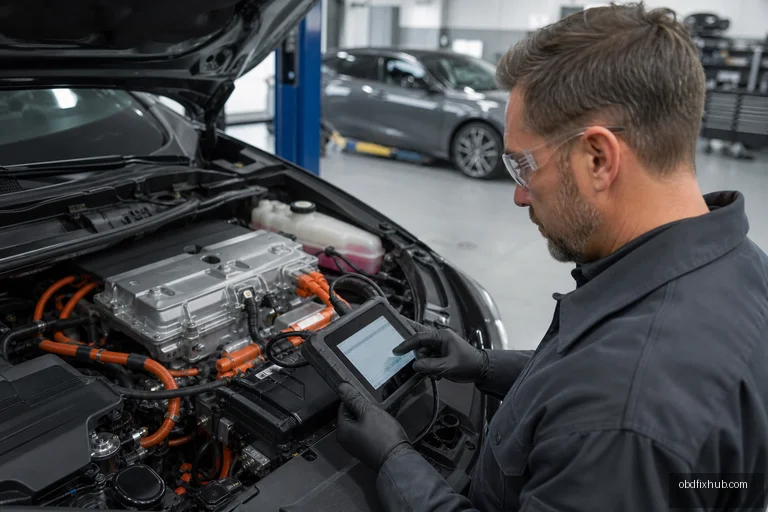
P0DFA Generator Phase Current Sensor Correlation: Meaning, Causes, Symptoms & Fix
P0DFA Generator Phase Current Sensor Correlation means the vehicle’s control system has detected an implausible relationship between phase-current measurements inside the hybrid or electric powertrain generator circuit. In practical terms, the inverter is seeing current signals that do not agree with one another or with the torque and voltage it has commanded. The fault may be caused by a current sensor, wiring, inverter electronics, software, or an underlying generator problem—not automatically by the generator itself.
This is an informational diagnostic code, but it can involve high-voltage components. A qualified technician should perform any test that requires opening the inverter, disconnecting orange high-voltage cables, or working near the hybrid battery.
What Does P0DFA Mean?
A hybrid or electric powertrain generator uses multiple electrical phases to create and control magnetic torque. Current sensors monitor those phases so the inverter can regulate motor-generator operation accurately. The powertrain control module compares the sensor signals with expected values, including rotor position, commanded torque, DC-link voltage, and the other phase currents.
P0DFA is stored when those readings fail a correlation check. For example, one phase may report substantially more or less current than the other phases under the same operating condition. A signal can also become implausible only during acceleration, regenerative braking, high temperature, or a specific range of generator speed.
The exact component names and test thresholds vary by manufacturer. Always use the service information for the specific vehicle rather than assuming that every P0DFA code follows the same repair procedure.
Common Symptoms of P0DFA
The vehicle may continue to drive when the fault is intermittent, but the control system can reduce electric power to protect the inverter and generator. Common symptoms include:
- Hybrid system, EV system, or powertrain warning message
- Reduced acceleration or a restricted-power mode
- Engine running more often than normal because electric assistance is limited
- Loss of regenerative braking or reduced battery charging while driving
- Warning lights such as the check-engine light or master system warning
- Whining, vibration, or abnormal generator operation in some cases
- A no-start condition if the system detects an unsafe or severe inverter fault
A code that appears only after the vehicle becomes hot is especially significant. Heat can increase resistance in a damaged connector, expose a cracked solder joint, or cause an electronic sensor to drift beyond its calibrated range.
Most Likely Causes of P0DFA Generator Phase Current Sensor Correlation
1. Defective phase-current sensor
Current sensors may be integrated into the inverter assembly or mounted around the generator phase conductors. A sensor that is biased, noisy, or intermittently open can produce a correlation failure even when the generator windings are healthy.
2. Damaged wiring or terminals
Low-voltage sensor circuits can be affected by corrosion, loose terminal tension, water intrusion, chafing, or poor ground connections. A connector may look clean externally while its female terminals have lost tension and open briefly under vibration.
3. Inverter or power electronics failure
The inverter supplies and interprets the phase-current signals. Internal gate-driver faults, damaged signal-conditioning circuits, thermal damage, or an unstable internal power supply can create incorrect sensor correlation. Replacing the generator without testing the inverter will not correct this type of fault.
4. Generator winding or insulation damage
A shorted winding, phase imbalance, mechanical damage, or insulation breakdown can make the actual phase current differ from the expected value. This is more likely when P0DFA appears with generator performance, insulation, overcurrent, or inverter temperature codes.
5. Software, calibration, or power-supply problems
Low 12-volt voltage during startup, a poor ground, interrupted programming, or outdated control-module software can create implausible sensor data. Check for battery and communication faults before condemning expensive hybrid hardware.
How to Diagnose P0DFA Correctly
- Record all codes and freeze-frame data. Note generator speed, commanded torque, battery state of charge, inverter temperature, vehicle speed, and whether the code occurred during acceleration or regeneration. Related codes often identify the direction of the fault.
- Check the 12-volt system first. Verify battery condition, charging voltage, grounds, and power feeds. A weak auxiliary battery can produce several misleading hybrid-control codes.
- Inspect the low-voltage sensor harness. Look for fluid contamination, rodent damage, rubbed insulation, bent pins, corrosion, and terminals pushed backward in the connector. A gentle harness movement test while monitoring live data can reveal an intermittent connection.
- Review live phase-current data. With the scan tool, compare the three phase signals at key-on, during low-load operation, and under controlled acceleration if the manufacturer permits it. A fixed offset in one channel suggests sensor or circuit bias; a deviation that follows load may indicate a power-stage or winding problem.
- Test circuits against the wiring diagram. Measure reference voltage, sensor ground, signal integrity, and continuity using the manufacturer’s specified method. Do not apply arbitrary resistance values to a sensor circuit; some sensors are Hall-effect devices and cannot be diagnosed like simple coils.
- Perform high-voltage tests only with approved equipment. Insulation resistance, phase-to-phase checks, and inverter testing require the correct scan tool, service plug procedure, personal protective equipment, and wait time for capacitors to discharge.
- Confirm the repair. Clear the code, complete the required drive cycle, and verify that phase-current signals remain consistent during the operating condition that originally triggered P0DFA.
P0DFA Repair: What Usually Fixes It?
The repair depends on the failed test. A corroded terminal may require connector repair and moisture protection. A damaged sensor harness may need replacement and correct routing away from heat and vibration. If the sensor is integrated into the inverter, the manufacturer may specify inverter replacement rather than replacing the sensor separately.
A generator replacement is justified only when testing confirms winding imbalance, mechanical damage, or an internal generator fault. Likewise, an inverter should not be replaced solely because P0DFA is present. Before installing a costly assembly, confirm the sensor power, ground, signal behavior, software level, and related fault codes.
Can You Drive With P0DFA?
Short-distance driving may be possible when the vehicle has normal power and the warning is intermittent, but it is not advisable to ignore the code. Continued operation under reduced or incorrect current control can place additional stress on the inverter and generator. Stop driving and arrange professional inspection if there is a severe power reduction, burning smell, unusual electrical noise, overheating message, or a warning that instructs you to stop safely.
Key Takeaway
P0DFA Generator Phase Current Sensor Correlation is a plausibility fault involving generator phase-current feedback. The fastest accurate diagnosis comes from analyzing freeze-frame data and live phase signals, then checking the sensor circuit, inverter, generator, and 12-volt supply in that order. Because the system may contain lethal high voltage, use factory procedures and a trained hybrid technician for component-level testing.
Frequently Asked Questions
Is P0DFA caused by a bad alternator?
Usually, no. In hybrid applications, “generator” generally refers to a motor-generator controlled by an inverter, not a conventional 12-volt alternator. The exact terminology depends on the vehicle manufacturer.
Can a weak 12-volt battery trigger P0DFA?
Yes. Low 12-volt voltage can corrupt startup checks and communication between control modules. Test the auxiliary battery and its grounds before replacing high-voltage components.
Does P0DFA always mean the inverter must be replaced?
No. Wiring, connector tension, sensor bias, software, power supply, and generator winding faults can all produce the code. Inverter replacement should follow confirmed circuit and component testing.
Can I clear P0DFA with an OBD scanner?
You can clear the stored code with a compatible scanner, but it will return if the fault remains. Some hybrid systems also require a manufacturer-specific reset or drive cycle after repair.




