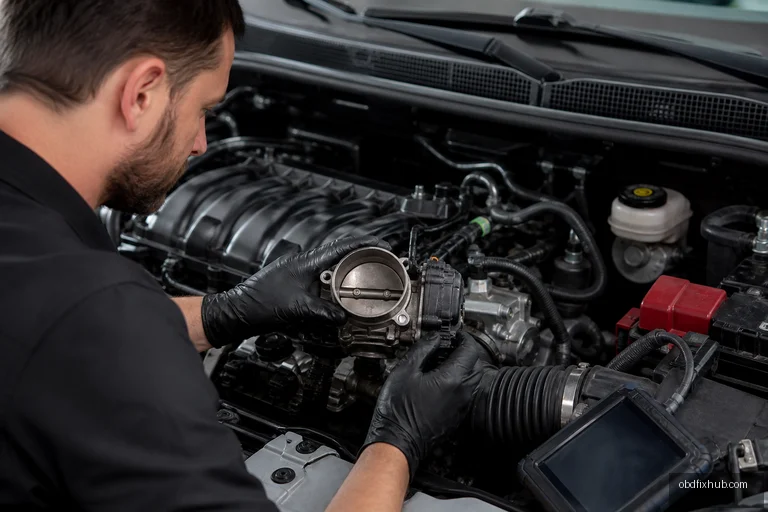
P2110 Throttle Actuator Forced Limited RPM Mode: Meaning, Causes, Symptoms & Fix
P2110 means the engine computer has deliberately limited engine speed because it detected a problem in the electronic throttle control system. The code itself usually describes the vehicle’s protective response, not the failed component. You may still be able to move the vehicle, but reduced power, poor acceleration, or an unstable throttle can make driving unsafe, especially in traffic or when merging.
What Does P2110 Mean?
P2110 is a generic OBD-II trouble code defined as Throttle Actuator Control System – Forced Limited RPM. Modern vehicles use an electronic throttle body rather than a traditional cable. The powertrain control module (PCM) compares throttle-pedal position, throttle-plate position, motor operation, voltage, and other sensor signals many times per second.
When those signals do not agree, the PCM may enter a fail-safe strategy. It limits the throttle opening or maximum engine speed to prevent unintended acceleration and reduce the risk of engine or transmission damage. On many vehicles, P2110 appears alongside a more specific code such as P2101, P2111, P2112, P2135, or a throttle-pedal sensor code. That companion code is often the real starting point for the repair.
P2110 Symptoms You May Notice
The exact behavior varies by manufacturer and by the fault that triggered the protective mode. A vehicle with P2110 may show several of these symptoms:
- Check Engine light and an electronic throttle or wrench warning light
- Reduced engine power or a message such as “Reduced Power”
- Engine speed limited to a fixed range, often around 1,500–3,000 RPM
- Very slow acceleration, hesitation, or no response from the accelerator pedal
- Rough idle, stalling, or difficulty restarting
- Throttle opening that does not match accelerator-pedal movement
- Intermittent symptoms that disappear after cycling the ignition
An important diagnostic clue is whether the engine runs normally for a few minutes before the problem returns. Heat-sensitive wiring, a failing throttle motor, or an internal sensor track can work when cold and fail after the engine compartment warms up.
Common Causes of the P2110 Code
P2110 can be caused by an electronic, mechanical, wiring, or power-supply problem. Replacing the throttle body immediately is not always the correct fix.
- Dirty or sticking throttle plate: Carbon deposits can prevent the plate from reaching its commanded position.
- Failed electronic throttle body: The actuator motor or built-in throttle-position sensors may have an internal fault.
- Accelerator-pedal position sensor failure: Conflicting pedal signals can cause the PCM to limit throttle operation.
- Damaged wiring or loose connectors: Oil contamination, water intrusion, corrosion, and broken wires near the throttle body are common real-world findings.
- Low system voltage: A weak battery, failing alternator, or poor ground can create implausible throttle signals during cranking or operation.
- PCM software or control fault: Some vehicles require a software update, throttle relearn, or manufacturer-specific calibration.
- Air-intake or mechanical interference: A damaged air filter housing, foreign object, or bent throttle plate can restrict movement.
How to Diagnose P2110 Correctly
A professional diagnosis should identify the code that caused the forced limited RPM mode. Clearing P2110 without finding that cause may restore normal operation temporarily, but the vehicle will usually enter limp mode again.
- Scan every module and record freeze-frame data. Note engine speed, battery voltage, coolant temperature, throttle position, and the exact moment the code set. Do not erase codes before saving this information.
- Check for companion codes. Sensor correlation, throttle motor, pedal position, and low-voltage codes are often more useful than P2110 itself.
- Inspect the throttle connector and harness. Look for bent terminals, green corrosion, pulled wires, oil inside the connector, or harness damage where it contacts the engine or air-intake duct.
- Verify battery and charging voltage. A battery that drops excessively during cranking can produce misleading electronic throttle faults. Check grounds and voltage drops, not just open-circuit battery voltage.
- Compare live data. Accelerator-pedal sensor tracks should change smoothly and consistently. Actual throttle position should follow commanded position without sudden dropouts or disagreement between sensor tracks.
- Inspect the throttle plate. With the ignition off, follow the manufacturer’s procedure. Do not force an electronic throttle plate by hand unless the service information specifically permits it.
- Perform the required relearn. Cleaning or replacing a throttle body may require an idle learn, throttle-position learn, or scan-tool initialization. The procedure differs substantially between makes and models.
A useful workshop tip is to perform a gentle harness wiggle test while monitoring throttle-position data. If the signal jumps when the connector or harness moves, the fault is probably electrical rather than a dirty throttle plate.
How Do You Fix a P2110 Code?
The correct repair depends on the confirmed cause. A repair may involve cleaning the throttle bore with an approved throttle-body cleaner, repairing a damaged wire, replacing a corroded connector terminal, fixing a poor engine ground, replacing the accelerator pedal assembly, or installing a new throttle body.
After the repair, clear the codes only after recording the diagnostic information. Complete the required relearn procedure, start the engine, and verify that commanded and actual throttle positions agree. A road test should include idle operation, light acceleration, and a controlled higher-load check while monitoring live data. If P2110 returns immediately, replacing parts at random is likely to increase the cost without solving the problem.
Is P2110 a Costly Fix?
The cost ranges from minor to substantial because P2110 identifies a system response rather than one guaranteed failed part. A loose connector, wiring repair, or throttle cleaning may cost relatively little. A complete electronic throttle body, accelerator pedal assembly, software update, or diagnostic labor can cost considerably more depending on the vehicle.
- Low-cost possibilities: connector repair, wiring repair, cleaning, battery, or ground correction
- Moderate-cost possibilities: accelerator-pedal sensor or throttle-body replacement
- Higher-cost situations: difficult wiring faults, dealer programming, repeated relearn procedures, or PCM-related repairs
Before authorizing a throttle-body replacement, ask for the stored companion codes, test results, and the relearn requirement. This is the simplest way to avoid paying for a component that was never proven faulty.
Can You Drive With a P2110 Code?
Only drive as far as necessary to reach a safe location or repair facility if the vehicle has severe power loss, an unresponsive accelerator, stalling, surging, or unstable idle. A car that cannot accelerate predictably is dangerous at intersections, on highways, and during overtaking. If the engine will barely move the vehicle, use a tow truck.
If the car is running smoothly and has only stored a pending code, a short, low-speed trip may be possible, but it is not a guarantee of safety. Avoid heavy traffic, steep hills, and highway merging. The fault can progress without warning, even if cycling the ignition temporarily restores normal throttle response.
Can You Still Drive With a Throttle Actuator Malfunction?
Sometimes, but the vehicle may be operating in a deliberately restricted limp-home mode. The throttle actuator controls engine airflow, so a malfunction can affect acceleration, idle stability, and the ability to maintain speed. Treat the warning as a control and safety problem rather than a minor Check Engine light.
If the throttle warning light is flashing, the engine is surging, or the pedal has little or no effect, stop driving as soon as it is safe. Do not rely on repeatedly turning the ignition off and on; that may reset the symptom without correcting the underlying fault.
Frequently Asked Questions
Is P2110 caused by a bad throttle body?
It can be, but P2110 alone does not prove the throttle body has failed. A wiring fault, accelerator-pedal sensor, low battery voltage, dirty throttle plate, or software issue can produce the same limited-RPM strategy.
Will disconnecting the battery fix P2110?
Disconnecting the battery may clear temporary symptoms, but it does not repair the underlying fault. It can also erase useful freeze-frame data and reset vehicle settings, so proper diagnosis should come first.
Does cleaning the throttle body always clear P2110?
No. Cleaning helps when carbon buildup prevents smooth plate movement, but it will not repair a failed actuator motor, internal position sensor, damaged wiring, or a faulty pedal sensor. A relearn may also be required after cleaning.
How long can I drive with P2110?
There is no reliable time or mileage limit. If power is reduced or throttle response is abnormal, drive only to a safe place or repair shop, preferably by tow. A vehicle that currently feels normal can enter limited mode again without warning.
Bottom Line
P2110 tells you that the PCM has forced the engine into limited-RPM operation to protect the vehicle after detecting an electronic throttle-control problem. Start with all stored codes, battery voltage, connectors, wiring, and live sensor data before replacing parts. If acceleration is unpredictable or the engine is stalling, stop driving and have the system diagnosed promptly.




