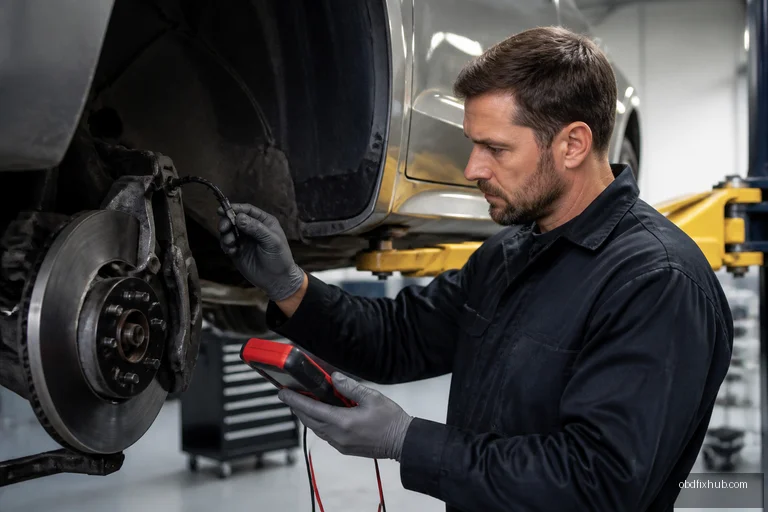
P215A Vehicle Speed and Wheel Speed Correlation means the vehicle’s computer has detected that the reported vehicle speed does not agree with one or more wheel-speed signals. The most common causes are a failed wheel-speed sensor, damaged wiring, a cracked tone ring, mismatched tires, or an inaccurate vehicle-speed signal. You may still be able to drive briefly, but ABS, traction control, stability control, cruise control, and sometimes transmission shifting may be affected.
What Does the P215A Code Mean?
The P215A diagnostic trouble code is set when control modules compare vehicle speed with individual wheel speeds and find a mismatch outside the expected range. Depending on the vehicle, the comparison may be performed by the ABS module, powertrain control module (PCM), transmission controller, or a network of these modules.
A modern vehicle does not rely on only one speed signal. Wheel-speed sensors measure the rotation of each wheel, while the vehicle-speed value may be calculated from those sensors or supplied through another sensor and the CAN communication network. If one signal suddenly says the vehicle is traveling at 40 mph while another indicates 15 mph, the system may store P215A.
Although the code is often described as “generic,” the exact diagnostic strategy varies by manufacturer. Always check the service information for the specific year, engine, drivetrain, and ABS system before replacing parts.
Common Symptoms of P215A
Some drivers notice only a warning light, while others experience several electronic systems operating in a fallback mode. Typical symptoms include:
- ABS, traction control, or electronic stability control warning lights
- Check Engine Light or a service vehicle message
- Inoperative cruise control or speed limiter
- Speedometer fluctuations, an inaccurate reading, or a speedometer that drops to zero
- Harsh, delayed, or unusual automatic transmission shifts
- Traction control activating unexpectedly at low speed
- Loss of ABS or stability-control intervention during braking
- Additional network or wheel-speed sensor trouble codes
A particularly useful clue is when the fault appears after driving through heavy rain, washing the vehicle, replacing a wheel bearing, or fitting new tires. Those events often expose damaged wiring, incorrect sensor air gaps, or a disturbed tone ring.
Most Likely Causes of the P215A Code
1. Failed wheel-speed sensor
Each wheel-speed sensor produces a signal that allows the ABS module to calculate wheel rotation. A sensor can fail internally, become contaminated with metal debris, or lose its signal when hot. Passive magnetic sensors and active Hall-effect sensors require different tests, so a generic resistance check is not valid for every vehicle.
2. Damaged wiring or electrical connectors
Wiring near the steering knuckle and wheel hub is exposed to water, salt, vibration, and repeated flexing. A conductor may break inside insulation while appearing normal from the outside. Green corrosion in a connector, a loose terminal, or wiring stretched during suspension work can create an intermittent P215A that is difficult to reproduce in the workshop.
3. Damaged tone ring or encoder ring
The sensor reads a toothed reluctor ring or a magnetic encoder built into a wheel bearing. Missing teeth, rust swelling, a cracked ring, or a bearing installed backward can distort the signal. On many vehicles, the encoder is part of the bearing, meaning the sensor itself may test correctly even though the wheel-speed waveform is wrong.
4. Tire or wheel mismatch
Different tire diameters can make one wheel rotate at a different speed from the others. A temporary spare, severely uneven tire wear, incorrect tire size, or substantially different tire pressures may trigger a correlation fault. This is less likely to create a major mismatch by itself, but it should be checked before expensive parts are installed.
5. Vehicle-speed signal, ABS module, or network fault
The wheel sensors may be working while the vehicle-speed signal is corrupted by a transmission output-speed sensor, instrument cluster issue, PCM problem, or CAN-bus communication fault. An ABS module fault is possible, but it should be considered only after power, ground, wiring, sensor signals, and mechanical components have been verified.
How to Diagnose P215A Correctly
Replacing the sensor named in a scan-tool description is not a complete diagnosis. In real repairs, the fastest approach is to compare live data and inspect the mechanical signal path.
- Scan every module. Read ABS, PCM, transmission, and body-control modules, not just generic engine codes. Note which wheel, if any, has its own fault code and whether communication codes are also present.
- Compare live wheel-speed data. During a slow road test, all four wheel-speed readings should rise smoothly and remain close to one another. A reading that stays at zero, drops out, or jumps while the other three remain stable identifies the circuit that needs attention.
- Inspect the tire and hub assembly. Confirm matching tire sizes, reasonable pressures, correct wheel bearing installation, and the absence of excessive bearing play or damaged tone-ring teeth.
- Inspect the sensor harness. Follow the cable from the hub to its connector. Look for rubbing against the tire, stretched sections, broken retaining clips, water intrusion, and terminals pushed backward inside the plug.
- Test the signal, not only resistance. A professional may use a multimeter, oscilloscope, or dedicated ABS tester. An oscilloscope is especially useful because it can reveal a weak, noisy, or missing waveform that a resistance test cannot find.
- Check module power, ground, and network data. If several wheels show implausible readings at the same time, a common power, ground, CAN-bus, or module problem is more likely than four failed sensors.
After the repair, clear the codes and perform a controlled road test. Some vehicles will not complete the ABS self-test until they exceed a minimum speed, while others require steering-angle or yaw-rate calibration after related repairs.
Can You Drive With a Bad Wheel-Speed Sensor?
You may be able to drive the vehicle, but it is not equivalent to driving normally. If a wheel-speed sensor fault is active, the ABS module may disable anti-lock braking, traction control, and electronic stability control. Conventional hydraulic braking may still work, but the vehicle can lock its wheels during an emergency stop, especially on wet, icy, or loose surfaces.
Drive only far enough to reach a repair facility if the pedal feels normal, no red brake warning is present, and the vehicle behaves predictably. Avoid high speeds, hard braking, towing, and slippery roads. Stop driving and arrange a tow if the brake pedal is soft, the vehicle pulls while braking, multiple red brake warnings appear, or the speedometer and transmission are behaving erratically.
How Long Can You Drive With a Bad Vehicle Speed Sensor?
There is no reliable mileage limit. A vehicle may continue for weeks with a minor intermittent fault, or it may lose ABS and stability functions immediately after the warning appears. The safe answer is to treat the fault as a repair-needed condition rather than a countdown based on miles.
Driving longer can also create secondary problems. For example, an incorrect speed signal may affect automatic transmission shift timing, cruise control, adaptive systems, or the ability to complete emissions readiness monitors. If the fault is intermittent, record when it occurs—on turns, over bumps, in rain, or after the vehicle warms up—to help the technician reproduce it.
What Happens When a Wheel-Speed Fault Is Set in the ABS Module?
The ABS module usually stores the fault, turns on the ABS warning lamp, and disables the affected control functions or switches them to a limited backup strategy. Depending on the vehicle, traction control, stability control, hill-start assist, automatic emergency braking, and adaptive cruise control may also be unavailable.
The module may continue receiving data from the other wheels, but it cannot accurately determine wheel slip if one signal is missing or implausible. This is why a vehicle can feel normal during gentle braking while still lacking critical safety assistance in an emergency.
Wheel-Speed Sensor Replacement Cost
The cost to replace a damaged wheel-speed sensor commonly falls between $150 and $450 for parts and labor on many mainstream vehicles. The actual price depends on sensor location, labor rates, accessibility, brand, and whether the sensor is sold separately from the hub or bearing.
- Sensor only: often about $40–$180 for the part, plus labor.
- Integrated hub or wheel bearing: commonly $250–$700 or more, depending on the vehicle.
- Wiring repair: approximately $100–$400 when the harness is accessible; extensive harness damage can cost more.
- ABS module or network diagnosis: potentially $150–$300 before parts, programming, or module replacement.
These are planning ranges, not a quote. Ask whether the estimate includes diagnostic time, calibration, code clearing, and a post-repair road test. A low-cost sensor can become an expensive repair if the real problem is a rusted encoder ring or a damaged wheel bearing.
Practical Repair Advice
Do not replace all four wheel-speed sensors simply because the ABS light is on. Identify the sensor whose live data disagrees, then verify its wiring and the tone ring before ordering a part. Aftermarket sensors can work well, but poor-quality units sometimes produce an incorrect amplitude or air-gap signal even when newly installed.
If the fault began immediately after a wheel bearing, axle, brake, or suspension repair, inspect that work first. A pinched harness, incorrectly routed cable, missing sensor shield, or bearing installed with the encoder facing away from the sensor is often the real cause.
Summary: What to Do About P215A
P215A indicates a disagreement between vehicle speed and wheel-speed information, not automatically a failed sensor. Start with a full-module scan, compare live data, inspect tires and hub components, and test the wiring and signal waveform before replacing parts. Because ABS and stability control may be disabled, arrange a prompt diagnosis and limit driving until the system has been repaired and road-tested.
Frequently Asked Questions
How serious is the P215A code?
It can be serious because ABS, traction control, and stability control may not operate. The vehicle may still have basic braking, but its emergency braking performance and stability assistance can be reduced.
Can a bad wheel bearing cause P215A?
Yes. Excessive bearing play can change the sensor air gap, while a damaged or incorrectly installed magnetic encoder can produce an invalid wheel-speed signal. In those cases, replacing only the sensor will not solve the problem.
Will changing a wheel-speed sensor clear the code?
Not always. The code may need to be cleared with a scan tool, and some vehicles will turn the warning off only after a successful self-test. If the underlying wiring or tone-ring fault remains, P215A will return.
Can mismatched tires trigger P215A?
Yes, especially when tire diameters differ significantly because of a temporary spare, incorrect tire size, or severe wear. Check all four tire sizes, pressures, and tread depths before diagnosing electronic components.




