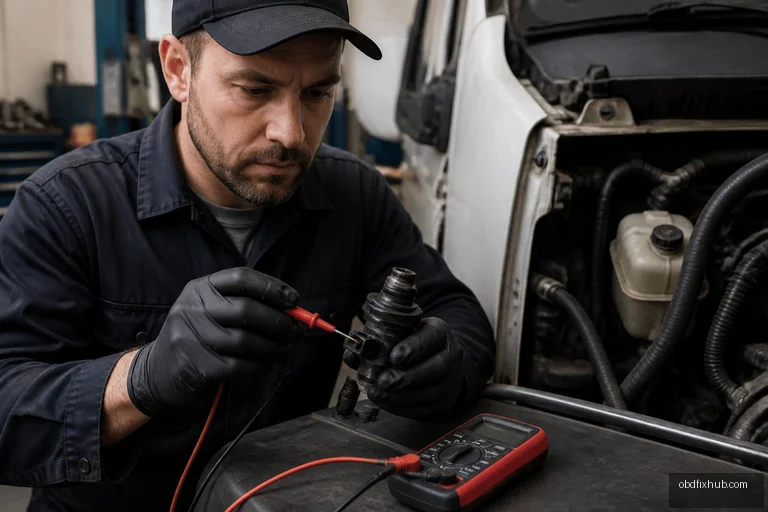
P2170 Exhaust Pressure Regulator Vent Solenoid Circuit Low means the engine control module has detected lower-than-expected voltage or electrical performance in the exhaust pressure regulator vent solenoid circuit. In practice, the fault is usually caused by a damaged wire, poor connector, failed solenoid, blown fuse, or a control-side problem—not automatically by a blocked exhaust system.
This is an information-seeking fault code, but it should not be ignored. The exhaust pressure regulator can influence exhaust backpressure, diesel warm-up, emissions control, turbocharger behavior, or DPF regeneration, depending on the vehicle. The exact component and repair procedure vary by make, model, engine, and calibration.
What Does P2170 Mean?
The exhaust pressure regulator is a valve or flap that changes exhaust flow to create or release backpressure. Its vent solenoid controls a vacuum actuator or regulates air pressure within the system. When the PCM or ECM sees a circuit voltage that remains too low, it stores P2170 and may turn on the check engine light.
The word circuit low is important. It usually points to an electrical condition such as a short to ground, a solenoid coil drawing excessive current, or a missing power supply. It does not, by itself, prove that the exhaust valve is physically stuck.
P2170 Symptoms You May Notice
- Check engine light or service engine warning
- Reduced engine power or limp mode
- Slow turbo response or unusual boost behavior
- Hard starting, rough running, or extended warm-up on some diesel engines
- Failed or interrupted DPF regeneration
- Higher exhaust emissions or increased fuel consumption
- Unusual hissing near vacuum hoses or the exhaust control assembly
Some vehicles show only the warning light and drive normally. Others reduce torque as a protective strategy. A useful real-world clue is when P2170 appears alongside DPF, turbocharger, exhaust pressure, or actuator-position codes. Those companion codes can reveal whether the electrical fault is creating a secondary airflow problem.
Common Causes of P2170
- Failed exhaust pressure regulator vent solenoid
- Shorted control wire or wire rubbed through against the engine or exhaust
- Corroded, loose, oil-contaminated, or heat-damaged connector
- Blown fuse or missing ignition-feed voltage
- Broken vacuum hose or incorrectly routed hose, where the system uses vacuum control
- Exhaust regulator valve binding because of carbon, soot, or corrosion
- Blocked vent filter or contaminated solenoid passage
- Faulty engine control module or an outdated calibration
Heat is a frequent but overlooked cause. A harness may look intact from above while its insulation has hardened and split beside the turbocharger, exhaust manifold, or DPF. Moving the harness while monitoring the scan tool or multimeter can reproduce an intermittent fault that a visual inspection misses.
How to Diagnose P2170 Correctly
1. Check all stored codes and freeze-frame data
Start with a full vehicle scan, not just a basic code reader. Record engine speed, coolant temperature, battery voltage, and vehicle speed when P2170 was set. If low system voltage or multiple actuator codes are present, test the battery and charging system before replacing parts.
2. Identify the exact component
Use the vehicle-specific wiring diagram and service information. On one engine, the vent solenoid may be mounted near a vacuum reservoir; on another, it may be integrated into an exhaust backpressure assembly. Do not confuse it with an EGR solenoid, turbo wastegate control valve, or differential pressure sensor simply because the parts are located close together.
3. Inspect the connector and harness
Disconnect the solenoid and look for green corrosion, pushed-back terminals, moisture, melted plastic, and loose pin tension. Trace the wiring toward the exhaust system, paying particular attention to areas where a retaining clip has broken. A quick resistance check across the terminals is useful, but compare the reading with the manufacturer’s specification; a generic “good” resistance value is not reliable for every design.
4. Verify power, ground, and control
With the ignition on, confirm that the solenoid receives its expected supply voltage. Then test the ground or PCM-controlled side with a load, not only with a high-impedance meter. A circuit can show voltage with no load and still fail when the solenoid is commanded on. A test light or suitable load tool can expose excessive resistance in the supply or ground path.
5. Use an actuator test
Many professional scan tools can command the exhaust pressure regulator or its vent solenoid. Listen for a distinct click and observe whether the vacuum signal or valve position changes. If the command is present but the valve does not move, inspect the vacuum supply and mechanical linkage. If there is no electrical response, return to the circuit tests before condemning the ECM.
How to Fix P2170
The correct repair depends on what the tests reveal. Common repairs include replacing a heat-damaged connector, repairing a shorted harness, installing a new vent solenoid, replacing a split vacuum hose, or cleaning and freeing a carbon-bound exhaust regulator. Afterward, clear the code and complete a drive cycle that includes the operating conditions shown in the freeze-frame data.
Do not force an exhaust valve by hand if the actuator is connected to a delicate position sensor. Do not bypass the solenoid with a permanent jumper, either. That may remove the warning temporarily while creating incorrect exhaust backpressure, failed regeneration, or turbocharger control problems.
Is It Safe to Drive With P2170?
Short trips may be possible if the engine runs normally and no red warning lights, overheating, smoke, or severe power loss are present. However, continued driving is risky on a diesel that is attempting or failing DPF regeneration. Stop driving and arrange diagnosis promptly if the vehicle enters limp mode, produces excessive smoke, loses boost, or displays a DPF or overheating warning.
P2170 Repair Cost
Cost varies significantly by vehicle and access. A wiring repair or vacuum hose may be relatively inexpensive, while a solenoid or complete exhaust regulator assembly can cost substantially more because of labor and restricted access. The most expensive mistake is replacing the valve before testing the fuse, power supply, connector, and control wire.
Ask the repair shop for the measured supply voltage, solenoid resistance, control-circuit test results, and actuator-test outcome. Those details show whether the diagnosis is evidence-based rather than a parts-swapping exercise.
Key Takeaway
P2170 identifies a low electrical condition in the exhaust pressure regulator vent solenoid circuit. Begin with a complete code scan, battery-voltage check, wiring inspection, and circuit measurements. Confirm the solenoid’s operation with an actuator test before replacing the component, and use the manufacturer’s wiring diagram because P2170 hardware differs widely between vehicles.
Frequently Asked Questions
Can a bad fuse cause P2170?
Yes. A blown fuse or missing ignition-feed voltage can make the solenoid circuit appear electrically low. Always test the fuse under load and determine why it failed before installing a replacement.
Is P2170 the same as an EGR fault?
No. The exhaust pressure regulator and EGR system can affect one another, but they are different systems. Correct component identification from the vehicle’s wiring diagram is essential.
Can I replace only the P2170 solenoid?
Sometimes. If the solenoid is a separate serviceable component and the valve moves freely, replacing only the solenoid may solve the problem. If the solenoid is integrated into the regulator assembly, the complete unit may be required.
Will clearing P2170 fix the problem?
No. Clearing the code only removes the stored fault temporarily. If the low-voltage condition remains, the code and warning light will return, often during the next actuator test or drive cycle.




