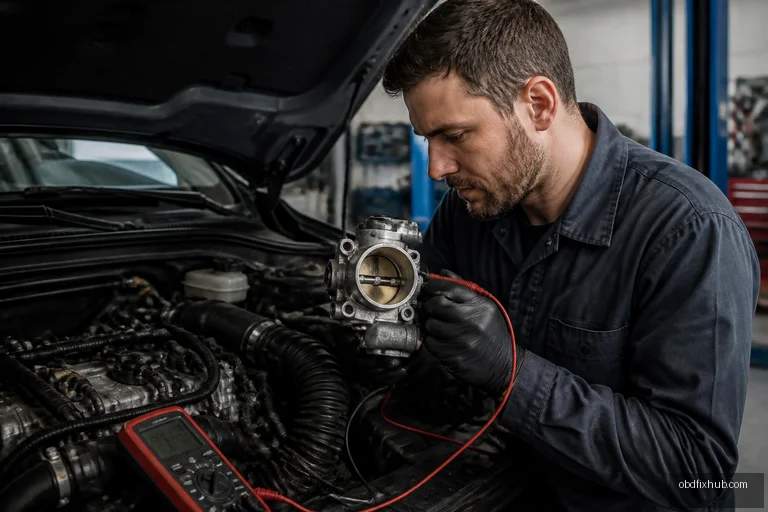
P2176 Electronic Throttle Idle Position Not Learned means the engine computer has not successfully identified the throttle body’s closed or minimum air position. The most reliable fix is to check battery voltage, wiring, throttle-body contamination, and related fault codes before performing an electronic throttle relearn with a suitable scan tool. If the relearn fails, the throttle body, connector, power supply, or PCM may need further testing.
What Does P2176 Mean?
Modern engines use an electronic throttle control system instead of a traditional accelerator cable. The accelerator pedal sends a driver-demand signal, while a motor inside the throttle body moves the throttle plate. Position sensors report the plate angle back to the powertrain control module (PCM).
When the ignition is switched on, the PCM needs to know the throttle plate’s minimum or idle position. It learns this position by comparing sensor signals and, on many vehicles, briefly moving the plate through a programmed range. Code P2176 is stored when that minimum position is missing, implausible, or cannot be learned within the manufacturer’s limits.
The exact wording varies by manufacturer. On some vehicles, P2176 is described as Minimum Throttle Position Not Learned or Throttle Actuator Control System Idle Position Not Learned. It does not automatically prove that the throttle position sensor itself is defective.
P2176 Symptoms You May Notice
The car may still start and run, but the PCM can enter a reduced-power or limp-home mode to prevent unintended acceleration. Symptoms depend on whether the fault is intermittent or permanent.
- Check Engine Light or electronic throttle warning light
- Rough, high, or unstable idle
- Engine stalling when coming to a stop
- Slow, limited, or completely unresponsive accelerator pedal
- Reduced engine power and restricted RPM
- Hard starting or an engine that starts only with the accelerator released
- Surging, hesitation, or inconsistent throttle response
A useful diagnostic clue is the timing. If P2176 appeared immediately after a weak battery, battery replacement, throttle-body cleaning, or electrical repair, a lost learned value or interrupted relearn is more likely than a suddenly failed PCM.
Common Causes of P2176
- Low system voltage: A weak battery, poor ground, or charging problem can interrupt throttle initialization. During a relearn, voltage that drops too far may cause the procedure to fail.
- Carbon buildup: Deposits around the throttle plate can change the amount of air entering at the closed position. This is especially common on high-mileage engines or vehicles with oil vapor contamination.
- Failed throttle body: The integrated position sensors, actuator motor, or internal electronics may be worn or out of range. Many vehicles do not use a separately replaceable throttle position sensor.
- Damaged wiring or connectors: Loose terminals, water intrusion, corrosion, and harness damage near the throttle body can create intermittent sensor readings.
- Air leaks or engine modifications: A major intake leak, incorrectly installed intake tube, or aftermarket throttle component can prevent the expected idle conditions.
- Unresolved related codes: Accelerator pedal position, throttle actuator, reference-voltage, or communication codes may need to be repaired first.
- PCM software or memory issue: Some models require a software update or a specific factory scan-tool routine after throttle-body replacement.
How to Diagnose P2176 Properly
Do not begin by replacing the throttle body simply because the code mentions throttle position. A professional diagnosis starts with all stored and pending codes, freeze-frame data, and the battery condition.
- Check voltage first. With the engine off, a healthy fully charged battery is typically near 12.6 volts. With the engine running, charging voltage is commonly around 13.5 to 14.8 volts, although specifications vary. Test voltage during the relearn, not just before it.
- Inspect the throttle connector and harness. Look for bent pins, green corrosion, oil contamination, broken locking tabs, and wires stretched tightly against the intake.
- Inspect the intake tract. Confirm that the air duct is sealed and correctly fitted. A disconnected duct can allow unmetered air and may cause symptoms that look like a throttle fault.
- Check the throttle plate. Heavy black deposits around the bore can interfere with the learned stop position. Follow the vehicle service manual before cleaning; some electronic throttle bodies can be damaged by forcing the plate open or spraying cleaner into the motor housing.
- Use live data. Compare commanded throttle angle with both throttle-position sensor signals. The values should change smoothly and agree with the manufacturer’s expected relationship. A drop-out, sudden jump, or implausible fixed reading points toward a sensor, wiring, or throttle-body problem.
- Perform the specified relearn. Use a bidirectional scan tool whenever the manufacturer requires one. Clear the code only after recording diagnostic information, then verify whether it returns during initialization or a road test.
How Do You Fix Code P2176?
The repair depends on the failed part or condition. In a common real-world case, a vehicle develops P2176 after its battery has been disconnected. The battery tests good, the throttle connector is clean, and a scan-tool idle-position relearn completes successfully. In that situation, no throttle-body replacement is needed.
If the plate is dirty, clean it with an appropriate throttle-body cleaner and a lint-free cloth while following the service procedure. Do not use aggressive carburetor cleaner unless the manufacturer permits it, and do not scrape the coating from the throttle bore. After cleaning, the learned minimum position usually must be reset.
If the throttle position signals are erratic, the actuator does not respond, or the relearn repeatedly fails with correct voltage and wiring, replacement of the complete throttle body may be necessary. Some manufacturers require programming, an idle learn, or an accelerator-pedal calibration after installation. Always use the vehicle-specific procedure rather than assuming that one generic sequence fits every car.
How Do I Reset the Electronic Throttle?
A scan tool reset is the safest and most repeatable method. The menu may be named Throttle Valve Closed Position Learning, ETC Relearn, Idle Learn, or Minimum Throttle Position Reset. Battery voltage must remain stable, and the accelerator pedal should not be pressed unless the instructions specifically say so.
Some vehicles support a manual key-cycle procedure, but the steps differ significantly. A typical sequence may involve turning the ignition on without starting, waiting for throttle initialization, switching the ignition off, and then allowing a short key-off period. This is not universal, and using the wrong timing can leave the fault unchanged.
Never repeatedly disconnect the battery as a substitute for diagnosis. It may erase useful adaptive data without correcting a failed sensor, damaged wire, or mechanical restriction. Also, do not force an electronic throttle plate by hand unless the service information explicitly permits it.
How Long Does a Throttle Position Sensor Take to Relearn?
The actual electronic learning routine often takes less than five minutes. Allow approximately 10 to 30 minutes for the full process, including battery stabilization, ignition cycles, engine warm-up, and a verification drive. Some vehicles complete the relearn automatically after a few normal drive cycles; others require a professional scan tool.
If the relearn does not complete after several attempts, stop repeating it. A persistent failure usually indicates a mechanical, electrical, voltage, or software problem rather than a need for more waiting.
Can You Still Drive With a Bad Throttle Position Sensor?
Driving is not recommended when P2176 causes reduced power, stalling, unpredictable acceleration, or an unresponsive pedal. The vehicle may lose the ability to accelerate safely in traffic, merge, or climb a hill. If the light is flashing, the engine is stalling, or throttle response is abnormal, have the vehicle towed or drive only the minimum distance needed for professional diagnosis.
If the car runs normally and the code is pending, a short trip to a repair facility may be reasonable, but avoid high-speed roads and heavy traffic. A code that appears intermittently can become a permanent limp-mode event without warning.
Frequently Asked Questions
Is P2176 caused by a bad throttle position sensor?
It can be, but not always. Low voltage, carbon buildup, wiring faults, a failed throttle actuator, or a lost learned value can produce the same code. Testing live data and performing the correct relearn prevents unnecessary parts replacement.
Will clearing P2176 fix the problem?
Clearing the code only removes the stored fault temporarily. If the throttle position still cannot be learned, P2176 will return during the next key cycle, start-up, or drive cycle.
Can a weak battery trigger P2176?
Yes. A battery that drops voltage during starting or throttle initialization can interrupt the learning routine. Check the battery, terminals, engine grounds, and alternator before condemning the throttle body.
Does every car need a scan tool for a throttle relearn?
No. Some vehicles have a manufacturer-approved manual procedure, while others require a bidirectional scan tool. The correct answer depends on the year, engine, and manufacturer service information.
What should be repaired first if other codes are present?
Address power-supply, reference-voltage, accelerator-pedal, communication, and throttle-actuator codes first. These faults can prevent P2176 from completing its learning routine even when the throttle body is mechanically sound.
Bottom Line
P2176 means the PCM has not learned a reliable electronic throttle idle position; it is not a diagnosis of one specific part. Start with voltage, grounds, connectors, intake leaks, and throttle-body condition, then perform the vehicle-specific relearn. If the code returns, use live data and wiring tests before replacing the throttle body. Repair the fault promptly, especially if power is limited or the accelerator response is unpredictable.




