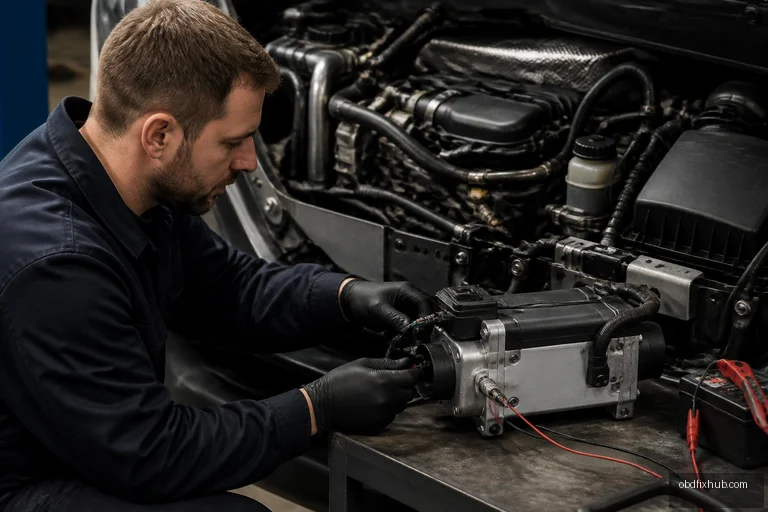
P23CE fuel heater control module feedback performance means the engine computer is receiving a feedback signal from the diesel fuel heater system that is missing, implausible, or outside the expected range. In practice, the fault is usually caused by a weak power or ground connection, damaged wiring, a failing fuel heater, or a control module that cannot correctly monitor heater operation. Clearing the code may turn the warning light off temporarily, but it will not repair the underlying fault.
What Does P23CE Mean?
P23CE is an OBD-II fault code associated with the fuel heater control module and its feedback performance. Diesel vehicles use a fuel heater to warm diesel fuel in cold conditions, often around the fuel filter housing or fuel supply circuit. Warming the fuel helps prevent waxing, restriction, hard starting, and fuel starvation during winter operation.
The control module does more than switch the heater on. It monitors current draw, temperature, voltage, and confirmation feedback. If the commanded heater operation does not match the signal reported back to the engine control module, P23CE may be stored.
The exact component layout and diagnostic thresholds vary by manufacturer. A Ford, Mercedes-Benz, Ram, Chevrolet, or commercial diesel may use a different heater design, so the vehicle-specific wiring diagram and service information should always take priority over a generic code definition.
Common Symptoms of P23CE
Some vehicles set P23CE without obvious drivability symptoms, particularly when ambient temperatures are mild. The problem becomes more noticeable when the vehicle needs fuel heating during cold starts or sustained winter driving.
- Check Engine Light or diesel system warning message
- Hard starting or extended cranking in cold weather
- Rough running immediately after startup
- Loss of power under load
- Engine hesitation or intermittent fuel starvation
- Reduced fuel economy in severe conditions
- A diesel fuel heater that switches on and off repeatedly
- Additional low-voltage, heater circuit, or communication codes
A useful field clue is temperature dependence. If the vehicle starts and drives normally at 20°C but develops hesitation at -10°C, the heater circuit deserves more attention than an injector fault. That pattern does not prove the heater is defective, but it helps prioritize the diagnosis.
What Causes P23CE Fuel Heater Control Module Feedback Performance?
1. Low supply voltage or poor ground
Fuel heaters draw significant current. A battery that appears acceptable at rest can drop below the required voltage during cranking or heater activation. Corroded ground points, loose battery terminals, and high-resistance connections can also cause the module’s feedback signal to become unreliable.
2. Damaged wiring or connector corrosion
The harness near a fuel filter, frame rail, or underbody is exposed to water, salt, vibration, and diesel contamination. Look for rubbed insulation, green corrosion in terminals, pushed-back pins, and wiring stretched tightly around the filter housing. A connector may look clean externally while having poor terminal tension internally.
3. Failed fuel heater element
The heater element can become open-circuit, shorted, or internally intermittent. An open element usually produces no current draw, while a partial short may blow a fuse or cause the control module to shut the circuit down for protection. Do not condemn the heater from resistance alone; compare the measured value with the manufacturer’s specification and test it at the connector.
4. Defective fuel heater control module
The module may fail to provide the correct output, interpret the heater’s feedback incorrectly, or lose communication with the engine controller. Module replacement should not be the first step. Confirm power, ground, fuse integrity, wiring continuity, and the heater load before installing an expensive control unit.
5. Fuel filter restriction or water contamination
A severely restricted fuel filter can imitate a heater problem by causing poor fuel delivery in cold weather. Water in the filter can freeze and block supply, while waxed diesel can restrict flow even when the heater itself is functioning. Inspect the filter condition and fuel quality as part of the diagnosis, not as an unrelated maintenance item.
How to Diagnose and Fix P23CE
- Scan all modules, not only the engine ECU. Record P23CE and any accompanying voltage, communication, fuel pressure, or heater codes. Freeze-frame data may show whether the fault occurred during a cold start, low battery voltage, or active heater command.
- Check the battery and charging system. Test battery voltage under load and verify alternator output. A weak battery can create misleading heater feedback faults, especially during a cold morning start.
- Inspect the fuse, relay, connector, and ground. Use a voltage-drop test while the heater is commanded on. A continuity test with the circuit switched off may show a good wire even when it cannot carry current under load.
- Test the heater circuit. Measure resistance only against the service-manual specification. Check for an open circuit, short to ground, and abnormal current draw. If the vehicle supports bi-directional controls, command the fuel heater on and monitor actual versus requested feedback.
- Check live data and the feedback wire. Depending on the design, feedback may be a voltage signal, a digital message, a current estimate, or a temperature-related value. A scope or suitable scan tool can reveal a signal that drops out when the harness is moved.
- Repair the confirmed fault. Replace damaged terminals rather than merely spraying them with contact cleaner. Repair rubbed wiring properly, restore the ground connection, replace the heater or filter assembly when specified, and program or initialize a new module if the manufacturer requires it.
- Clear the code and perform a cold-condition road test. The system may not complete its self-test until the engine is cold and the heater is requested. Confirm that the code does not return and that fuel pressure and drivability remain stable.
One practical diagnostic mistake is testing the heater with a random external power source. Some modern systems use pulse-width control or module supervision, so bypassing the original circuit can damage the component or produce a misleading result. Follow the wiring diagram and test procedure for the specific vehicle.
How Do I Reset a Diesel Heater?
There are two different systems people commonly call a “diesel heater.” A fuel heater attached to the engine’s diesel supply normally resets when the fault is repaired and the diagnostic code is cleared with an OBD scanner. Disconnecting the battery may erase temporary adaptations on some vehicles, but it is not a reliable repair and can create radio, window, security, or emissions-system issues.
A separate diesel parking heater may enter a lockout after repeated failed starts. That system is reset through its own controller, fuse procedure, diagnostic software, or manufacturer-specific sequence. Do not repeatedly cycle it if the combustion chamber is flooded or the exhaust is blocked. Inspect the fuel supply, glow plug, combustion-air intake, exhaust, battery voltage, and overheat protection first.
Is It Safe to Drive With a P20B9 Code?
P20B9 is not the same fault as P23CE. P20B9 generally refers to the reductant heater “A” control circuit, commonly associated with the DEF or AdBlue system, while P23CE concerns a diesel fuel heater control feedback problem. P20B9 often indicates an open circuit, although the precise definition can vary by manufacturer.
The vehicle may continue to drive with P20B9, but ignoring it is risky because cold DEF can freeze and the emissions system may eventually trigger a warning countdown or engine restart restriction. Driving a short distance to a repair facility is usually reasonable if there is no severe warning, overheating, fuel leak, or major drivability problem. Arrange diagnosis promptly rather than treating the code as harmless.
Where Is the Reductant Heater “A” Control Circuit Located?
The reductant heater “A” circuit is usually located around the DEF tank, reductant pump, heated DEF lines, or the electrical connector supplying the tank-mounted heater. On some vehicles the heater is integrated into the DEF tank module; on others, separate heated lines and control components are used.
Look underneath the vehicle for the DEF tank, normally identified by a blue filler cap or a dedicated filler neck. Trace the harness from the tank and inspect connectors for road-salt corrosion, broken clips, water intrusion, and wiring damaged by exhaust heat. The exact “A” circuit pin and component must be confirmed with the vehicle wiring diagram because manufacturers label heater circuits differently.
My Diesel Heater Keeps Cutting Out—Why?
A heater that starts and then cuts out commonly has insufficient voltage, excessive current draw, poor fuel delivery, overheating protection activation, or an intermittent feedback signal. In an engine fuel-heater system, pay particular attention to battery voltage, the heater connector, fuel filter restriction, and wiring movement near the filter housing.
In a parking heater, cutting out after one to three minutes often points to failed flame detection, blocked combustion air or exhaust, weak glow-plug operation, low fuel pump delivery, or low battery voltage. Note exactly when it stops: immediate shutdown suggests power or control problems, while shutdown after ignition suggests combustion or flame-monitoring problems.
Final Takeaway
P23CE should be treated as a feedback and circuit diagnosis, not simply a command to replace the fuel heater. Start with battery voltage, grounds, fuses, connectors, wiring, and live data; then test the heater and control module against manufacturer specifications. If P20B9 is also present, diagnose the DEF reductant heater separately, because it belongs to a different system.
If the warning returns after clearing, stop guessing and use the freeze-frame data plus a wiring diagram to identify the failed part. A proper voltage-drop and load test is often the difference between a low-cost wiring repair and an unnecessary module replacement.
Frequently Asked Questions
Can a weak battery cause P23CE?
Yes. Low voltage during cranking or heater activation can interrupt the control module’s feedback signal and set P23CE. Test the battery under load and verify charging voltage before replacing heater components.
Will clearing P23CE permanently fix the problem?
No. Clearing the code only removes the stored fault until the system runs its self-test again. If the wiring, heater, power supply, or module remains defective, the code will usually return.
Is P23CE the same as P20B9?
No. P23CE concerns feedback performance from a fuel heater control system. P20B9 generally concerns the reductant or DEF heater “A” control circuit. They may appear together, but they require separate tests.
Can I replace the fuel filter to fix P23CE?
A restricted or waxed fuel filter can contribute to cold-weather symptoms, but it does not automatically explain a feedback-performance code. Inspect the filter and fuel quality while also testing the heater circuit and its electrical feedback.




