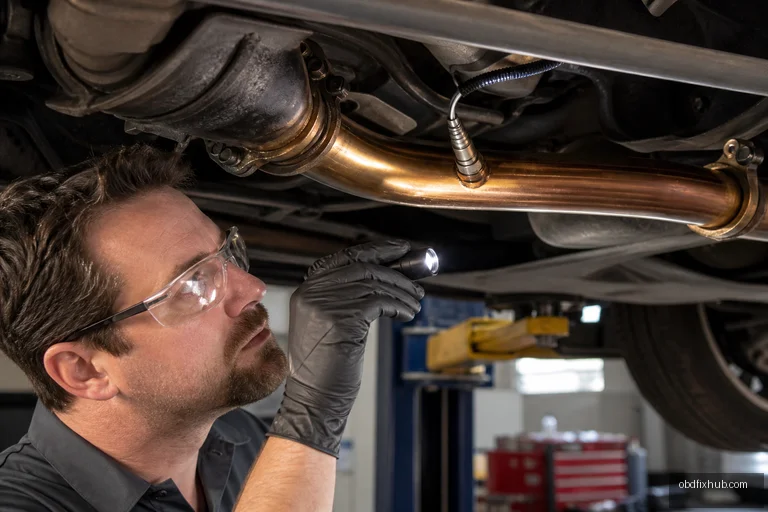
P23A0 Oxygen Sensor Exhaust Sample Error means the engine computer believes Bank 1 Sensor 2 is not receiving, sensing, or reporting a representative exhaust sample. The code usually points to the downstream oxygen sensor, an exhaust leak or restriction near that sensor, damaged wiring, or a sensor that has been contaminated or installed incorrectly. Do not replace the O2 sensor immediately: a careful exhaust and circuit inspection often finds the real fault.
What Does P23A0 Mean?
P23A0 is an OBD-II diagnostic trouble code associated with an oxygen sensor exhaust sample error on Bank 1 Sensor 2. Bank 1 is the side of the engine containing cylinder number one. Sensor 2 is the oxygen sensor positioned after the catalytic converter, commonly called the downstream or post-catalyst sensor.
The downstream sensor primarily monitors catalytic converter performance rather than controlling the air-fuel mixture. However, the engine control module still expects its signal to reflect actual exhaust conditions. If the sensor sees diluted air, an abnormal pressure pattern, or an implausible signal, it may store P23A0 and illuminate the check engine light.
Code definitions can vary slightly between manufacturers, so the vehicle-specific service manual remains the final authority. On some models, the fault relates to the way exhaust gas reaches the sensor through a sampling passage, shield, tube, or sensor housing. That detail matters because replacing the sensor alone may not correct the problem.
Common Symptoms of P23A0
Some vehicles drive almost normally with this code because the affected sensor is downstream of the catalytic converter. Others may show additional emissions-related symptoms, especially when the exhaust problem is severe or multiple codes are present.
- Illuminated check engine light
- Failed emissions or inspection test
- Unusual or fluctuating downstream O2 sensor readings
- Reduced fuel economy in certain operating conditions
- Exhaust smell near the engine or under the vehicle
- Rattling from a damaged catalytic converter or heat shield
- Additional oxygen sensor, catalyst efficiency, or fuel-trim codes
A noticeable ticking sound during cold starts is a useful clue. It often indicates an exhaust manifold, gasket, or front-pipe leak that can pull outside air into the exhaust stream and distort the Bank 1 Sensor 2 reading.
Most Likely Causes
1. Exhaust leak near the downstream sensor
A leak before or close to Bank 1 Sensor 2 can draw fresh oxygen into the exhaust, especially during deceleration or when exhaust flow pulses create a low-pressure area. The oxygen sensor may then report a leaner sample than the engine is actually producing. Inspect flanges, welds, flex sections, catalyst seams, and sensor threads.
2. Blocked or damaged exhaust sampling passage
Some vehicles use a specific sensor port, shield, or sampling passage to expose the sensor to exhaust gas. Carbon buildup, melted material, a dented pipe, or an incorrectly fitted replacement component can obstruct that path. This is one reason the code can return even after a new oxygen sensor has been installed.
3. Faulty or contaminated oxygen sensor
Coolant, oil, silicone sealant, fuel additives, and excessive soot can contaminate the sensing element. A sensor that responds slowly or becomes electrically biased may trigger an exhaust sample error. If the sensor tip is wet with oil or coolant, diagnose the source of the contamination instead of simply fitting another sensor.
4. Wiring, connector, or heater circuit damage
The harness is exposed to road debris, water, exhaust heat, and movement from the engine or exhaust system. Look for melted insulation, wires stretched tight, corrosion inside the connector, and terminals pushed backward. A poor ground or heater supply can make a sensor appear defective even when its sensing element is healthy.
5. Exhaust restriction or catalytic converter damage
A collapsed catalyst or internally broken substrate can change exhaust pressure and flow around the sensor. A restriction may also cause sluggish acceleration, loss of power under load, or excessive heat in the exhaust. These symptoms should prompt a backpressure or vacuum test rather than another sensor replacement.
How to Diagnose P23A0 Correctly
- Record all diagnostic codes and freeze-frame data. Note engine temperature, vehicle speed, load, fuel trims, and whether the code set during acceleration, cruising, or deceleration. Related codes often reveal whether the main issue is an exhaust leak, heater circuit, misfire, or catalyst problem.
- Confirm the sensor location. Identify cylinder one and verify that the suspected component is Bank 1 Sensor 2. Misidentifying the bank or replacing Sensor 1 is a common and expensive mistake on V6 and V8 engines.
- Inspect the exhaust while cold. Check for black soot marks, loose flanges, missing plugs, cracked welds, and a damaged sensor bung. With the engine briefly running, a mechanic can use a smoke machine or listen for leaks; avoid touching hot exhaust components.
- Examine the sampling area. Compare the sensor installation with the factory arrangement. Look for a blocked port, incorrect aftermarket exhaust component, damaged heat shield, or a sensor that is not fully seated or is positioned incorrectly.
- Test the electrical circuit. Use the wiring diagram to verify heater power, ground, signal continuity, and connector integrity. Do not apply test voltage to the sensor signal wire unless the manufacturer specifically permits it.
- Evaluate live data. The downstream O2 signal should generally be more stable than the upstream sensor once the engine is warm. A scan tool graph showing erratic readings that change when the exhaust is manipulated can support a sampling or leak diagnosis, but live data must be interpreted with the vehicle’s specifications.
- Clear the code and verify the repair. After correcting the fault, clear the DTC and complete the required drive cycle. A short idle test is not enough; the monitor may need specific temperature, speed, and load conditions before it runs.
How to Fix P23A0
The correct repair depends on the test results. Repair an exhaust leak with the appropriate gasket, clamp, weld, or replacement pipe. Remove carbon or replace a damaged sampling component only when the service procedure allows it. If the sensor is contaminated, slow, or electrically out of specification, replace it with a quality part that matches the vehicle application.
Route the replacement harness away from the pipe and secure it in the original clips. Avoid copper-based anti-seize on the sensor tip, and keep sealant out of the exhaust passage. A small installation mistake can recreate the same code within a few drive cycles.
If testing shows high backpressure or a rattling catalyst, diagnose the cause of the converter failure before installing a new converter. Misfires, oil consumption, coolant entry, and rich fuel operation can destroy the replacement part quickly.
Can You Drive With P23A0?
Short-distance driving is often possible when the vehicle has no severe loss of power, overheating, misfire, or strong exhaust fumes in the cabin. Still, ignoring the code can leave an exhaust leak unrepaired, cause an emissions test failure, or hide a developing catalytic converter problem.
Stop driving and arrange an inspection if the check engine light flashes, the engine misfires, the vehicle loses power, the exhaust smells inside the cabin, or the floor becomes unusually hot. Those signs indicate a potentially more serious safety or engine problem.
Common Diagnostic Mistakes
- Replacing the O2 sensor without checking for an exhaust leak
- Confusing Bank 1 Sensor 2 with Bank 2 Sensor 2
- Using a universal sensor with poor wiring connections
- Testing the sensor before the engine and exhaust reach operating temperature
- Clearing the code without completing the monitor drive cycle
- Replacing a catalytic converter without checking for misfire or oil-consumption causes
Frequently Asked Questions
Is P23A0 caused by a bad oxygen sensor?
It can be, but the code does not prove that the sensor itself has failed. An exhaust leak, blocked sampling passage, wiring fault, or exhaust restriction can produce the same result.
Which oxygen sensor is associated with P23A0?
It normally refers to Bank 1 Sensor 2, the downstream sensor located after the catalytic converter. Always confirm the definition and sensor location in the service information for the exact vehicle.
Will an exhaust leak cause P23A0?
Yes. A leak near the sensor can introduce outside oxygen into the exhaust stream and make the sensor’s sample inaccurate, particularly during deceleration or low-flow conditions.
Should I replace the catalytic converter for P23A0?
Not without testing. Replace or repair the converter only if inspection and pressure or efficiency tests show that it is damaged or restricted. P23A0 alone is not sufficient evidence.
How do I prevent P23A0 from returning?
Use the correct sensor, repair leaks completely, protect the wiring from heat, and address misfires, oil burning, coolant leaks, or rich-running conditions that can contaminate the sensor or damage the converter.
Bottom Line
P23A0 is best treated as a sampling and exhaust-system diagnosis, not an automatic oxygen-sensor replacement code. Start with the sensor location, inspect the exhaust and sampling path, test the wiring, and verify live data at operating temperature. Once the underlying fault is repaired, clear the code and complete the proper drive cycle before deciding that the vehicle is fixed.




