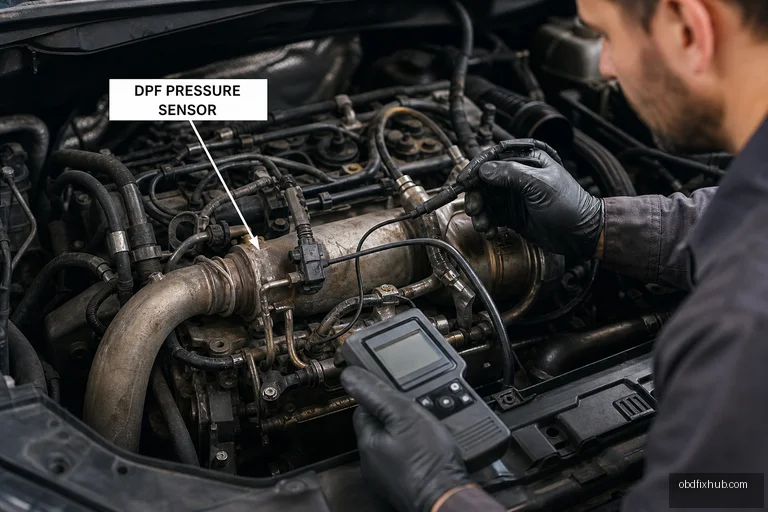
P2453 Diesel Particulate Filter Pressure Sensor: Meaning, Causes, Symptoms & Fix
P2453 means the engine computer has detected an implausible range or performance signal from the diesel particulate filter (DPF) pressure sensor, usually called pressure sensor A. You may be able to drive a short distance if the vehicle runs normally, but continuing to ignore the fault can prevent regeneration, increase backpressure, and eventually put the engine into reduced-power mode. The sensor itself may be faulty, but blocked pressure tubes, wiring damage, or a genuinely overloaded DPF are just as common.
What Does Code P2453 Mean?
Diagnostic trouble code P2453 is a generic OBD-II fault for “Diesel Particulate Filter Pressure Sensor A Circuit Range/Performance.” The sensor measures the pressure difference across the DPF through two small pipes or hoses: one samples pressure before the filter and the other samples pressure after it.
The engine control module uses that pressure difference, together with exhaust temperature, engine speed, fuel quantity, and calculated soot load, to decide whether the DPF needs regeneration. P2453 is set when the reported pressure does not make sense for the operating conditions or does not change as expected.
This is not exactly the same as a failed particulate matter sensor. A PM sensor detects soot particles downstream of the filter, while the DPF differential-pressure sensor measures restriction. Some vehicles use both systems, so the correct sensor must be identified from the vehicle’s wiring diagram and diagnostic data.
P2453 Symptoms You May Notice
A vehicle with P2453 can initially feel completely normal. The problem often appears first as a warning light, then becomes more obvious when the control unit is unable to verify DPF loading or complete an automatic regeneration.
- Check Engine Light, DPF warning, or an exhaust-system warning
- Frequent or unsuccessful active regenerations
- Reduced fuel economy and higher idle speed during attempted regeneration
- Loss of power or a reduced-power/limp-home mode
- Cooling fan operation after shutdown
- Hard starting, sluggish acceleration, or uneven throttle response
- Additional codes for DPF soot load, exhaust temperature, or sensor circuit faults
Do not judge the DPF condition from P2453 alone. A sensor reporting excessive pressure can make a healthy filter appear blocked, while a sensor stuck at an artificially low reading can allow soot to accumulate unnoticed.
Can You Drive with a Bad DPF Pressure Sensor?
Only for a limited trip to a repair facility if there is no severe loss of power, overheating, smoke, or flashing warning light. Gentle driving may be reasonable, but a long motorway journey intended to “burn it clean” is not a reliable fix for P2453. The engine computer may disable regeneration because it cannot trust the pressure signal.
Stop driving and arrange recovery if the vehicle enters limp mode, the DPF warning is flashing, exhaust temperatures become abnormal, or the engine oil level rises. Repeated failed regenerations can dilute the oil with diesel fuel, and a heavily restricted DPF can create damaging exhaust backpressure.
Common Causes of P2453
1. Blocked or cracked pressure hoses
The small hoses connected to the sensor are exposed to soot, condensation, heat, and vibration. A hose can fill with carbon near the exhaust connection, split, melt against a heat shield, or become kinked. This is one of the first things an experienced technician checks because replacing the sensor will not correct a blocked hose.
2. A failing DPF differential-pressure sensor
The sensor’s internal pressure transducer can drift, stick, or produce an implausible voltage. Water condensation is especially troublesome on vehicles that make short trips or operate in cold, damp conditions. A sensor that reads nearly the same pressure with both hoses connected and disconnected deserves close attention.
3. Damaged wiring or connectors
Look for wiring rubbed through by the engine or exhaust, heat-damaged insulation, corrosion inside the connector, and terminals that have lost tension. A good-looking connector can still have a poor terminal connection, so a wiggle test while watching live data is useful.
4. A genuinely restricted DPF
A filter overloaded with ash or soot creates a real pressure problem. Ash cannot be removed by normal regeneration; it usually requires professional off-car cleaning or DPF replacement. Soot loading may result from failed glow plugs, faulty injectors, EGR problems, low engine temperature, or repeated short journeys.
5. Other sensor or exhaust faults
Incorrect exhaust gas temperature readings, intake-air problems, boost leaks, EGR faults, and calibration issues can interfere with the regeneration strategy and produce related codes. Diagnose all stored codes together rather than replacing the first component named by a scan tool.
How a Technician Should Diagnose P2453
- Record all codes and freeze-frame data. Note engine speed, calculated soot load, exhaust temperature, vehicle speed, and the pressure reading when the code appeared.
- Inspect the two pressure lines. Remove them carefully and check that both are open, undamaged, correctly routed, and connected to the correct sensor ports. Do not blindly force compressed air into the sensor because excessive pressure can damage it.
- Check live pressure data. With the engine off, the reading should generally be close to atmospheric differential pressure or zero, depending on the scan tool’s units and manufacturer strategy. At idle and under load, pressure should change smoothly rather than remaining fixed or jumping randomly.
- Test the electrical circuit. Confirm the sensor’s reference voltage, ground integrity, and signal response according to the manufacturer’s service information. Typical three-wire sensors use a 5-volt reference, ground, and signal, but pin assignments and allowable values vary.
- Compare calculated and measured values. A high differential pressure with normal engine operation may indicate a blocked line or sensor error; high pressure that rises sharply under acceleration may indicate real DPF restriction.
- Check for the reason behind soot accumulation. If a DPF is replaced without correcting an injector, thermostat, glow-plug, or EGR problem, the new filter can overload again.
A useful workshop clue is to compare the sensor reading before and after disconnecting both pressure hoses with the ignition on and engine off. The exact expected value is manufacturer-specific, but a reading that does not change at all, is implausibly high, or moves when the connector is disturbed points toward a sensor or circuit problem.
P2453 Repair Options
The correct repair depends on the test results. A technician may clear carbon from the pressure tubes, repair a heat-damaged harness, replace the differential-pressure sensor, perform a stationary or road regeneration, or remove the DPF for ash cleaning. If the filter substrate is cracked or melted, cleaning is not an appropriate substitute for replacement.
After installing a sensor, some vehicles require a “DPF pressure sensor learned value,” “offset reset,” or adaptation procedure. This is different from merely deleting the fault code. The vehicle may also require a commanded regeneration, depending on the stored soot-load calculation and manufacturer procedure.
How Much Does It Cost to Replace a DPF Pressure Sensor?
In the United States, a typical DPF differential-pressure sensor replacement costs approximately $150 to $450, including parts and labor. The sensor itself may cost $60 to $250, while diagnostic time, difficult access, seized hoses, or required calibration can increase the final bill.
Dealer pricing, diesel-truck applications, and premium European vehicles may exceed that range. Do not confuse this estimate with DPF replacement: a new DPF can cost roughly $1,000 to more than $4,000, while professional cleaning is often several hundred dollars. Get a diagnosis before approving the more expensive repair.
How Do You Reset the DPF Pressure Sensor?
There is no universal button sequence that safely resets P2453. The proper process is:
- Repair the underlying sensor, hose, wiring, or DPF problem.
- Use a compatible scan tool to clear the stored P2453 code.
- Run the manufacturer’s DPF pressure-sensor calibration or offset reset if specified.
- Start the engine and confirm that the pressure reading is plausible at idle and during a controlled road test.
- Complete a regeneration only when the service information says conditions are safe and the filter is suitable for regeneration.
Disconnecting the battery may erase some temporary data, but it does not perform the required sensor adaptation and may create additional electrical or readiness issues. If the fault immediately returns, the problem has not been fixed.
Final Takeaway
P2453 identifies an implausible DPF pressure-sensor signal, not automatic proof that the particulate filter must be replaced. Start with the pressure hoses, connector, wiring, and live-data readings before buying parts. Drive only as far as necessary if the vehicle is otherwise safe, and have the fault properly diagnosed before attempting a forced regeneration.
Action step: Ask the repair shop to show you the differential-pressure reading at key-on/engine-off, idle, and under load, along with the condition of both pressure lines. Those observations often separate a $200 sensor repair from an unnecessary DPF replacement.
Frequently Asked Questions
What does code P2453 mean?
P2453 means the engine computer sees an out-of-range or implausible signal from the DPF differential-pressure sensor A circuit. The cause can be the sensor, hoses, wiring, or a restricted filter.
Can I drive with a bad particulate matter sensor?
A short, gentle drive to a repair shop may be possible if the engine is running normally and warnings are not flashing. Avoid continued driving if there is limp mode, severe power loss, smoke, overheating, or a flashing DPF warning.
How much does it cost to replace a DPF pressure sensor?
Most replacements fall around $150–$450 in the United States, including parts and labor, although access, vehicle type, diagnosis, and calibration requirements can change the price.
How do I reset the DPF pressure sensor?
After repairing the cause, clear the code with a compatible scan tool and perform the vehicle-specific pressure-sensor adaptation or offset reset. Battery disconnection alone is not a proper reset.




