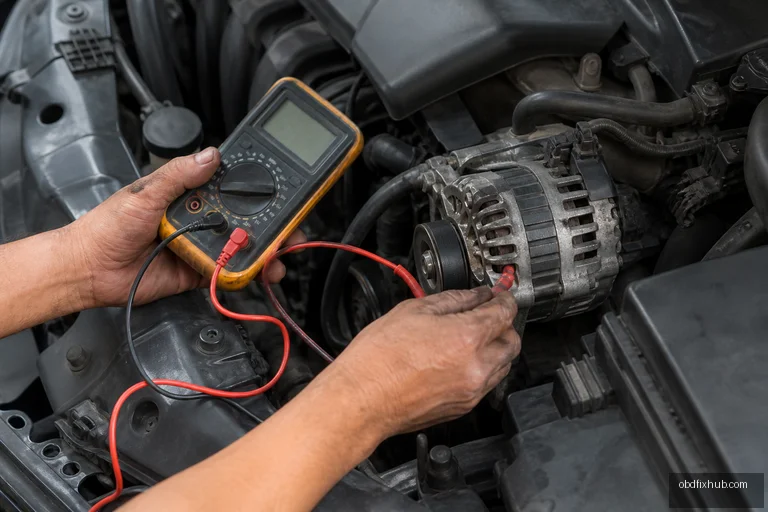
The P2500 generator lamp and L-terminal circuit low code means the engine computer has detected lower-than-expected voltage in the alternator’s warning-lamp or L-terminal control circuit. It does not automatically mean the alternator itself is bad. A discharged battery, blown fuse, damaged wiring, poor ground, incorrect replacement alternator, or a fault inside the instrument cluster can all trigger this code.
This is an informational diagnosis topic rather than a parts-buying decision: the correct repair depends on measuring the circuit instead of replacing the battery or alternator by guesswork. The most useful first step is to determine whether the L-terminal signal is missing, shorted to ground, or being pulled low by a component that should not be connected to it.
What Does P2500 Mean?
Diagnostic trouble code P2500 is a generic OBD-II code associated with the generator lamp, also called the alternator warning lamp, and its L-terminal circuit. The powertrain control module or another vehicle control module monitors this circuit to confirm that the charging system is being commanded and responding correctly.
On many vehicles, the L terminal controls or monitors the battery-shaped warning light in the instrument cluster. With the ignition switched on and the engine stopped, the lamp normally illuminates. Once the engine starts and the alternator begins charging, the circuit changes state and the warning lamp should go out. If the expected voltage or switching behavior is not present, P2500 may be stored.
Terminal labels and circuit logic vary by manufacturer. Some alternators use a simple lamp circuit, while newer units communicate through a regulator, a dedicated control wire, or a larger charging-system network. Always use the wiring diagram for the exact year, engine, and alternator configuration.
P2500 Symptoms You May Notice
The warning lamp circuit can fail before the charging system completely stops working. That is why a vehicle may still start normally while the code is active. Common symptoms include:
- The battery or charging warning light remains on after the engine starts.
- The battery lamp does not illuminate during the ignition-on bulb check.
- Low system voltage, dim headlights, or flickering interior lights.
- Slow cranking, repeated dead batteries, or a no-start condition.
- Electrical accessories operating unpredictably at idle.
- Additional communication, low-voltage, or body-control module codes.
- P2500 returning immediately after it is cleared.
A particularly important clue is the warning lamp behavior. If the lamp never comes on with the key on and the engine off, do not ignore it. A burned-out bulb, open cluster circuit, missing ignition feed, or broken L-terminal wire can prevent the alternator from receiving the initial excitation signal on systems that depend on it.
Common Causes of a Low Voltage Code
A “low” circuit code does not always mean the battery voltage is low. In P2500 terminology, “circuit low” usually means the computer sees an electrical signal below the expected range on the generator lamp circuit. The most common causes are:
- Open, chafed, corroded, or shorted L-terminal wiring.
- A loose alternator connector or terminal with poor pin tension.
- Blown fuse or missing ignition-switched power supply.
- Failed alternator voltage regulator or incorrect alternator application.
- Faulty instrument cluster, warning-lamp driver, or bulb circuit.
- Bad engine ground strap or high resistance in the battery negative cable.
- Loose, glazed, or slipping serpentine belt.
- Battery with an internal short or severe state-of-charge problem.
- Aftermarket remote-start, alarm, audio, or charging accessories connected incorrectly.
Connector corrosion deserves special attention on vehicles exposed to road salt or engine-bay moisture. A terminal can look connected yet have enough resistance to distort the signal. Carefully inspect the connector for green residue, pushed-back pins, broken locking tabs, and oil contamination before condemning the alternator.
How to Diagnose P2500 Correctly
1. Check battery and charging voltage
Begin with a fully charged battery and a digital multimeter. With the engine off after the vehicle has rested, a healthy battery is commonly around 12.4 to 12.7 volts, although temperature and state of charge affect the reading. With the engine running, many conventional charging systems measure approximately 13.5 to 14.8 volts at the battery, but smart-charging vehicles may intentionally operate outside that range.
Measure voltage directly at the battery posts, not only at the cable clamps. Then compare it with the voltage at the alternator output terminal. A significant difference indicates resistance in the positive cable, fusible link, ground path, or connection rather than necessarily an alternator failure.
2. Observe the generator warning lamp
Turn the ignition on without starting the engine. Confirm that the battery or charging lamp illuminates during the bulb check. Start the engine and watch whether it goes out. If the lamp is dark at key-on, inspect the cluster fuse, ignition feed, bulb or LED driver, and L-terminal circuit before replacing charging components.
3. Inspect the wiring and connector
Follow the L-terminal wire from the alternator to the harness and control module or instrument cluster. Look for areas where the harness may rub against a bracket, exhaust component, belt, or sharp body edge. A wiring diagram and connector pinout are essential because the L terminal should not be tested by randomly applying battery power to an unknown terminal.
Use a voltage-drop test under the condition that sets the code. A circuit can show continuity with the ignition off but fail when current or module control is active. Back-probe the connector carefully, avoid spreading terminals, and compare the measured signal with the manufacturer’s specified values.
4. Scan all modules, not only the engine computer
Read stored, pending, and history codes from the engine, body, instrument cluster, and charging-system modules. A U-code, battery sensor code, or low-voltage code may explain why P2500 appeared. Freeze-frame data can reveal whether the fault occurred during starting, at idle, under electrical load, or after a battery voltage drop.
Can a Bad Battery Cause a P0622 Code?
Yes, a weak or failing battery can contribute to a P0622 generator field F-terminal circuit code, but the battery is not the only possible cause. P0622 concerns the alternator’s field or F-terminal control circuit, while P2500 primarily concerns the generator lamp or L-terminal circuit. They are related to the charging system but are not interchangeable codes.
A severely discharged battery can cause unstable system voltage during cranking and operation. That voltage instability may make the control module interpret the field circuit incorrectly, especially if the battery has an internal short, a loose terminal, or poor ground. However, if P0622 returns with a known-good battery and stable power and ground supplies, investigate the F-terminal wiring, regulator, alternator, and control module commands instead of installing another battery.
What Is a Generator Field F-Terminal Circuit?
The generator field F-terminal circuit controls the alternator’s field current. The regulator or vehicle control module varies field current to adjust alternator output. More field current generally allows the alternator to produce more electrical power, while reduced field current limits output.
The F terminal is therefore different from the L terminal. The L terminal is associated with the warning lamp or charging-status signal; the F terminal is associated with field control or field feedback. Depending on the vehicle, the F circuit may use a duty-cycled signal rather than a fixed voltage, so a simple voltage reading can be misleading without a service manual or oscilloscope.
Repair Options for P2500
Once testing identifies the fault, the repair may be straightforward:
- Repair an open or shorted wire using sealed automotive-grade splices and proper heat-shrink protection.
- Clean corrosion and restore terminal tension, or replace a damaged connector pigtail.
- Replace a blown fuse only after finding the short or overload that caused it.
- Repair the instrument cluster or warning-lamp circuit if the alternator signal is correct but the lamp circuit is not.
- Replace the alternator or voltage regulator only after confirming the L-terminal and power circuits are functioning.
- Replace damaged battery cables, ground straps, or a slipping belt.
- Correct aftermarket accessory wiring that is loading or back-feeding the generator circuit.
After the repair, clear the code and perform a complete drive cycle with several electrical loads switched on. Recheck battery voltage, warning-lamp operation, and scan-tool data. A successful repair should eliminate the code without creating charging, communication, or battery-sensor faults.
Practical Mistakes to Avoid
- Do not disconnect the battery while the engine is running to “test” the alternator; voltage spikes can damage control modules.
- Do not install an alternator solely because the battery lamp is on. The L-terminal circuit itself may be the problem.
- Do not replace a fuse repeatedly without locating the short.
- Do not assume a universal aftermarket alternator has the same terminal logic as the original unit.
- Do not judge a battery by voltage alone; perform a proper conductance or load test after charging it.
Summary: The Fastest Route to a Reliable Fix
P2500 indicates a low or incorrect signal in the generator lamp/L-terminal circuit, not an automatic alternator verdict. Verify the battery and charging voltage, check the warning-lamp bulb test, inspect the connector and wiring, and scan every relevant module before replacing parts. If P0622 is also present, separate the F-terminal field-control diagnosis from the L-terminal lamp-circuit diagnosis. When the fault involves high current, melted wiring, or uncertain terminal identification, use the vehicle’s wiring diagram or have a qualified technician test it safely.
Frequently Asked Questions
What are the symptoms of a generator L-terminal circuit malfunction?
Typical symptoms include a battery warning lamp that stays on or never illuminates, low or unstable charging voltage, dim lights, slow cranking, repeated dead batteries, and additional low-voltage or communication codes.
What can cause a low voltage code?
A low voltage code can result from a discharged or defective battery, poor grounds, corroded terminals, a blown fuse, damaged wiring, a weak alternator, a slipping belt, or an electrical load pulling the circuit below its expected range. The exact meaning depends on the circuit named in the code.
Can a bad battery cause a P0622 code?
Yes. A severely weak battery or unstable battery connection can contribute to P0622 during cranking or charging-system operation. Confirm battery condition and power-ground integrity first, then test the F-terminal circuit and regulator if the code returns.
What is a generator field F-terminal circuit?
It is the circuit used to control or monitor alternator field current. The F-terminal is responsible for regulating alternator output and is different from the L-terminal, which is associated with the generator warning lamp or charging-status signal.




