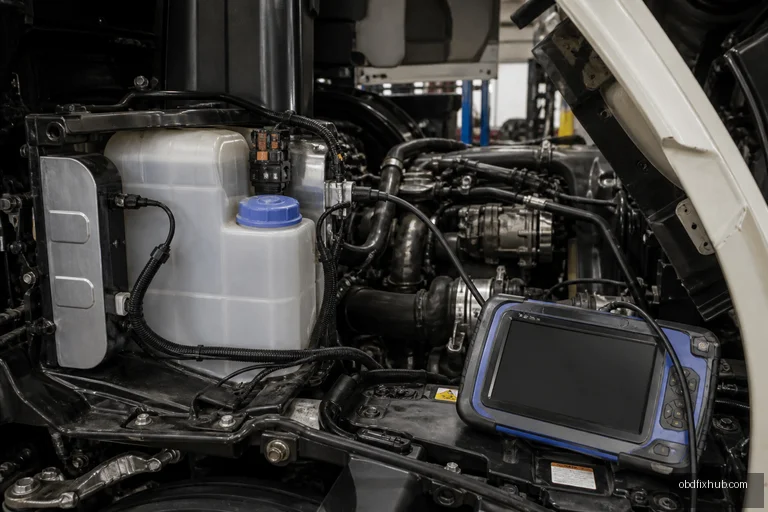
P24FF Reductant Temperature Too High means the engine control module has detected an excessively high temperature signal from the diesel exhaust fluid (DEF), also called AdBlue, reductant tank or its temperature sensor. The cause may be genuine heat around the tank, a failed sensor, damaged wiring, contaminated DEF, or a control-module interpretation problem. Do not replace the tank immediately: confirming the live temperature reading and the sensor circuit usually identifies the fault much faster.
What Does P24FF Mean?
Modern diesel vehicles use a selective catalytic reduction (SCR) system to reduce nitrogen oxide emissions. The system stores DEF in a reductant tank, pumps it toward the exhaust, and meters it through an injector. A temperature sensor in or near the tank tells the SCR module whether the fluid is within a safe operating range.
When the measured temperature is implausibly high, or remains high when the vehicle is cold, the module stores P24FF. In some vehicles, the code is manufacturer-specific and the exact temperature threshold varies. That is why the vehicle manufacturer’s service information and live-data description matter more than a generic code definition alone.
P24FF Symptoms You May Notice
The check engine light is usually the first sign, but SCR-related faults often produce a warning message such as “Emissions System Service,” “DEF System Fault,” or “AdBlue Quality Fault.” The vehicle may still drive normally at first because the SCR system can continue operating temporarily with a substitute or default temperature value.
- Check engine or emissions warning light
- DEF, AdBlue, or reductant system warning
- Reduced engine power or torque limitation
- A countdown until starting is disabled
- Incorrectly high DEF temperature shown on a scan tool
- Unusual DEF pump, heater, or dosing-system operation
- Failure to complete an emissions-system regeneration or readiness monitor
A countdown is not proof that the engine is overheating. It is typically the SCR controller warning that an emissions fault must be repaired before the permitted mileage expires.
Most Common Causes of P24FF
1. Failed reductant temperature sensor
Many DEF temperature sensors use an NTC thermistor. Their resistance decreases as temperature rises. If the sensor develops an internal short, an open circuit, or water intrusion, the reported temperature can become unrealistically high or erratic.
2. Wiring or connector damage
The harness near the DEF tank is exposed to road salt, vibration, moisture, and exhaust heat. A corroded connector, rubbed-through wire, poor ground, or terminal that has backed out can create the same code as a bad sensor. Inspect the connector before ordering an expensive tank assembly.
3. Genuine heat transfer to the DEF tank
A missing heat shield, incorrectly routed exhaust component, damaged insulation, or aftermarket exhaust modification can raise the actual tank temperature. Compare the tank temperature with the exhaust temperature and the surrounding air; the DEF tank should not instantly report extreme heat after a cold start.
4. Incorrect or contaminated DEF
DEF is a carefully specified urea-and-demineralized-water solution. Fuel, coolant, washer fluid, old fluid, or excessive crystallization can damage the pump and sensor assembly. Contamination more commonly causes quality or concentration faults, but it can also contribute to abnormal sensor readings and restricted flow.
5. Module, software, or power-supply problems
Low system voltage, poor grounds, water inside the reductant control module, or outdated software can cause misleading sensor codes. If the sensor reading is normal but the fault returns with stable wiring and voltage, check for a technical service bulletin before replacing hardware.
How to Diagnose P24FF Step by Step
- Record all codes and freeze-frame data. Scan the engine and SCR modules, not just the generic OBD menu. Note coolant temperature, ambient temperature, DEF temperature, battery voltage, and vehicle speed when the code was set.
- Compare the cold-soak reading. After the vehicle has sat for several hours, the reductant temperature should be reasonably close to ambient temperature. A reading such as 120 degrees Celsius on a cold vehicle strongly suggests a sensor or circuit issue rather than real heat.
- Inspect the tank and harness. Look for melted loom, exhaust contact, green corrosion, DEF crystals, broken clips, and liquid inside the connector. Do not pull hard on the wires; a partially released terminal can look normal until the harness moves.
- Check reference voltage, ground, and signal. Use the wiring diagram for the specific vehicle. Check the sensor supply and ground under load, then compare the signal voltage with the manufacturer’s specification. A voltage test at an unplugged connector alone may miss a high-resistance ground.
- Test sensor resistance only when appropriate. If the manufacturer provides a resistance-versus-temperature chart, measure the sensor and compare it with the actual tank temperature. Never apply random battery voltage to a thermistor circuit; doing so can damage the module.
- Confirm the repair with live data. Clear the code only after correcting the cause. Start the engine, monitor reductant temperature, and perform the required SCR or reductant-system test drive. A code that returns immediately points to a current electrical problem; one that returns after heat soak may indicate heat shielding or a temperature-dependent failure.
A professional scan tool is valuable because many basic code readers cannot access the SCR module, command the DEF pump, or display the reductant sensor’s raw data. Guessing from the dashboard warning alone often leads to unnecessary replacement of the complete tank.
How Do I Diagnose a P205B Code Myself?
P205B generally refers to a reductant tank temperature sensor circuit range or performance problem. It is related to P24FF, but it is not exactly the same code. P205B may indicate that the signal is implausible or outside the expected electrical range, while P24FF emphasizes a temperature that the controller interprets as too high.
For a sensible driveway diagnosis, allow the vehicle to cool completely, read the live DEF temperature, and compare it with ambient temperature. Then inspect the sensor connector and harness, measure the supply and ground, and use the vehicle’s resistance chart if available. If the scan tool shows a fixed extreme reading that does not change as the tank warms, suspect the sensor circuit rather than the actual DEF temperature.
Do not rely on resistance values found for another vehicle. Sensor calibration differs between manufacturers, and some temperature sensors are integrated into the DEF tank, pump, or quality sensor assembly.
What Happens If the DPF Temperature Sensor Is Faulty?
The DPF temperature sensor is different from the DEF tank temperature sensor, although both are part of the diesel emissions system. A faulty DPF exhaust gas temperature sensor can cause failed or interrupted regeneration, excessive soot loading, poor fuel economy, reduced power, and additional temperature or particulate-filter codes.
If the sensor reports a temperature that is too low, the engine computer may refuse to start regeneration. If it reports an unrealistically high temperature, the system may stop regeneration as a safety measure or calculate incorrect protection strategies. A DPF sensor fault does not automatically cause P24FF, but heat or wiring damage near the exhaust can create multiple emissions codes at the same time.
How to Reset a DEF Tank Sensor
There is normally no legitimate “reset” that repairs a defective DEF temperature sensor. Disconnecting the battery may erase some learned values on certain vehicles, but it will not correct an open circuit, short, contaminated connector, or failed tank sensor. It can also erase unrelated adaptations and may create additional warning lights.
The correct reset procedure is:
- Repair or replace the failed sensor, wiring, connector, or tank assembly.
- Refill with fresh, ISO 22241-compliant DEF if contamination or low fluid quality is suspected.
- Use a capable scan tool to clear the stored SCR codes.
- Run any required reductant pump, quality, heater, or dosing-system service routine.
- Complete the manufacturer-specified drive cycle and confirm that the warning does not return.
Some vehicles require a dealer-level SCR reset or inducement reset after repair. Clearing the code without completing that procedure may leave the starting countdown active.
Is It Safe to Drive With a P205B Code?
Short-term driving is often possible if the engine runs normally, there is no overheating, no strong ammonia or chemical odor, no visible melted wiring, and no severe power reduction. However, P205B means the SCR system may not be able to control emissions correctly. Continued driving can trigger a torque limit or a no-start countdown, leaving a diesel vehicle inconveniently immobilized after the remaining distance expires.
Stop driving and arrange an inspection if the warning is accompanied by smoke, a burning-plastic smell, rapidly rising engine or exhaust temperature, fluid leakage, severe power loss, or a red warning lamp. Even when the vehicle feels normal, schedule diagnosis promptly rather than treating the code as a harmless sensor glitch.
Repair Options and Typical Cost Factors
The repair may be as simple as repairing a corroded connector or securing a heat-damaged harness. Other vehicles use an integrated DEF tank module, meaning the temperature sensor cannot be purchased separately. Parts and labor vary substantially by vehicle, access, tank design, and whether a programming or SCR reset is required.
- Connector or wiring repair: usually the least expensive option when confirmed by testing.
- Temperature sensor replacement: possible on some systems, but not all.
- DEF tank or pump-module replacement: more expensive when the sensor is integrated.
- Software update or control-module repair: required in selected manufacturer-specific cases.
Ask the repair shop for the measured cold-soak temperature, circuit test results, and the reason a complete tank is being recommended. Those three details separate evidence-based diagnosis from parts swapping.
Key Takeaway
P24FF Reductant Temperature Too High is a warning about the DEF temperature signal, not a diagnosis of one specific component. Start with live data on a cold vehicle, inspect the tank harness and heat shielding, test the sensor circuit against the correct wiring diagram, and reset the SCR system only after the underlying fault is repaired. If P205B is also present, treat it as a circuit or plausibility clue and diagnose both codes together.
Action step: scan every emissions module, save the freeze-frame data, and compare the DEF temperature with ambient temperature before purchasing a replacement tank.
Frequently Asked Questions
Can low DEF cause P24FF?
Low DEF more commonly causes a low-level warning, but a low level alone does not normally explain an excessively high temperature signal. If P24FF is present, inspect the sensor circuit and live data rather than simply adding fluid.
Can I clear P24FF with a basic OBD scanner?
A basic scanner may erase the generic engine code, but it may not access the SCR module or complete the required reductant-system reset. If the fault remains, the warning and starting countdown can return quickly.
Does P24FF mean the DEF is actually boiling?
Not necessarily. An electrical fault can report an extremely high temperature even when the tank is cold. Confirm the actual temperature and inspect the sensor circuit before assuming the fluid has overheated.
Should I replace the DEF tank for P205B?
Only after testing confirms that the sensor is integrated into the tank and the wiring, connector, power, and ground are good. Many unnecessary tank replacements result from skipping those circuit checks.




