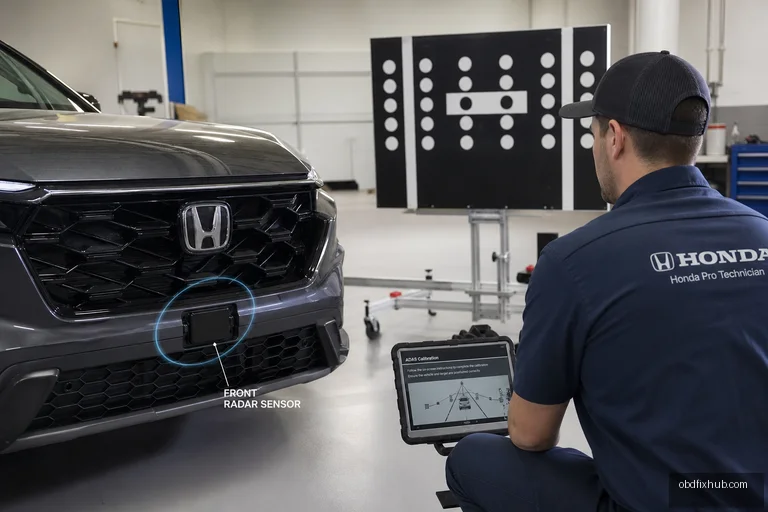
P2583 Adaptive Cruise Control Front Distance Sensor Fault means the vehicle has detected a problem with the forward-facing radar used to measure traffic distance. On Honda vehicles, the most common causes are a misaligned or damaged millimeter-wave radar unit, a bent mounting bracket, a blocked radar cover, wiring trouble, or a calibration that was never completed after bodywork. The practical fix is to inspect the radar and its mounting first, then perform the correct Honda aiming procedure; simply clearing the code rarely solves it.
What Does P2583 Mean?
P2583 is an adaptive cruise control, or ACC, fault code associated with the front distance sensor. That sensor continuously measures the position and relative speed of vehicles ahead so the ACC system can maintain a selected following gap. Depending on the scan tool and Honda model, the code may appear with a subcode such as P2583-64 for an out-of-range or incorrect signal, or P2583-76 for a calibration or alignment-related problem.
The exact subcode matters. A basic P2583 description tells you which system is unhappy, but it does not prove that the radar itself has failed. In many real repairs, the radar is electrically healthy and is simply pointing a few degrees away from the vehicle centerline after a bumper impact or bracket movement.
Where Is the Cruise Control Distance Sensor Located?
On most Honda models equipped with Honda Sensing, the adaptive cruise control distance sensor is a millimeter-wave radar unit mounted at the front of the vehicle. It is commonly positioned behind the front grille, behind the Honda emblem, or behind a dedicated smooth radar cover in the lower grille area. The precise location varies by model year, trim, and market.
- Do not confuse the radar with the windshield-mounted Honda Sensing camera.
- The camera handles lane and visual recognition functions; the front radar measures distance and closing speed.
- The radar cover must remain clean, securely fitted, and free from stickers, paint overspray, thick protective film, or non-approved accessories.
Look for signs that the bumper has been removed or repaired. A missing fastener, loose grille, bent support, or slightly twisted bracket can cause an alignment fault even when there is no visible damage to the sensor housing.
Common Causes of a P2583 Front Distance Sensor Fault
Radar misalignment after an impact or repair
A low-speed parking bump can move the radar bracket without cracking the bumper. Collision repairs, grille replacement, bumper removal, and even incorrect reassembly can change the sensor angle enough to trigger P2583. This is one of the most frequent causes of an otherwise healthy radar failing its self-check.
Blocked or contaminated radar cover
Snow, mud, road salt, ice, insects, or heavy wax residue can weaken or distort the radar signal. Clean the exterior gently with mild soap and water. Avoid scraping the cover, polishing it aggressively, or applying metallic-looking film, because surface damage can create a permanent sensing problem.
Damaged mounting hardware
A cracked bracket or bent mounting tab may allow the sensor to vibrate or move during driving. The system can pass a stationary check and then fail again on the road. Do not straighten a precision radar bracket by guesswork; even a small change in angle can affect the aiming result.
Electrical or communication faults
Low battery voltage, corrosion in a connector, water intrusion, a damaged harness, or a CAN communication problem can also set P2583. Check for additional body, chassis, or communication codes before replacing the radar. A sensor that has no power or ground cannot be calibrated successfully.
Incorrect vehicle geometry
Uneven tire pressures, a non-standard ride height, suspension damage, or significant cargo in the vehicle can interfere with an accurate aiming procedure. The radar is aligned relative to the vehicle body, so the vehicle must sit level and in the condition specified by the service information.
P2583 Symptoms You May Notice
The most obvious symptom is a dashboard message such as ACC System Problem, Collision Mitigation Braking System Problem, or Honda Sensing System Problem. The ACC indicator may be unavailable, and the vehicle may refuse to set or maintain a following distance.
- Adaptive cruise control will not activate.
- Forward collision warning or automatic emergency braking may be disabled.
- Multiple Honda Sensing warning lights may appear at the same time.
- The system may work intermittently after rain, washing, or a temperature change.
- The code may return immediately after being cleared.
These warnings are protective, not merely cosmetic. The car may still drive normally with ordinary cruise control or without cruise control, but the driver should not assume that forward collision protection remains available while the warning is displayed.
How to Fix an Adaptive Cruise Control Problem
Use this order of diagnosis rather than installing an expensive radar unit immediately:
- Read all diagnostic codes. Use a scanner that can access Honda ADAS and body control modules. Record the exact P2583 subcode and freeze-frame data.
- Inspect the front of the vehicle. Check the radar cover, grille, bumper fit, bracket, connector, and harness. Look for evidence of a recent impact or repair.
- Clean the radar cover correctly. Remove dirt and ice with water and a soft cloth. Do not cover the area with accessories or apply abrasive compounds.
- Check basic vehicle condition. Set all tire pressures correctly, confirm the steering wheel is centered, inspect ride height, and remove unusually heavy cargo.
- Check power, ground, and communication. A technician should verify the radar supply voltage and network communication rather than relying on a visual inspection.
- Perform Honda radar aiming or calibration. This requires the specified target, distance, level floor, and scan-tool functions. A generic code reader usually cannot complete the procedure.
- Clear the codes and road-test safely. Follow the model-specific test route and confirm that ACC and related Honda Sensing functions return without warning messages.
If calibration repeatedly stops or reports that the radar cannot align, suspect a bent bracket, incorrect target setup, wrong sensor part number, body geometry issue, or a defective radar. Repeating the same calibration without finding the physical cause wastes time and may produce misleading results.
How to Reset Adaptive Cruise Control on a Honda
There is no universal button sequence that permanently resets a Honda ACC fault. After the cause has been corrected, a Honda-capable diagnostic scanner is normally used to clear the stored DTCs and initialize or calibrate the radar. Turning the ignition off, locking the car, and waiting several minutes may clear a temporary warning, but it will not repair an alignment or hardware fault.
Disconnecting the battery is also not a reliable reset. It can erase learned settings, create additional warning lights, and leave the underlying P2583 code stored in another module. If the warning returns immediately after an ignition cycle, treat that behavior as useful diagnostic evidence rather than repeatedly attempting resets.
How Much Does Millimeter-Wave Radar Calibration Cost on a Honda?
In the United States, a typical Honda millimeter-wave radar calibration costs approximately $150 to $400 when the sensor and bracket are intact. Dealer pricing, local labor rates, the vehicle model, and whether a target setup or additional wheel-alignment work is required can move the total outside that range.
If the radar bracket is bent, the bumper requires repair, or the sensor itself must be replaced, the bill can rise to roughly $600 to more than $2,000. Sensor replacement is expensive because the part may require coding, aiming, and a post-repair road test. Ask the repair facility whether the quoted price includes diagnosis, target calibration, code clearing, and verification of the related Honda Sensing systems.
A useful cost-saving question is: Was the radar tested electrically before replacement? If the answer is no, request a connector, power, ground, communication, and bracket inspection first. Many P2583 repairs require alignment rather than a new sensor.
Can You Drive With P2583?
You can usually steer and brake the vehicle normally, but the disabled driver-assistance functions must be treated as unavailable. Do not follow traffic closely or rely on ACC, forward collision warning, or automatic emergency braking while the warning remains active. Arrange diagnosis promptly, especially if the code appeared after a collision or bumper repair.
Frequently Asked Questions
Is P2583 always caused by a bad radar sensor?
No. Misalignment, a damaged bracket, blocked cover, wiring fault, low voltage, and incorrect calibration are all common causes. Test the complete system before replacing the radar.
Can a regular OBD2 scanner clear P2583?
A basic scanner may read or erase a generic code, but it often cannot access Honda ADAS data or perform millimeter-wave radar aiming. A Honda-capable scan tool is usually required for a proper repair.
Will washing the car fix an ACC sensor fault?
It can resolve a temporary obstruction caused by mud, snow, or road salt, but it will not correct a bent mount, wiring problem, or failed calibration. If the warning returns, the system needs further diagnosis.
Does a windshield camera replacement cause P2583?
Usually the windshield camera and front radar are separate components. Camera work can create other Honda Sensing codes, but a P2583 diagnosis should still include a dedicated inspection of the front radar and its alignment.
What is the best next step when P2583 comes back after calibration?
Stop repeating the procedure and inspect the target setup, radar bracket, bumper geometry, ride height, sensor part number, and wiring. A returning code often indicates a physical alignment problem or a sensor that cannot hold calibration.
Bottom Line
P2583 identifies a fault in the front distance-sensing system, not automatically a failed radar. Start with the cover, bracket, bumper history, wiring, vehicle condition, and exact subcode; then have the radar aimed with the correct Honda procedure. Clearing the warning without correcting the cause only postpones the problem. If ACC or Honda Sensing remains disabled, use a qualified ADAS repair facility and confirm the system passes its final calibration and road test before relying on it again.




