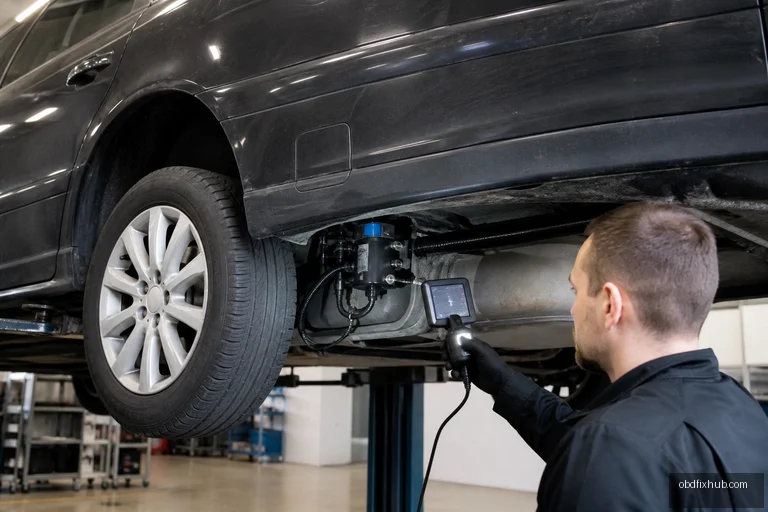
P2584 means the fuel additive control module has detected a problem and requested the engine computer to turn on the warning light. The code is commonly associated with diesel vehicles that use a fuel-borne additive to support diesel particulate filter regeneration. It does not automatically prove that the additive pump or tank has failed; the module’s stored subcodes, live data, wiring, and vehicle-specific service information must be checked before replacing parts.
Search intent: This is an informational and diagnostic query. Vehicle owners usually want to know whether the car is safe to drive, what the warning means, and which repair should be performed first.
What Does the P2584 Code Mean?
The technical definition of P2584 is Fuel Additive Control Module Requested MIL Illumination. MIL means Malfunction Indicator Lamp, commonly called the check engine light. In practical terms, the additive control module has reported a fault to the powertrain control module (PCM), and the PCM has switched on the warning light.
The fuel additive system is not the same as a conventional fuel injector. Depending on the vehicle, it may use an additive reservoir, a dosing pump, an additive injector, a level sensor, and a dedicated control module. The additive helps the diesel particulate filter reach regeneration temperature, often by lowering the soot-burning temperature.
Because P2584 is a requested-warning code, it is often a “summary” code rather than the original failure. A second manufacturer-specific code may identify the actual issue, such as an empty reservoir, pump circuit fault, communication failure, incorrect additive counter, or sensor problem.
Common Causes of P2584
- Low or empty fuel additive: The reservoir may be empty after an additive warning was ignored, or the level may be below the module’s calibrated threshold.
- Incorrect additive or contamination: Different systems require specific fluids. Mixing products, using the wrong additive, or introducing water can damage the dosing system.
- Failed additive pump or dosing injector: A seized pump, blocked line, or crystallized additive can prevent the commanded dose from reaching the fuel tank.
- Faulty level or quantity sensor: The control module may interpret an implausible reading as an additive-system failure.
- Damaged wiring or connectors: Wiring near the fuel tank is exposed to road salt, moisture, vibration, and impact damage. Corrosion is a frequent cause of intermittent faults.
- Control-module communication failure: A weak battery, poor ground, CAN-bus fault, or failed additive module can interrupt communication with the PCM.
- Service procedure not completed: After refilling the additive tank, many vehicles require an additive refill counter reset or a priming procedure with a scan tool.
P2584 Symptoms to Watch For
The most obvious symptom is an illuminated check engine light or a message such as Diesel additive low, Refill additive, or Engine fault. Some vehicles show a separate service or emissions warning instead of a traditional check engine light.
Other possible symptoms include difficult or incomplete DPF regeneration, reduced engine performance, increased fuel consumption, cooling fans running after shutdown, and a countdown to restricted starting or reduced power. The exact symptoms depend on whether the vehicle is merely low on additive or has lost the ability to dose the DPF system.
A vehicle can sometimes drive normally with P2584 stored. That does not make the fault harmless: repeated failed regenerations may increase soot loading and eventually create an expensive DPF problem.
How to Diagnose P2584 Correctly
- Scan every module, not just the PCM. Use a diagnostic tool that can communicate with the fuel additive module. Record all current, pending, and history codes before clearing anything.
- Check the additive level and fluid type. Do not rely only on the dashboard message. Inspect the reservoir and verify the correct additive specification using the vehicle’s service data.
- Inspect the tank area. Look for a loose connector, damaged harness, leaking line, broken mounting bracket, or crystallized residue around the pump and dosing components.
- Test power, ground, and communication. Measure voltage at the module under load and perform a voltage-drop test on the ground circuit. A visual inspection alone will not find high-resistance wiring.
- Use actuator tests and live data. A professional scan tool may command the pump, display additive quantity, and confirm whether the module sees a plausible response.
- Complete the required reset or priming routine. If the reservoir was refilled, the control module may still show an empty calculated quantity until the refill counter and dosing system are initialized.
- Check DPF data before forced regeneration. Ash load, soot load, differential pressure, and regeneration history should be reviewed. A forced regeneration is unsafe if the DPF is severely blocked or an additive fault remains active.
How to Fix P2584
The correct repair depends on the failed component. A low reservoir usually requires the specified additive, a leak check, and a scan-tool refill reset. If the pump does not operate during an actuator test, test its power and ground before condemning the pump; many unnecessary parts replacements result from skipping that step.
Corroded terminals should be repaired with the correct sealed connectors rather than simply sprayed with contact cleaner. A blocked dosing injector may require removal and cleaning or replacement, while a failed module may need programming or configuration after installation. Some systems also require the additive quantity counter to be synchronized with the PCM.
Do not pour additive directly into the diesel fuel tank unless the vehicle manufacturer specifically instructs that procedure. The quantity and dosing method are system-specific, and an incorrect fluid can cause DPF, injector, or fuel-system damage.
Can You Drive With P2584?
Short-distance driving is often possible if the vehicle has normal power, no red warning messages, no overheating, and no severe DPF restriction. Arrange diagnosis promptly, especially if an additive countdown or reduced-power message appears. Stop driving and seek professional assistance if the engine enters limp mode, the DPF warning flashes, the vehicle struggles to accelerate, or multiple emissions codes are present.
What Do “Please,” “Why,” and “Video” Mean in This Search?
These words are ordinary English terms that sometimes appear in voice searches or auto-generated search queries. Please is a polite word used when making a request. Why asks for a reason or explanation. Video means a recorded visual demonstration; in this case, a diagnostic video may show how to read the code or inspect the additive system, but it cannot replace vehicle-specific test data.
Frequently Asked Questions About P2584
Is P2584 the same as a low additive warning?
Not always. Low additive is one possible cause, but P2584 only confirms that the additive control module requested the warning light. Additional codes and live data are needed to identify the exact fault.
Will clearing P2584 fix the problem?
No. Clearing the code may turn the light off temporarily, but it will return if the underlying fault remains. After a refill or repair, the required reset and system test must be completed.
Can a weak battery cause P2584?
Yes. Low system voltage or a poor ground can interrupt module communication and create misleading additive-system codes. Battery and charging voltage should be checked before replacing the additive module.
How much does a P2584 repair cost?
Costs vary widely. A refill and reset may be relatively inexpensive, while a pump, wiring repair, injector, or programmed control module can cost substantially more. Diagnosis should come before ordering parts.
Should I watch a P2584 repair video?
A video can help you locate the reservoir or understand scan-tool menus, but procedures differ by make and model. Use the manufacturer’s repair information for fluid type, safety precautions, priming, and reset requirements.
Bottom Line
P2584 indicates that the fuel additive control module requested the warning light; it is not, by itself, a complete diagnosis. Scan all modules, verify the correct additive level and type, test the pump and wiring, and perform the required refill or programming procedure. Addressing the fault early can prevent failed DPF regeneration, reduced performance, and a much more expensive emissions-system repair.




