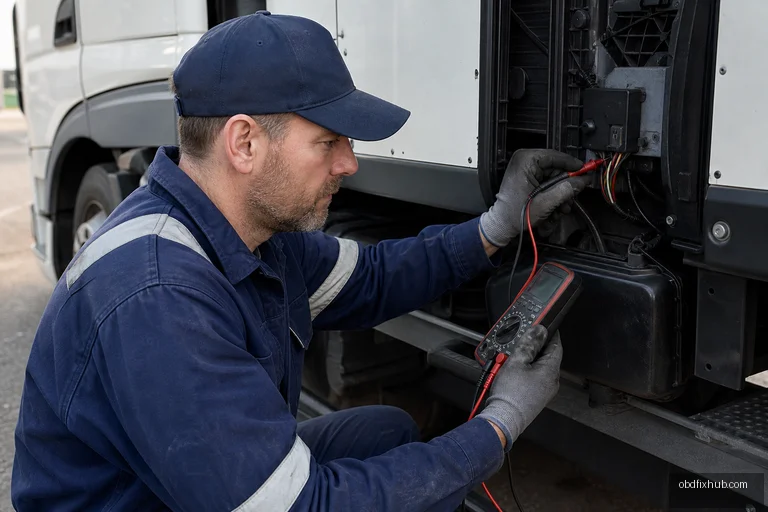
P25BA Particulate Filter Regeneration Switch Circuit means the engine control module has detected an electrical fault in the circuit used to request or control diesel particulate filter regeneration. The code does not automatically mean the DPF itself is blocked. In many cases, the fault is caused by a damaged switch, corroded connector, blown fuse, poor ground, or a broken wire between the switch and the control module.
This is an information-focused diagnostic issue rather than a part-swapping problem. The exact circuit design varies by vehicle, engine, and equipment manufacturer, so the wiring diagram and manufacturer-specific service information are essential before testing or replacing components.
What Does P25BA Mean?
P25BA is a diagnostic trouble code associated with the particulate filter regeneration switch circuit. The regeneration switch may be a dashboard button, a control-panel switch on industrial equipment, or part of a larger operator request circuit. When activated under the correct conditions, it tells the engine control system that the operator wants a DPF regeneration cycle.
The engine computer still decides whether regeneration is safe and appropriate. It may reject the request if coolant temperature, exhaust temperature, fuel level, vehicle speed, engine load, or other conditions are outside the permitted range. Therefore, P25BA usually points to the electrical signal path, not proof that the regeneration process itself has failed.
Common Causes of the P25BA Code
- Failed or internally shorted DPF regeneration switch
- Open, shorted, or chafed wiring in the switch circuit
- Loose, bent, contaminated, or water-damaged connector terminals
- Blown fuse or a failed power supply to the switch circuit
- Poor ground connection, especially on equipment exposed to vibration or moisture
- Incorrect switch installation after dashboard or control-panel repairs
- Faulty body, engine, or powertrain control module, although this is less common
- Low system voltage or unstable battery voltage creating an implausible switch signal
- Software or calibration issues identified in a manufacturer technical service bulletin
On forklifts, loaders, generators, and other diesel equipment, the switch and harness often suffer more physical stress than they would in a passenger vehicle. Repeated cab entry, pressure washing, engine vibration, and contact with metal brackets can damage insulation without leaving an obvious visual mark.
Symptoms of P25BA Particulate Filter Regeneration Switch Circuit Failure
The symptoms depend on whether the circuit is stuck open, stuck closed, or producing a signal that the control module cannot interpret. A vehicle may continue to run normally at first, which is why this code is sometimes discovered during routine servicing rather than after a dramatic breakdown.
- Check Engine or malfunction indicator lamp illuminated
- Manual or parked regeneration will not start
- Regeneration request button has no response
- DPF warning lamp or exhaust-system warning message
- Reduced engine power or derate after soot loading increases
- Repeated failed regeneration attempts
- Higher fuel consumption and possible limp mode
A key practical clue is the relationship between the button and the scan tool. If the scan tool shows that the regeneration request never changes when the switch is pressed, investigate the switch and input circuit first. If the request changes correctly but regeneration is still inhibited, other faults—such as excessive soot load, exhaust temperature problems, or differential-pressure sensor errors—may be present.
How to Diagnose P25BA Correctly
1. Read all stored and pending codes
Begin with a full vehicle scan, not just a generic code read. Record active, pending, and history codes, along with freeze-frame data. Codes for low battery voltage, DPF differential pressure, exhaust gas temperature sensors, or communication faults may explain why the regeneration switch circuit is being flagged.
2. Confirm the switch input with live data
Use a scan tool that can display the regeneration request or switch status. Press the switch only under safe conditions and observe whether the data changes from inactive to active. If the parameter does not change, the problem is likely upstream of the control module or inside the input circuit.
3. Inspect the switch and connector
Remove the switch connector and look for pushed-back terminals, green corrosion, moisture, overheated plastic, or evidence of previous repairs. Do not rely on a visual inspection alone; a terminal can look clean yet lose contact when vibration or harness movement is introduced.
4. Test power, ground, and signal wiring
Use the wiring diagram to identify the circuit type. Some systems use a simple switched voltage, while others use a resistor-based input or a networked control signal. Check voltage and ground with the connector loaded whenever possible, then perform a wiggle test on the harness while monitoring the signal.
Do not assume that a measured battery voltage proves the circuit is healthy. A corroded terminal may show normal voltage with no load but fail when current flows. A voltage-drop test across the power and ground sides is often more revealing than a continuity check with the circuit disconnected.
5. Check fuses and module-side wiring
Test the relevant fuse on both sides with the circuit powered. If a fuse is open, find the reason rather than installing a larger fuse. A shorted switch or harness rubbing against a grounded bracket can cause the replacement fuse to fail immediately.
6. Verify regeneration enable conditions
Once the switch circuit responds correctly, confirm that the engine meets the requirements for a commanded regeneration. Check coolant temperature, fuel level, exhaust temperature sensor readings, DPF pressure data, engine speed, and active safety inhibit conditions. A correct switch signal cannot override a regeneration lockout caused by excessive soot or another engine fault.
Common Repair Solutions
- Replace a defective regeneration switch with the correct OEM-quality part.
- Repair damaged wiring using sealed automotive terminals and heat-shrink protection.
- Clean or replace corroded terminals rather than spraying contact cleaner and reusing loose pins.
- Repair damaged grounds and tighten them to the manufacturer’s specified torque.
- Replace the correct fuse only after confirming there is no short circuit.
- Perform required control-module software updates or relearn procedures.
- Clear the code and confirm the switch status and regeneration request through a complete drive or work cycle.
If the DPF is already heavily loaded, repairing P25BA may not be enough. The system may require a service regeneration, professional DPF cleaning, or replacement after the cause of the failed regeneration has been corrected. Repeatedly forcing regeneration on a filter with excessive restriction can raise exhaust temperatures and damage the turbocharger, sensors, or aftertreatment components.
Can You Drive With P25BA?
Short-distance driving to a repair facility is often possible if the engine has normal power and no severe warning message is displayed. However, continued operation allows soot accumulation to increase if manual regeneration is unavailable. Stop operating the vehicle if you notice extreme power loss, a flashing warning lamp, abnormal exhaust heat, smoke, or an engine shutdown/derate warning.
Never attempt a parked regeneration indoors, near dry grass, flammable materials, people, or equipment that cannot tolerate very high exhaust temperatures. Follow the manufacturer’s regeneration procedure and keep the area ventilated and clear.
How Much Does P25BA Repair Cost?
The cost depends on the failed component and the vehicle or machine involved. A loose terminal or broken wire may be inexpensive to repair, while a switch, harness section, control module, or professional DPF cleaning can cost considerably more. Diagnostic time is usually the most valuable part of the repair because replacing the DPF before testing the switch circuit often solves nothing.
Practical Diagnostic Tip
Before replacing the regeneration switch, monitor the switch input while moving the harness near the steering column, dashboard, firewall, or engine harness clips. If the status changes without pressing the button, you have likely found an intermittent open or short. This simple test has prevented many unnecessary switch replacements, particularly on high-vibration commercial equipment.
Summary
P25BA identifies a fault in the particulate filter regeneration switch circuit. Start with a complete scan, verify the live-data switch response, inspect connectors and grounds, and test the circuit under load using the correct wiring diagram. Repair the electrical fault before attempting regeneration, then confirm that all DPF and engine operating conditions are satisfied.
If the code returns after a verified circuit repair, investigate related DPF pressure, temperature, soot-load, and control-module faults with manufacturer-level diagnostic equipment. Accurate testing is safer and usually less expensive than replacing the filter or control components by guesswork.
Frequently Asked Questions
Can a bad DPF cause P25BA?
Usually, P25BA directly indicates a problem with the regeneration switch circuit rather than a physically blocked DPF. A severely loaded DPF can exist at the same time, but it should be confirmed with pressure and soot-load data.
Will clearing P25BA fix the problem?
No. Clearing the code only removes the stored fault temporarily. If the switch signal, wiring, or connector remains faulty, the code will return when the control module runs its circuit checks again.
Why will my manual regeneration button not work?
A failed switch circuit is one possibility, but regeneration may also be inhibited by low fuel, cold engine temperature, active sensor faults, excessive soot loading, or a manufacturer safety lockout.
Is P25BA the same on every diesel vehicle?
No. The general meaning concerns the particulate filter regeneration switch circuit, but the circuit design, test voltages, connector pins, and repair procedure are manufacturer-specific. Always use the correct service information for the vehicle or machine.




