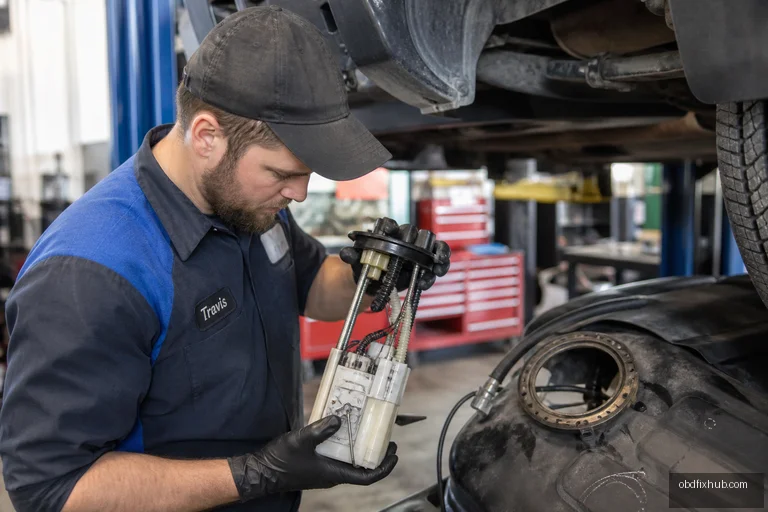
P26EA Secondary Fuel Pump Control Module Fault means the vehicle has detected a problem with the control, communication, power supply, or performance of its secondary fuel pump system. The code does not automatically prove that the pump itself has failed. A weak battery, blown fuse, damaged wiring, poor ground, failed control module, or a fuel-pressure problem can trigger the same diagnostic trouble code.
This is an informational search intent: you want to understand the code before deciding whether diagnosis or repair is needed. Because P26EA is not interpreted identically by every manufacturer, the vehicle year, make, model, engine, and the exact scan-tool description matter.
What Does P26EA Mean?
P26EA is an OBD-II powertrain code associated with the secondary fuel pump control module. In practical terms, the engine computer has seen an implausible signal or operating condition from the module that controls an additional fuel pump. Depending on the vehicle, this may be an auxiliary, transfer, lift, or high-pressure fuel delivery pump.
The word secondary does not necessarily mean the pump is unimportant. It often describes a second pump used during cold starts, high-load operation, fuel-tank transfer, or precise pressure control. Some vehicles use a separate controller, while others integrate the pump electronics into the fuel pump assembly.
Why the exact vehicle matters
Generic code databases may display P26EA as a secondary fuel pump control module fault, but manufacturers can define the monitoring conditions differently. One vehicle may set it after losing communication with the module; another may set it when commanded fuel pressure does not match actual pressure. Always compare the generic description with the manufacturer-specific service information.
Common Symptoms of a P26EA Code
Some drivers notice only an illuminated Check Engine light. Others experience a clear fuel-delivery problem, especially when the vehicle is cold, under acceleration, or climbing a hill.
- Extended cranking before the engine starts
- Hard starting or an engine that starts and stalls
- hesitation, stumbling, or reduced power under load
- Engine misfires caused by low or unstable fuel pressure
- Reduced-power or limp-home operation
- Fuel pump noise that is louder, intermittent, or absent
- Poor fuel economy or unstable idle
- Additional low fuel pressure, communication, or voltage codes
A vehicle that still drives normally can become difficult to start without warning. Do not treat the absence of drivability symptoms as proof that the pump system is healthy.
Most Likely Causes
- Low system voltage: A weak battery, charging fault, or voltage drop during cranking can make a healthy module appear defective.
- Blown fuse or faulty relay: High current draw from a failing pump can repeatedly open the fuse or damage relay contacts.
- Open, shorted, or corroded wiring: Wiring near the fuel tank is exposed to water, road salt, vibration, and impact damage.
- Poor ground connection: A loose ground can cause intermittent module resets and misleading communication faults.
- Failed secondary fuel pump: A worn motor may run slowly, draw excessive current, or stop after warming up.
- Defective control module: Internal electronic failure, moisture intrusion, or software problems can prevent correct pump operation.
- Fuel-pressure or restriction problem: A blocked filter, pinched line, restricted pickup, or faulty pressure sensor may make the commanded and measured values disagree.
- Connector damage: Loose terminals and pushed-back pins can pass a visual inspection but fail under vibration or load.
How to Diagnose P26EA Correctly
Replacing the pump first is an expensive gamble. A professional diagnosis begins by recording every stored, pending, and history code, along with freeze-frame data. Note engine temperature, battery voltage, commanded pump speed, actual fuel pressure, and whether the code appeared during starting or driving.
- Confirm the code. Clear the code only after saving the scan data, then check whether P26EA returns during a controlled test. Look for related low-voltage or network communication codes.
- Check battery and charging voltage. A fully charged battery should generally be near 12.6 volts with the engine off. Running voltage is commonly around 13.5 to 14.8 volts, although the vehicle specification takes priority.
- Inspect the fuse, relay, and connectors. Look for heat discoloration, green corrosion, loose pins, water intrusion, and damaged insulation. A fuse should never be replaced with a higher rating.
- Test power and ground under load. A voltage reading with the connector unplugged can look normal. Perform voltage-drop testing while the pump is commanded on; excessive loss indicates resistance in the power or ground path.
- Verify module communication. If the control module cannot communicate with the scan tool, test its power, ground, CAN wiring, and termination according to the service manual.
- Measure fuel pressure and current draw. Compare actual pressure with the specified range. A pump drawing too much current may be mechanically worn, while low current with no pressure often points to an open circuit or failed pump.
- Check software and calibration updates. Some manufacturers release module programming updates for false or intermittent pump-control faults.
Never open a fuel system near sparks, heaters, or smoking materials. Relieve fuel pressure using the manufacturer procedure, wear eye protection, and use a suitable fuel-pressure gauge. Modern high-pressure fuel systems can remain dangerous even after the engine is switched off.
P26EA Repair: What Usually Fixes It?
The correct repair depends on the failed test, not the code label. A corroded ground may require cleaning and terminal repair; a damaged harness may need an approved splice or replacement; and a failed pump or control module may require replacement followed by programming or a relearn procedure.
After the repair, clear the codes, confirm that the module communicates, and verify fuel pressure during cold start and acceleration. A short idle test is not enough if the original fault occurred under heavy load. Perform a road test using the conditions recorded in the freeze-frame data, then rescan the vehicle for pending codes.
Can You Drive With P26EA?
Short-distance driving may be possible if the engine starts easily, runs smoothly, and fuel pressure remains within specification. However, stalling in traffic or losing power during overtaking creates a safety risk. Stop driving and arrange diagnosis if the vehicle has hard starting, repeated stalling, severe misfires, a strong fuel smell, or a flashing Check Engine light.
Technical Meaning of the Words
In this fault description, fault means the system has detected behavior outside its expected range; it does not always mean a component is completely dead. Words can have different meanings depending on context: a pump can mean a mechanical device in a fuel system or a verb meaning to move fluid, while module can mean an electronic controller or a removable section of a larger system.
When a repair guide says see the service information, see means read, consult, or refer to that technical source. A video means a visual recording, such as a repair demonstration, but a video should support—not replace—the correct wiring diagram, safety procedure, and manufacturer specifications.
Key Takeaway
P26EA points to a problem in the secondary fuel pump control system, but it does not identify one guaranteed failed part. Start with scan data, battery voltage, fuses, grounds, wiring, communication, fuel pressure, and pump current draw. If the code returns, use the manufacturer’s diagnostic tree before buying a pump or control module.
Frequently Asked Questions
What is the meaning of P26EA?
It generally indicates a fault involving the secondary fuel pump control module or its operation. The exact monitoring strategy and repair procedure vary by vehicle manufacturer.
Can a weak battery cause P26EA?
Yes. Low voltage during cranking or unstable charging voltage can interrupt module communication and cause an apparent pump-control failure.
Does P26EA always mean the fuel pump must be replaced?
No. Wiring, grounds, fuses, relays, pressure restrictions, sensors, and the control module can all produce the code.
What does see mean in a repair instruction?
In this context, see means consult or refer to the specified service manual, wiring diagram, or diagnostic procedure.
What does video mean?
Video means a visual recording. A repair video can show general techniques, but vehicle-specific electrical and fuel-system specifications should come from reliable service information.




