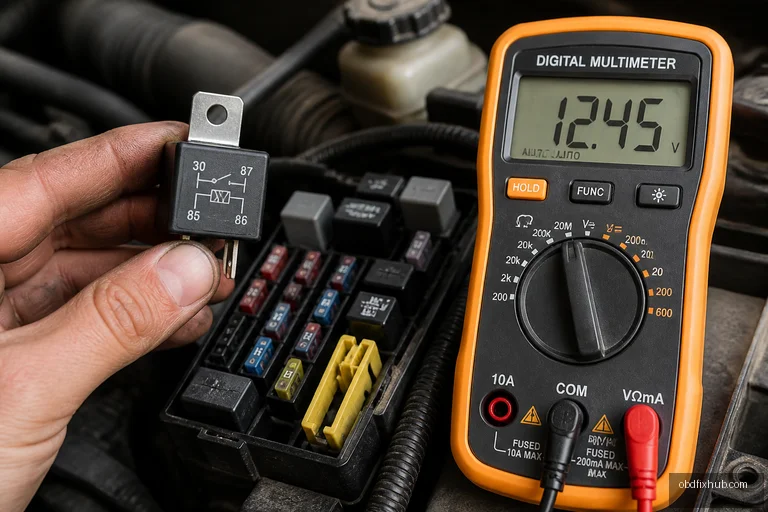
P26F0 Starter Relay Stuck On means the vehicle’s control module has detected that the starter relay circuit remains active when it should be off. The most common causes are welded relay contacts, a shorted control wire, a faulty starter relay driver, or an incorrect signal from the ignition switch or push-button start system. Do not replace the relay automatically: a relay that sticks again usually has an underlying electrical problem.
What Does P26F0 Mean?
P26F0 is commonly described as “Starter Relay A Stuck On”. The relay is an electrically controlled switch that sends high current from the battery to the starter solenoid. Under normal conditions, the powertrain or body control system energizes the relay only while the vehicle is authorized to crank.
When the module sees voltage or current on the starter relay circuit after the crank request has ended, it stores P26F0. The exact circuit designation can vary by manufacturer, so the factory service manual and the scan tool’s full description matter. On some vehicles, “Relay A” identifies one of several starter-control paths rather than a relay with that exact label in the fuse box.
Symptoms of P26F0 Starter Relay Stuck On
A stuck starter relay can create obvious symptoms, but it can also remain intermittent. The vehicle may start normally during a short test drive and then fail after the engine is switched off. Pay particular attention to what happens immediately after releasing the key or start button.
- The starter motor continues cranking after the engine starts.
- The starter engages without a normal crank request.
- A rapid clicking or grinding sound comes from the starter area.
- The battery becomes discharged after the vehicle is parked.
- The starter relay or fuse becomes unusually hot.
- The engine will not crank because the control module disables starting.
- Warning lights appear, including the check engine or starting-system warning.
- Additional communication, immobilizer, or low-voltage codes are stored.
If the starter keeps running after the engine has started, switch the ignition off and disconnect the negative battery cable only if it is safe to do so and you know the vehicle’s battery-disconnection procedure. Continuous cranking can overheat the starter, damage the ring gear, and flatten the battery within minutes.
Common Causes of Code P26F0
1. Welded or mechanically stuck relay contacts
High current, repeated hot starts, corrosion, or a worn starter solenoid can cause the relay contacts to arc and weld together. In this situation, removing the relay’s control signal may not stop the starter because battery power is still bridged through the damaged contacts. This is the classic cause of a relay that is genuinely “stuck on.”
2. Short to voltage in the relay control circuit
A damaged harness can allow ignition voltage or battery voltage to reach the relay coil continuously. Look for insulation rubbed through near the fuse box, steering column, starter, or areas recently disturbed during engine or transmission work. Aftermarket remote starters and alarm systems are frequent sources of poorly insulated splices.
3. Faulty ignition switch or start button
A worn ignition switch may keep the crank signal active after the key returns from the START position. On push-button vehicles, a defective button, brake-pedal switch, clutch switch, or start-author request can produce a similar result. The switch may test normally when cold and fail only after the cabin warms up.
4. Starter solenoid or starter motor fault
The relay may be functioning correctly while the starter solenoid contacts remain closed. A failing solenoid can draw excessive current, overheat the relay, or create voltage feedback that confuses the control module. If a new relay immediately becomes hot or sticks, test the starter current draw instead of installing another relay.
5. Control module or software problem
A damaged relay driver inside the engine, body, or powertrain control module is less common but possible. Water intrusion, reverse polarity, jump-start mistakes, and wiring shorts can damage the driver. Some manufacturers also publish software updates for starter-control logic, so check technical service bulletins before condemning an expensive module.
How to Diagnose P26F0 Correctly
A professional diagnosis separates a power-side fault from a control-side fault. The following workflow is safer and more reliable than swapping parts:
- Record all codes and freeze-frame data. Low system voltage and immobilizer codes may be related. Save the data before clearing anything.
- Check the battery and charging system. A weak battery can cause erratic relay operation, while overcharging can damage electrical components. A healthy resting battery is typically close to 12.6 volts, but follow the vehicle manufacturer’s test specifications.
- Confirm whether the starter remains energized. With the engine off and the key removed, listen for the starter and measure voltage at the starter solenoid control terminal. Avoid probing near moving belts or the rotating starter gear.
- Remove the starter relay, if accessible. If the starter stops when the relay is removed, inspect the relay contacts and control circuit. If it continues, the problem may be a different relay, a solenoid fault, or a wiring bypass.
- Test the relay socket. Use a wiring diagram to identify battery feed, load output, coil power, and coil ground or control. Never apply power to an unknown terminal; terminal layouts differ between vehicles.
- Check for a commanded signal with a scan tool. Bi-directional controls can show whether the module is intentionally commanding the relay. If the module says OFF but the control output remains active, suspect a stuck driver or shorted wire.
- Inspect connectors and grounds. Green corrosion, loose terminals, water in the fuse box, and a poor engine ground can create misleading relay faults.
A useful field clue is the relay-swap test, but it should be used carefully. Exchange the suspect relay only with an identical relay having the same part number and pin configuration. If the symptom follows the relay, the relay is defective; if it stays with the vehicle, continue testing the wiring and module command.
How to Fix P26F0
The correct repair depends on the failed component. Replace a relay with burned or welded contacts, repair damaged wiring with sealed automotive-grade splices, and correct loose or corroded terminals. If the starter solenoid has excessive current draw or remains engaged, repair or replace the starter assembly rather than repeatedly replacing the relay.
For ignition-switch, brake-switch, clutch-switch, or push-button faults, verify the input and output signals under the exact conditions that trigger the code. A control-module replacement should be the final step, supported by voltage-drop tests, wiring checks, and manufacturer diagnostic procedures. Many modules require programming, immobilizer pairing, or configuration after installation.
Can You Drive With P26F0?
Driving is not recommended if the starter cranks by itself, remains engaged, or the relay becomes hot. The vehicle can lose starting ability without warning, and continued starter operation can damage expensive components. If the code is stored without any abnormal starter behavior, drive only as necessary to reach a repair facility after confirming that the battery is not being drained.
Final Takeaway
P26F0 points to a starter relay circuit that the vehicle believes is staying active. Start with battery voltage, relay operation, and the distinction between a welded relay contact and an unwanted control signal. A wiring diagram, a capable scan tool, and voltage testing will prevent unnecessary replacement of the starter or control module. If the starter remains engaged, disconnect power safely and arrange prompt electrical diagnosis.
Frequently Asked Questions
Can a bad battery cause P26F0?
A weak battery can contribute to erratic relay behavior and additional fault codes, but it usually does not physically weld relay contacts. Test the battery and charging system first, then investigate the relay circuit if the code returns.
Will replacing the starter relay fix P26F0?
It may, if the relay contacts are welded or the coil has failed. If a shorted wire, faulty ignition switch, starter solenoid, or control-module driver caused the relay to stick, the replacement relay may fail again.
Why does the starter keep running after the engine starts?
The relay contacts or starter solenoid may be stuck closed, or the relay may still be receiving a crank command. Turn the ignition off and disconnect the battery safely to prevent starter and flywheel damage.
Is P26F0 the same on every vehicle?
No. The general meaning is related to a starter relay remaining on, but circuit names, relay locations, control strategies, and repair procedures vary. Always verify the code definition for the specific year, make, model, and engine.
How much does it cost to repair P26F0?
A relay or wiring repair is usually inexpensive compared with a starter or control-module replacement. The final cost depends on access, diagnostic time, programming requirements, and the vehicle’s electrical design.




