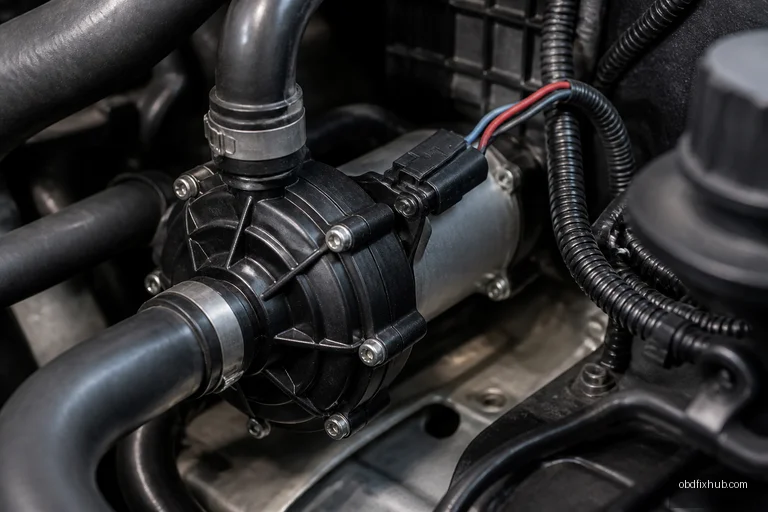
The P26CA code means the engine computer has detected a fault in the electronic engine coolant pump control circuit. In many vehicles, this can indicate an open circuit, poor power or ground supply, wiring damage, a failed coolant pump, or a control-module problem. You may be able to drive a short distance if the engine temperature remains normal, but continuing to drive an overheating vehicle can cause severe engine damage.
What Does the P26CA Code Mean?
P26CA is a generic powertrain diagnostic trouble code associated with an electronic engine coolant pump. Unlike a traditional belt-driven water pump, an electric pump is controlled by the engine control module (ECM) and can operate independently of engine speed. This allows the vehicle to manage coolant flow more precisely during warm-up, idling, turbocharger cooling, hybrid operation, and after-run cooling.
The exact meaning can change slightly by manufacturer and by the additional fault suffix. For example, a scan tool may display P26CA-12, P26CA-14, or P26CA-31. Those extensions can identify a short to power, an open or electrical plausibility problem, or a manufacturer-specific signal fault. Do not diagnose the vehicle from the base P26CA code alone; the complete code, vehicle identification number, freeze-frame data, and service information matter.
Most Common Causes of P26CA
- Failed electronic coolant pump: The internal motor, electronics, position sensor, or pump impeller may have failed.
- Open or damaged wiring: A broken conductor near the pump connector can interrupt power, ground, or the control signal.
- Corroded connector pins: Coolant vapor, road salt, water intrusion, and poor connector sealing can create high resistance.
- Blown fuse or faulty relay: A fuse may open because of a shorted pump, but replacing the fuse without testing the circuit can lead to another failure.
- Weak ground connection: A corroded chassis ground can make the pump appear defective even when the pump itself is functional.
- Low battery voltage: Voltage drops during starting can set misleading actuator and control-circuit codes.
- ECM or pump-control software fault: This is less common and should only be considered after power, ground, wiring, and pump operation have been verified.
P26CA Symptoms to Watch For
Some drivers see only a check-engine light, while others notice a clear cooling-system problem. Common symptoms include an engine-temperature warning, temperature rising in traffic, an electric pump running loudly, reduced cabin heat, cooling fans operating continuously, reduced engine power, or a coolant-pump noise that continues after the ignition is switched off.
A useful real-world clue is the pattern of the temperature change. If the engine stays cool while moving but overheats at idle, airflow and coolant circulation should both be tested. If the temperature rises quickly under all conditions, stop driving and inspect the coolant level and pump operation immediately. Never remove the coolant reservoir cap on a hot engine.
How to Diagnose P26CA Correctly
Replacing the pump immediately is a common but avoidable mistake. A professional diagnosis should confirm whether the pump is receiving the correct voltage and ground, whether the ECM is sending the commanded control signal, and whether the pump responds to an active test.
- Record all codes and freeze-frame data. Related low-voltage, communication, fan, or temperature-sensor codes may reveal the original problem.
- Check coolant level and leaks. A low coolant level can cause poor circulation and may damage an electric pump.
- Inspect the connector closely. Look for green corrosion, pushed-back terminals, overheated plastic, loose pins, and coolant inside the plug.
- Test the fuse, power feed, and ground under load. A simple continuity test may pass even when a wire cannot carry pump current.
- Use a bidirectional scan tool. Command the pump on and compare the commanded state with actual pump operation and current draw.
- Perform a voltage-drop test. Excessive voltage loss on the positive or ground side points to resistance in the wiring or connections.
- Check technical service bulletins. Some vehicles have known connector, software, harness-routing, or pump-calibration issues.
After the repair, the cooling system may require a manufacturer-specific bleeding procedure. Air trapped near an electric pump can reduce circulation and make a correctly installed pump appear faulty. Clear the code only after the system has been bled, the engine has reached operating temperature, and the pump has passed a commanded-output test.
Can You Drive With P26CA?
Driving is only reasonably safe when the coolant level is correct, the engine temperature stays completely normal, and there are no overheating warnings. Keep the trip short, avoid heavy traffic and high engine load, and monitor the temperature gauge continuously. If the gauge rises, the heater suddenly blows cold air, steam appears, a warning message flashes, or the cooling fans behave unusually, pull over and shut the engine off.
An electric coolant pump can fail intermittently. That means a vehicle may seem normal during a short test drive and then overheat when idling, climbing a hill, or shutting down after a hot run. For that reason, P26CA should be treated as a prompt repair, not a code to ignore until the car becomes undriveable.
What Does Coolant Pump A Control Circuit Open Mean?
“Control circuit open” means the ECM cannot detect the expected electrical path to or from the coolant pump control circuit. The cause may be a disconnected plug, broken wire, failed internal pump electronics, a missing power supply, or a failed ground. It does not automatically prove that the mechanical pump has seized.
Testing at the pump connector is important. If power, ground, and the control command are present but the pump does not operate, pump replacement is likely. If one of those inputs is missing, the harness, fuse, relay, ground point, and ECM control side must be diagnosed before installing a new pump.
How Much Does an Auxiliary Coolant Pump Replacement Cost?
An auxiliary electric coolant pump commonly costs approximately $150 to $600 installed, but the total depends heavily on the vehicle. The part may cost $80 to $350, while labor, coolant, bleeding, and access requirements add to the bill. Dealer pricing, hybrid systems, turbocharger cooling circuits, and premium-brand parts can push the repair above $700.
Ask the repair shop whether the estimate includes diagnosis, a new connector or wiring repair, coolant, system bleeding, and post-repair testing. If the quote is for a pump alone but the original fault is an open circuit in the harness, the code may return after the repair.
Related Codes: P26AB and P261B
P26AB and P261B also relate to coolant-pump control on some vehicles, but their precise definitions are manufacturer-dependent. P26AB may describe a low, high, or performance condition in a designated coolant-pump circuit. P261B often refers to coolant pump B range or performance. The letter designation does not always identify the same physical pump across different brands.
You may drive with P26AB or P261B only if the engine temperature remains stable and no cooling-system warning is present, and even then only long enough to reach a repair facility. Because the codes can involve different pumps and failure types, use the exact code description from a factory-capable scan tool rather than assuming that every coolant-pump code requires the same part.
Key Takeaways
- P26CA points to an electronic engine coolant-pump control fault, not necessarily a mechanically seized pump.
- Check power, ground, wiring, connector condition, and pump commands before replacing parts.
- Do not continue driving if the temperature rises, coolant is low, or an overheating warning appears.
- Auxiliary coolant-pump replacement often costs $150–$600, with hybrid and premium vehicles costing more.
- After repair, bleed the cooling system and verify pump operation with a scan tool.
Frequently Asked Questions
Can you drive with a P26AB code?
Only cautiously and for a short distance if the coolant level and engine temperature are normal. Stop immediately if the temperature rises or an overheating warning appears, because an electric pump can fail without much notice.
What does coolant pump A control circuit open mean?
It means the ECM detects an interrupted electrical path in the pump A control circuit. A broken wire, loose connector, failed fuse, poor ground, or defective pump electronics can all create this message.
Can I drive with a P261B code?
It is not advisable to use the vehicle normally until it is diagnosed. A short trip to a repair shop may be acceptable only when the engine stays at normal temperature and no coolant warning is active.
How much does it cost to replace an auxiliary coolant pump?
A typical installed price is about $150–$600. The final cost depends on the pump location, vehicle brand, labor time, coolant bleeding requirements, and whether wiring or connector damage is also found.




