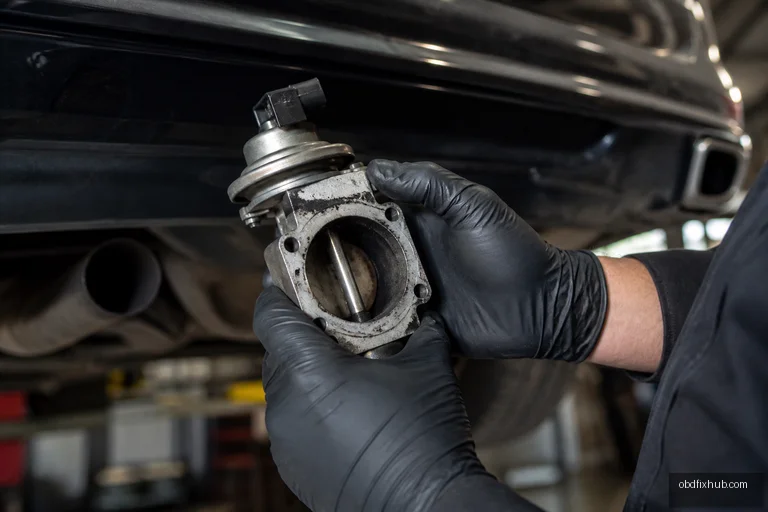
P26C5 Exhaust Flow Control Valve Circuit Open means the engine control module has detected an open or interrupted electrical circuit in the exhaust flow control valve system. This valve is commonly used on diesel engines to manage exhaust backpressure, support EGR operation, and improve DPF regeneration. The fault may be caused by a failed valve actuator, damaged wiring, a poor connector, a blown fuse, or a control-module issue—not necessarily a stuck valve itself.
What Does P26C5 Mean?
The P26C5 diagnostic trouble code is generally defined as Exhaust Flow Control Valve “A” Circuit/Open. The exact component name and testing procedure vary by manufacturer, so the vehicle’s service information should take priority over a generic code description.
On many modern diesel vehicles, the exhaust flow control valve is an electronically controlled butterfly-style valve installed in the exhaust system. It can partially close to create controlled backpressure. That backpressure helps the engine manage exhaust gas recirculation, reach the correct temperature during a diesel particulate filter regeneration, and reduce emissions during particular operating conditions.
The word open usually refers to an electrical circuit problem. The powertrain control module may detect zero current through the actuator, an implausible position signal, or a missing response when it commands the valve. A valve that is physically stuck open can trigger related faults, but P26C5 should not automatically be treated as a purely mechanical failure.
Common Symptoms of P26C5
Some vehicles will continue to drive almost normally with this code, while others will enter reduced-power mode. The symptoms depend on how heavily the manufacturer relies on the valve for emissions and engine management.
- Check Engine Light or Service Engine Soon warning
- Reduced engine power or limp-home mode
- Slow or incomplete DPF regeneration
- Higher exhaust temperatures or abnormal exhaust temperature readings
- Rougher operation during EGR-related conditions
- Increased fuel consumption
- Black smoke or poor throttle response on some diesel applications
- Additional EGR, DPF, turbocharger, or actuator position codes
A useful real-world clue is when the vehicle drives well on short trips but develops repeated DPF warnings after highway use. If the exhaust flow valve cannot move or cannot report its position, the engine controller may cancel regeneration even though the DPF itself is not yet blocked.
Most Likely Causes of the P26C5 Code
1. Damaged wiring or a poor connector
Exhaust-mounted components live in severe heat, vibration, salt, and moisture. Wiring can become brittle near the valve, insulation may melt against the exhaust, or a terminal may lose tension inside the connector. A connector that looks clean externally can still have corrosion or a pushed-back pin.
2. Failed exhaust flow control valve actuator
The actuator motor or internal position sensor may fail electrically. In some designs, the motor and valve are sold as one assembly; in others, the actuator can be serviced separately. Never assume the actuator is replaceable without checking the parts catalog for the exact engine and emissions package.
3. Blown fuse, failed relay, or missing power supply
A fuse may fail because of a shorted actuator, damaged harness, or water intrusion. Replacing the fuse without finding the reason it opened can cause another failure immediately. Check both the actuator power circuit and the control-module supply using the wiring diagram, not only a visual inspection.
4. Carbon or soot restricting the valve
Heavy soot can make the butterfly plate bind. Carbon buildup alone is more likely to produce a performance or position-related fault than a pure circuit-open code, but it can overload the actuator and damage its motor. If the valve is removed, inspect the shaft for free movement rather than forcing it with excessive leverage.
5. Control-side or software problem
In less common cases, the engine control module driver, ground circuit, or calibration may be at fault. Manufacturer technical service bulletins sometimes identify software updates or harness repairs for intermittent exhaust valve codes. Check for bulletins before installing an expensive valve assembly.
How to Diagnose P26C5 Properly
A basic code reader can identify P26C5, but it usually cannot prove which part failed. A professional diagnosis should combine a wiring diagram, a multimeter, bidirectional scan-tool tests, and a physical inspection.
- Record all codes and freeze-frame data. Note engine speed, coolant temperature, vehicle speed, battery voltage, and whether other DPF or EGR codes appeared at the same time.
- Inspect the valve and harness. Look for melted insulation, exhaust leaks near the actuator, oil or water inside the connector, damaged retaining clips, and wiring pulled tight against the exhaust.
- Check fuses and grounds under load. A circuit can show battery voltage with no load and still fail when the actuator is commanded. A voltage-drop test is more reliable than relying on an unloaded voltage reading.
- Test actuator power and control circuits. Compare resistance, supply voltage, ground quality, and signal behavior with the manufacturer’s specifications. Do not apply direct battery power to a smart actuator unless the service procedure specifically permits it.
- Use the scan tool to command the valve. Listen for actuator operation and observe the commanded-versus-actual position. No movement with good power and ground points toward the actuator or a seized valve; no command may indicate a control or enable-condition problem.
- Inspect mechanical movement. With the actuator disconnected only as instructed by the service manual, verify that the valve shaft is not seized by soot or corrosion.
- Clear the code and verify the repair. Complete the required drive cycle or a manufacturer-approved regeneration procedure. A successful road test should confirm that the valve tracks its commanded position and that the code does not return.
Common Repairs for P26C5
- Repairing or replacing heat-damaged wiring
- Cleaning corrosion from terminals and repairing loose connector pins
- Replacing a blown fuse after correcting the underlying short
- Replacing the exhaust flow control valve or actuator assembly
- Cleaning a carbon-restricted valve when permitted by the manufacturer
- Updating engine-control software or repairing a control-module circuit
After replacing the valve, some vehicles require an actuator relearn, adaptation, or calibration with a scan tool. Skipping that step can leave the new component uninitialized and cause the same code to return. A forced DPF regeneration should also not be performed until the electrical fault is repaired and the DPF soot load is confirmed safe.
Can You Drive With P26C5?
Short, gentle driving may be possible if the vehicle has normal power and no red warning lights. However, continued driving can prevent DPF regeneration, increase soot loading, and eventually lead to reduced power or a much more expensive exhaust-system repair. Stop driving and seek immediate diagnosis if the vehicle overheats, enters severe limp mode, produces excessive smoke, or displays a flashing warning light.
What Not to Do When This Code Appears
- Do not replace the DPF before testing the exhaust valve circuit.
- Do not keep replacing fuses without locating the short or overloaded actuator.
- Do not force a seized butterfly valve with pliers, as the shaft or actuator gears can break.
- Do not assume a cleared code means the problem is fixed; intermittent wiring faults often return after heat and vibration.
Final Takeaway
P26C5 points first to an electrical interruption or missing response in the exhaust flow control valve circuit. Start with the fuse, power, ground, connector, and heat-damaged wiring before condemning the valve or DPF. If the circuit checks out, test actuator operation and mechanical movement, then complete any required relearn and regeneration verification. The fastest repair is usually the one based on measured circuit tests rather than replacing emissions components by guesswork.
Frequently Asked Questions
Is P26C5 the same as a stuck exhaust valve?
No. P26C5 primarily indicates an open or interrupted electrical circuit, although a mechanically seized valve can damage the actuator and create related faults. Test the electrical circuit and valve movement separately.
Can a bad battery cause P26C5?
Low system voltage can create misleading actuator codes, especially during starting or regeneration. Check battery condition and charging voltage, but do not assume the battery is the cause unless the voltage data supports it.
Will clearing P26C5 fix the problem?
Clearing the code only resets the warning temporarily. If the wiring, actuator, or valve remains faulty, the code will return when the control module runs its next diagnostic test.
How much does it cost to repair P26C5?
The cost ranges from a relatively small wiring repair to a substantially more expensive valve and actuator replacement. Labor access, vehicle design, required calibration, and whether the DPF has been affected all influence the final price.




