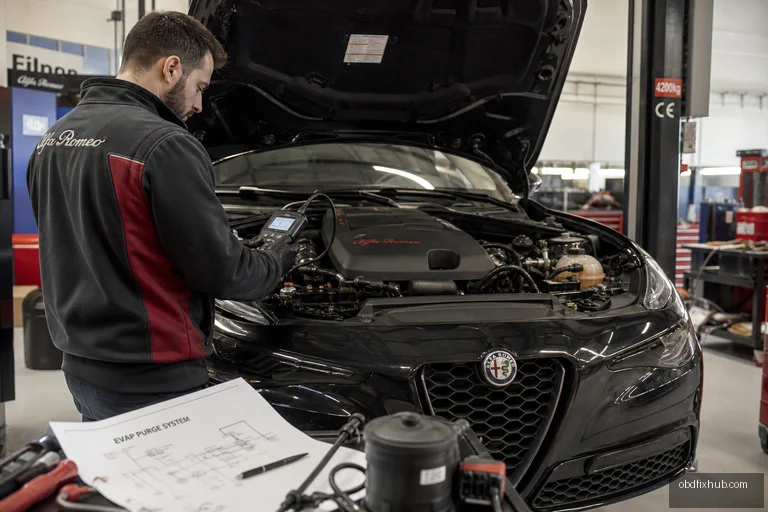
P28C3 EVAP high-load purge line performance means the engine computer has detected that the vapor purge circuit is not behaving as expected when purge demand is high. On Alfa Romeo, Fiat, and related FCA applications, this usually points to a restriction, leak, sticking purge valve, wiring issue, or a problem in the EVAP vapor path—not automatically a bad fuel cap.
The code is often misunderstood because “high load” describes the operating condition used by the diagnostic test, not necessarily a high-load driving problem. The vehicle may drive normally, yet the ECU can still identify a mismatch between commanded purge flow and the pressure or fuel-trim response it observes.
What Does P28C3 Mean?
P28C3 is a manufacturer-specific or enhanced OBD-II powertrain code. Its wording is commonly shown as EVAP System High Load Purge Line B Performance. The exact component assigned to “Line B” can vary by engine and calibration, so the factory service information and a scan tool capable of manufacturer data are important.
The EVAP system stores fuel vapors in a charcoal canister instead of releasing them into the atmosphere. When conditions are suitable, the engine control module opens a purge valve and draws those vapors into the intake to be burned. P28C3 is set when the expected result of that purge event does not match the measured result.
Common Symptoms of the P28C3 EVAP Code
Some vehicles show only a check-engine light. Others develop drivability complaints, particularly immediately after refueling or during warm restart. The symptoms depend on whether the purge circuit is restricted, leaking, or flowing when it should be closed.
- Illuminated check-engine light or stored fault code
- Hard starting or extended cranking after filling the fuel tank
- Rough idle, hesitation, or an occasional stall
- Fuel odor near the engine bay or rear of the vehicle
- Unstable short-term fuel trim at idle
- Reduced fuel economy or intermittent poor throttle response
- Failure of an emissions readiness monitor
A completely blocked purge path may cause few noticeable symptoms, while a purge valve stuck open can create a vacuum leak-like condition. A small EVAP leak may produce no drivability complaint at all.
Most Likely Causes of P28C3
1. Restricted or damaged purge line
Plastic EVAP tubing can kink, split, soften from fuel exposure, or become restricted by debris or a damaged connector. On turbocharged engines, heat near the intake and turbo plumbing can make brittle vapor lines especially vulnerable. Inspect the full route rather than checking only the hose beside the purge valve.
2. Faulty purge control valve
A purge valve that leaks while closed can admit unmetered vapor and air at idle. A valve that fails to open can prevent the required purge flow during the high-load test. A basic resistance check is not enough: a coil may measure correctly while the valve is mechanically stuck or contaminated.
3. EVAP vent valve or charcoal canister problem
A blocked vent filter, saturated charcoal canister, or vent valve that does not respond can make the system appear to have a purge-line fault. Liquid fuel entering the canister after repeated overfilling is a common reason for abnormal purge behavior. Stop clicking the fuel nozzle after it shuts off; that practice can damage the vapor-control system.
4. Electrical or connector fault
Corrosion, loose terminals, damaged wiring, and poor ground connections can prevent the ECU from controlling the purge valve accurately. Pay particular attention to connectors exposed to engine heat, oil vapor, or water intrusion. A visual inspection should be followed by a wiggle test while monitoring the commanded state.
5. Intake or manifold leak
A leak downstream of the purge connection can mimic incorrect EVAP flow. Cracked intake tubing, a leaking manifold gasket, or a loose purge-port seal may alter fuel trims enough to trigger the performance monitor even when the EVAP components themselves are functional.
How to Diagnose P28C3 Properly
Replacing the fuel cap or purge valve without testing is a common way to spend money without fixing the fault. Use this sequence instead:
- Record all codes and freeze-frame data. Note engine temperature, fuel level, RPM, purge command, and fuel trims when the code was stored. Related codes such as P0441, P0455, or mixture faults can change the diagnostic direction.
- Check technical service information. Confirm what “Line B” means on the specific vehicle. Some systems use multiple purge paths or valves, and the label is not a universal reference to cylinder bank B.
- Inspect the hoses and connectors. Look for crushed tubing, disconnected quick-connect fittings, rubbed-through lines, and incorrect hose routing. A line can appear connected while its internal seal is torn.
- Test the purge valve with a bidirectional scan tool. Command the valve on and off while watching engine RPM, manifold pressure, or fuel-trim response. The change should be repeatable and consistent, not merely audible.
- Check whether the valve seals. With the valve commanded closed and the engine off, it should not pass vacuum or allow unrestricted airflow. Follow the manufacturer’s test method; some valves require a specified voltage and duty-cycle test.
- Smoke-test the EVAP system. Use an EVAP-approved smoke machine and the correct test port. Test pressure must stay within the manufacturer’s specification, because excessive pressure can damage valves or the charcoal canister.
- Evaluate vent operation and canister condition. A vent valve stuck closed can create a restriction that looks like a purge problem. If the canister smells strongly of raw fuel or releases liquid fuel, it may need replacement.
Do not use shop air directly on the fuel-vapor system, and do not smoke or create sparks during testing. Fuel vapors can ignite even when no liquid fuel is visible.
P28C3 EVAP High-Load Purge Line Performance: Repair Options
The correct repair depends on the test result. Replace a split or collapsed vapor line with the correct fuel-vapor-rated hose, not ordinary vacuum hose. If the purge valve fails its sealing or flow test, install the correct application-specific valve and confirm that the electrical connector is fully locked.
If a smoke test identifies a leaking connector, replace the seal or the complete fitting as required. A saturated charcoal canister, damaged vent valve, or contaminated vent filter should be addressed before clearing the code. After repair, clear the fault, verify that no new codes return, and complete the EVAP monitor drive cycle specified for the vehicle.
Can You Still Drive With P28C3?
Short-distance driving is usually possible if the engine runs smoothly and there is no strong fuel smell. However, continued driving with a purge valve stuck open can cause stalling, poor mixture control, and difficult restarts. Stop driving and arrange an inspection if you smell raw fuel, notice a fuel leak, or the vehicle repeatedly stalls after refueling.
A check-engine light caused by P28C3 can also prevent an emissions test from passing because the EVAP readiness monitor may remain incomplete. Clearing the code immediately before inspection will not solve the problem; the monitor must run successfully through its complete drive cycle.
Final Takeaway
P28C3 is a purge-flow performance fault, not a diagnosis of one guaranteed failed part. Start with scan data, hose and connector inspection, purge-valve testing, and an EVAP smoke test. Treat “Line B” as a vehicle-specific circuit designation, and avoid replacing the fuel cap or canister until testing proves it is responsible.
Best next step: have the code diagnosed with a manufacturer-capable scan tool and an EVAP smoke machine. That approach is faster, safer, and more accurate than replacing parts based on the code description alone.
Frequently Asked Questions
Is P28C3 the same as a loose gas cap?
Usually not. A loose or damaged fuel cap more commonly causes a general EVAP leak code, although it can contribute to system faults. P28C3 specifically concerns purge-line performance, so the purge valve, vapor line, vent system, and canister should be tested.
Can a bad purge valve cause hard starting after refueling?
Yes. If the purge valve is stuck open, fuel vapors can enter the intake in an uncontrolled amount while the tank is being filled. This can create an overly rich mixture and cause extended cranking, rough running, or stalling after refueling.
Does P28C3 always mean the charcoal canister must be replaced?
No. The canister is only one possible cause. A damaged hose, blocked vent, leaking connector, failed purge valve, or wiring issue can produce the same code. Testing should identify the defective part before replacement.
Will clearing P28C3 permanently fix the problem?
No. Clearing the code only erases the stored fault and turns off the warning light temporarily. If the underlying purge-flow problem remains, the ECU will run the monitor again and usually reset P28C3 after the appropriate drive cycle.




