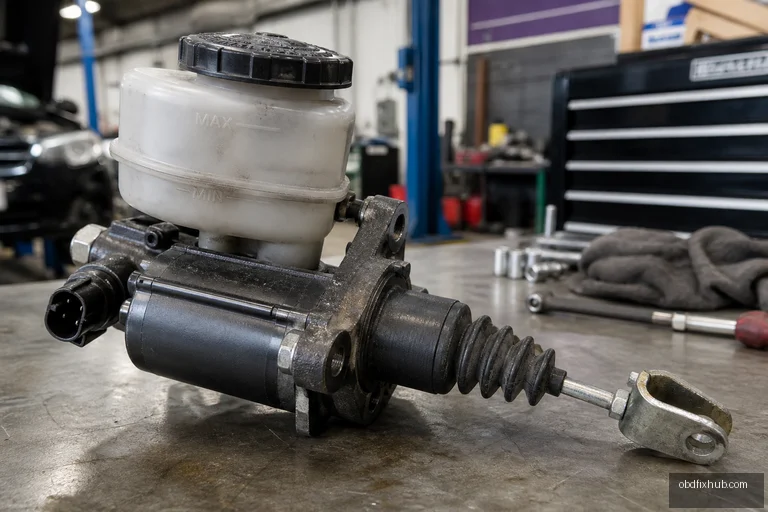
P28C8 clutch pump motor performance means the transmission control system has detected that the electric motor driving the clutch hydraulic pump is not operating as expected. The fault may be caused by low voltage, damaged wiring, a failing pump motor, restricted hydraulics, low fluid, or an internal clutch actuator problem. Because P28C8 is often manufacturer-specific, the exact test procedure and component location must be confirmed with the vehicle’s factory service information.
What Does P28C8 Mean?
P28C8 is an OBD-II powertrain fault code associated with the performance of a clutch pump motor. It is commonly seen on vehicles using an electro-hydraulic clutch actuator, automated manual transmission, or another electronically controlled clutch system. Instead of relying entirely on a conventional clutch pedal and mechanical linkage, these systems use an electric motor and pump to build hydraulic pressure for clutch engagement and release.
The transmission control module, often called the TCM, monitors pump operation through several signals. Depending on the vehicle, it may compare motor current, pump run time, hydraulic pressure rise, pressure retention, or clutch actuator position. If the expected pressure or operating response is not achieved, the module can store P28C8.
A useful distinction is that this code does not automatically prove the pump motor itself has failed. In many real-world cases, the motor is only the final component affected by a poor power supply, corroded connector, weak battery, or hydraulic restriction.
Common Symptoms of P28C8
The vehicle may still drive normally when the fault is first stored, particularly if the pump can build pressure intermittently. Once the system can no longer maintain adequate clutch pressure, the symptoms usually become more obvious.
- Transmission warning light or check engine light
- “Transmission fault,” “Gearbox fault,” or “Clutch unavailable” message
- Delayed engagement when selecting Drive, Reverse, or a gear
- Harsh, slipping, or incomplete clutch engagement
- Failure to select gears or a transmission stuck in neutral
- Repeated electric pump operation after the engine is switched off
- Hard starting because the transmission cannot confirm neutral
- Reduced-power or limp-home mode
One particularly useful clue is pump behavior. A pump that runs for an unusually long time, cycles every few seconds, or sounds slower than normal may be dealing with pressure loss, excessive mechanical load, or insufficient electrical current. Do not judge the pump solely by noise; a quiet motor may still fail to produce pressure.
Most Likely Causes of P28C8
1. Low battery voltage or charging problems
Clutch pump motors draw significant current, especially during cold starts and repeated gear changes. A weak battery, poor ground, loose battery terminal, or alternator problem can cause the motor to turn too slowly. A vehicle may crank successfully and still have enough voltage loss to trigger P28C8 during pump operation.
2. Damaged wiring, relay, or connector
High-current pump circuits are sensitive to resistance. Corrosion inside the pump connector, heat-damaged terminals, a failing relay, or a partially broken ground wire can reduce voltage at the motor. Inspect the wiring near the transmission carefully, since vibration, oil contamination, and exhaust heat commonly damage this area.
3. Worn or seized clutch pump motor
Brush wear, bearing damage, internal commutator faults, or contamination can make the motor draw excessive current or fail to reach operating speed. A motor may work when cold and fail after several cycles, which is why a quick visual inspection often misses the problem.
4. Low, contaminated, or incorrect hydraulic fluid
If the clutch actuator reservoir is low, the pump may draw air instead of building stable pressure. Contaminated fluid can damage seals and valves, while incorrect fluid may cause swelling or poor actuator performance. Use only the fluid specified by the vehicle manufacturer; ordinary brake fluid or transmission fluid is not automatically suitable.
5. Hydraulic leak or pressure accumulator failure
A leaking line, actuator seal, pump outlet, or pressure accumulator can cause pressure to fall faster than the pump can restore it. The motor then runs repeatedly, creating a pattern that looks like a motor-performance fault. A pressure accumulator with a failed diaphragm is an especially important possibility when the pump cycles frequently but appears electrically healthy.
6. Clutch actuator, valve, or transmission control fault
A stuck hydraulic valve or mechanically binding actuator can overload the pump and prevent the expected clutch movement. Less commonly, the pump driver inside the transmission control module may be defective. Software calibration issues are also possible, particularly if the code appeared after a battery replacement, transmission repair, or control-module programming event.
How to Diagnose P28C8 Correctly
Accurate diagnosis requires more than clearing the code and replacing the pump. The most efficient approach is to determine whether the fault is electrical, hydraulic, mechanical, or control-related.
- Confirm the code and vehicle definition. Record the make, model, engine, transmission type, mileage, freeze-frame data, and all related codes. P28C8 can have different manufacturer-specific descriptions, so the factory definition matters.
- Check battery voltage and grounds. Test battery state of charge, charging voltage, and voltage drop while the clutch pump is commanded on. A static battery reading is not enough; the circuit must be tested under load.
- Inspect the high-current circuit. Check the fuse, relay, connectors, power feed, and ground for heat marks, looseness, moisture, or green corrosion. Measure voltage directly at the pump while it operates rather than testing only at the battery.
- Use scan-tool actuator tests. A capable transmission scan tool should be able to command the clutch pump and display pump status, pressure, motor current, and possibly accumulator values. Compare actual readings with the manufacturer’s specifications.
- Evaluate hydraulic pressure and leakage. If the pump runs but pressure rises slowly or falls rapidly, follow the service procedure for pressure testing. Do not guess at acceptable pressure values; they vary substantially between systems.
- Check clutch actuator operation. If electrical supply and hydraulic pressure are normal, inspect clutch position feedback, actuator travel, valve operation, and adaptation values. A failed calibration may require a scan-tool relearn after the underlying repair.
- Clear the code and perform a controlled road test. After repairing the cause, run the required clutch bleeding, initialization, or kiss-point learning procedure. Then verify cold and hot operation, repeated starts, reverse selection, and stop-and-go driving.
P28C8 Clutch Pump Motor Performance Fix
The correct repair depends on the test results. If voltage drop is excessive, repair the power or ground circuit before condemning the pump. If the relay contacts are burnt or the connector terminals are loose, replacing the pump alone may leave the new part underpowered and cause the code to return.
A failed pump motor may require replacement of the motor, the complete pump assembly, or the integrated clutch actuator, depending on how the manufacturer supplies the part. After installation, the hydraulic system may need bleeding and the clutch control system may require a calibration or adaptation procedure. Skipping that step can produce poor engagement even when the mechanical repair is correct.
If the system has low fluid, find the leak rather than simply topping up the reservoir. Likewise, if the pump cycles repeatedly, test pressure retention and the accumulator. Repeated cycling can overheat a replacement motor and create a second failure within a short time.
Can You Drive With P28C8?
Short-distance driving may be possible if the transmission still selects gears normally and the pump is not running continuously. However, continued operation is risky because loss of hydraulic pressure can leave the vehicle unable to engage a gear without warning. Avoid heavy traffic, steep hills, towing, and long trips until the fault has been diagnosed.
If the vehicle is stuck in neutral, refuses to select Reverse or Drive, produces a burning electrical smell, or shows repeated transmission warnings, arrange recovery rather than forcing the system to operate. Repeatedly cycling the ignition can also overwork a weak pump and drain the battery.
Practical Diagnostic Tips From the Workshop
- Compare pump sound and run time during a cold start with the behavior after the vehicle is fully warm.
- Check for voltage drop on both the positive feed and ground side while the motor is running.
- Look for related low-voltage, communication, clutch-position, or hydraulic-pressure codes before focusing only on P28C8.
- Do not use a test light as the only circuit test; a circuit can illuminate a test light and still fail under high current demand.
- Record adaptation values before clearing codes when possible, especially if the transmission is still operational.
- Follow the manufacturer’s safety procedure because some clutch systems can move or pressurize unexpectedly during testing.
Summary
P28C8 indicates that the clutch pump motor is not delivering the expected performance, but the pump itself is only one possible cause. Begin with battery condition, voltage drop, wiring, connectors, and relay operation, then verify hydraulic pressure, leakage, accumulator performance, and clutch actuator movement. A professional repair should finish with the required bleeding, calibration, and road-test procedure rather than simply clearing the code.
If P28C8 is present, save the diagnostic data and have the system tested before buying a replacement pump. That single step can prevent an expensive part from being installed into a faulty power, hydraulic, or control circuit.
Frequently Asked Questions
Is P28C8 always caused by a bad clutch pump?
No. Low voltage, poor grounds, corroded connectors, hydraulic leaks, a failed accumulator, a restricted valve, or an actuator problem can all create the same code. Testing pump voltage and pressure is essential before replacement.
Can a weak battery trigger P28C8?
Yes. The clutch pump is a high-current device, and voltage can drop sharply when it operates. Test the battery and charging system under load, not just with the engine switched off.
Does P28C8 require clutch relearning after repair?
Many electronically controlled clutch systems require bleeding, initialization, or clutch bite-point adaptation after pump or actuator work. The exact procedure depends on the vehicle and should be confirmed in the service information.
How serious is the P28C8 fault?
It can be serious because the vehicle may eventually lose the ability to select or hold a gear. If warning messages, delayed engagement, or repeated pump cycling are present, diagnose it promptly and avoid unnecessary driving.
Can I clear P28C8 with an ordinary code reader?
A basic OBD reader may erase the stored code, but it usually cannot command the clutch pump, display hydraulic data, or perform clutch calibration. A manufacturer-capable transmission scan tool is normally required for a complete diagnosis.




