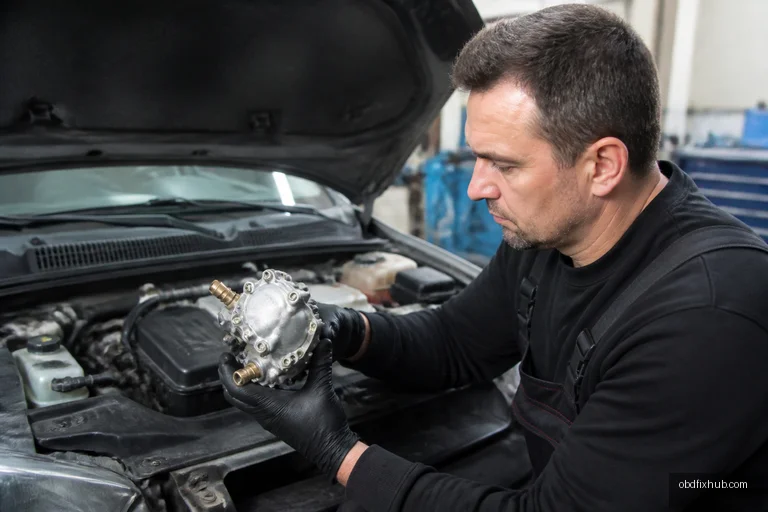
P2A8B Alternative Fuel Vaporizer Performance means the engine control module has detected that the alternative-fuel vaporizer or pressure regulator is not delivering the expected fuel condition. On LPG or CNG vehicles, this usually involves incorrect gas pressure, poor vaporization, abnormal temperature, or a control problem. The code does not automatically prove that the vaporizer itself is defective, so pressure, coolant flow, sensors, wiring, and fuel quality must be checked before replacing parts.
What Does Code P2A8B Mean?
The vaporizer is a critical component in a gaseous-fuel system. In an LPG system, it changes liquid propane into a usable gas and reduces tank pressure to the regulated pressure required by the injectors. On some CNG systems, the equivalent regulator performs a similar pressure-reduction role, although the hardware and diagnostic strategy can differ.
When the vehicle runs on alternative fuel, the PCM or dedicated gas-fuel control module monitors several values, including:
- Vaporizer outlet pressure
- Gas temperature and vaporizer temperature
- Coolant temperature or coolant flow through the regulator
- Fuel-pressure sensor voltage
- Gas injector operation and commanded fuel pressure
P2A8B is set when the measured performance falls outside the expected range for a specific period or driving condition. The exact enabling criteria vary by manufacturer, fuel system, and calibration. Always compare the code with the vehicle’s service information rather than relying only on a generic scan-tool description.
P2A8B Symptoms
Some drivers notice the fault only when the vehicle switches from gasoline to LPG or CNG. Others experience symptoms under load, during cold starts, or after the engine has been running long enough for the vaporizer to become heat-soaked.
- Check Engine Light or alternative-fuel warning lamp
- Automatic switch back to gasoline
- Hard starting or extended cranking after refueling
- Engine hesitation during acceleration
- Loss of power at high engine speed or under heavy load
- Rough idle, misfire, or stalling during fuel-mode changeover
- Reduced fuel economy or unusually high gas consumption
- Inconsistent vaporizer temperature or fuel pressure readings
A useful real-world clue is the timing of the symptom. If the engine runs normally on gasoline but stumbles only on LPG or CNG, the ignition system may still be involved, but the alternative-fuel delivery system becomes the primary suspect. If both fuels run poorly, diagnose common engine controls first instead of assuming the vaporizer is responsible.
Common Causes of P2A8B
1. Restricted coolant flow
Most LPG vaporizers use engine coolant to supply the heat needed to vaporize fuel. Low coolant level, trapped air, a blocked hose, a restricted filter, or incorrectly routed coolant can leave the regulator too cold. Liquid LPG may then fail to vaporize consistently, causing unstable pressure and a P2A8B code.
Compare the temperature of both vaporizer coolant hoses after warm-up. A large temperature difference can indicate poor flow, although an infrared thermometer or scan data should be used for confirmation. Never remove a coolant hose on a pressurized or hot engine.
2. Faulty pressure or temperature sensor
A pressure sensor can report a value that is too high, too low, or electrically implausible. A temperature sensor may also read incorrectly because of internal failure, damaged wiring, corrosion, or a loose connector. The controller may then interpret a sensor error as poor vaporizer performance.
Check live data against a mechanical pressure gauge and a reliable temperature measurement. A sensor reading that remains fixed, jumps without a physical cause, or disagrees sharply with the gauge is more meaningful than the stored fault code alone.
3. Blocked filter or contaminated fuel
LPG and CNG systems depend on filters to protect the regulator and injectors. A saturated filter can restrict flow and create a pressure drop that appears mainly during acceleration. Oil residue, water, debris, or poor-quality fuel can produce similar symptoms.
If the vehicle has recently been serviced, confirm that the correct filter was installed and that the sealing rings are positioned correctly. A filter that looks clean externally may still be restricted internally.
4. Regulator or vaporizer wear
Diaphragms, valves, springs, and internal seals wear over time. A regulator may hold acceptable pressure at idle but fail to maintain it when fuel demand rises. Conversely, a leaking regulator may allow pressure to drift upward after shutdown or create an overly rich mixture.
5. Wiring, grounding, or control-solenoid problems
Loose terminals, damaged harnesses, poor grounds, and water intrusion can interrupt sensor or solenoid operation. On electronically controlled systems, the vaporizer control valve may not receive the correct command even when the mechanical regulator is serviceable.
6. Incorrect calibration or recent component changes
After an injector, regulator, pressure sensor, or control module replacement, the fuel system may require programming, pressure calibration, or an adaptive reset. Incorrect software settings can trigger P2A8B without a clear mechanical failure.
How to Diagnose P2A8B Correctly
- Record all codes and freeze-frame data. Note engine temperature, fuel mode, commanded pressure, measured pressure, and vehicle speed when the code was stored. Additional sensor or communication codes may identify the real starting point.
- Confirm the fuel mode. Determine whether the code occurred on LPG, CNG, or during the transition from gasoline. If possible, compare the same operating conditions in both fuel modes.
- Perform a safety inspection. Look for the odor of gas, damaged pipes, loose fittings, frost around the regulator, and signs of liquid leakage. Do not use a flame to search for leaks; use an approved leak-detection method.
- Check coolant circulation. Verify coolant level, hose routing, air pockets, and vaporizer temperature. A regulator that stays cold after the engine reaches operating temperature needs attention before pressure diagnosis continues.
- Compare pressure data. Use the manufacturer’s specified gauge and test procedure. Check pressure at idle, during a controlled load increase, and after shutdown where applicable. Do not rely solely on a scan-tool pressure value.
- Test the electrical circuit. Inspect connector tension, reference voltage, sensor ground, signal voltage, continuity, and voltage drop under load. A visual inspection alone will not find every intermittent fault.
- Inspect filters and the regulator. Replace serviceable filters according to the manufacturer’s procedure. If pressure remains unstable after flow and sensor checks, the vaporizer may need rebuilding or replacement.
- Clear the code and verify the repair. Complete the required fuel-mode transition, cold start, idle, acceleration, and road-load tests. A short idle test is not enough to prove that the fault is fixed.
P2A8B Fix and Repair Options
The correct repair depends on the test results. A low-cost repair may involve correcting coolant flow, repairing a ground, replacing a filter, or renewing a damaged connector. If the regulator diaphragm or internal valve is worn, a quality rebuild kit may work when the manufacturer permits rebuilding and the housing is not damaged.
Replacement is generally the better option when the vaporizer has corrosion, a cracked housing, repeated pressure instability, or unavailable internal parts. After installation, check for leaks, confirm the correct pressure specification, perform any required calibration, and verify the system on both cold and fully warmed operation.
Do not adjust regulator screws at random. Changing base pressure without following the system’s calibration procedure can create lean or rich mixtures, damage the catalyst, increase emissions, and introduce a new drivability problem. High-pressure CNG components and liquid LPG lines should be serviced only by a technician trained for that fuel system.
Can You Drive With P2A8B?
Short, cautious driving may be possible if the vehicle runs normally on gasoline and there is no gas odor, leak warning, severe misfire, or loss of power. However, continuing to operate with unstable alternative-fuel pressure can cause stalling in traffic, poor combustion, catalyst damage, or repeated fuel-system faults.
Switch to gasoline if the manufacturer allows it and arrange a professional inspection. Stop driving and move the vehicle to a safe, well-ventilated location if you smell fuel, hear hissing, see frost near a fitting, or notice a severe engine misfire.
Key Takeaway
P2A8B is a performance code, not a direct instruction to replace the vaporizer. Start with fuel mode, coolant circulation, live pressure and temperature data, filters, wiring, and leak safety checks. A measured comparison between commanded and actual pressure usually separates a blocked filter or sensor fault from a genuinely worn regulator.
Recommended next step: Have the system diagnosed with the manufacturer’s pressure specifications and a fuel-safe test procedure. Avoid adjusting or opening pressurized components unless you have the correct training and equipment.
Frequently Asked Questions
What is the most common cause of P2A8B?
Common causes include restricted filters, poor coolant flow through the vaporizer, inaccurate pressure or temperature sensors, wiring faults, and a worn regulator. The most likely cause depends on whether pressure is low at all times or drops only under load.
Does P2A8B mean the LPG vaporizer must be replaced?
No. The code indicates that vaporizer performance is outside the expected range. A coolant problem, sensor error, electrical fault, or blocked filter can produce the same code, so testing should come before replacement.
Can a bad vaporizer cause an engine misfire?
Yes. If the regulator cannot maintain stable gas pressure, the mixture may become too lean or too rich, especially during acceleration or fuel-mode changeover. Ignition faults should still be checked because LPG and CNG can expose weak spark plugs, coils, or excessive plug gap.
Is P2A8B the same on every vehicle?
No. The generic description is similar, but the pressure targets, sensors, enabling conditions, and repair procedures vary by manufacturer and fuel system. Use the vehicle-specific service manual for exact specifications.




