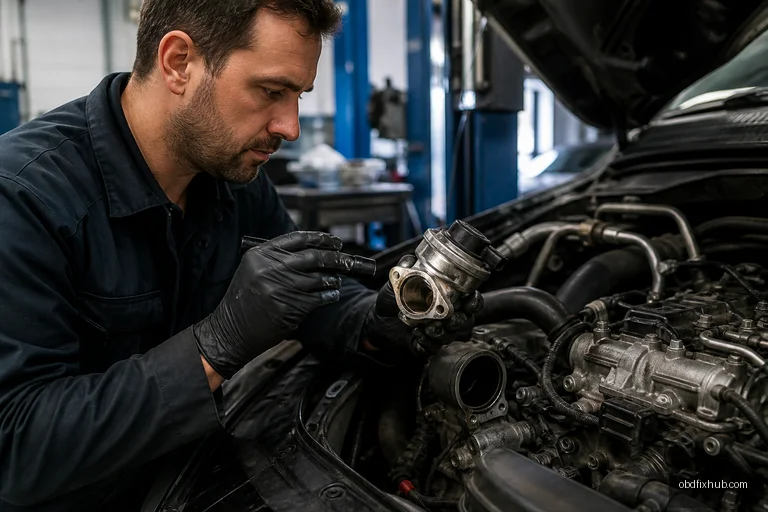
P2AA3 Cold-Start EGR Flow Insufficient means the engine computer detected less exhaust gas recirculation than expected during a cold-start operating test. The proper fix is not to replace the EGR valve immediately: first check the EGR passages, valve movement, control solenoid or actuator, pressure sensors, wiring, and the vehicle-specific technical service information. Cleaning a carbon-blocked passage may solve the problem, but a failed valve, sensor, vacuum supply, or wiring fault requires the related component to be repaired or replaced.
What Does P2AA3 Mean?
P2AA3 is an OBD-II powertrain fault code associated with insufficient EGR flow during cold-start conditions. The wording often appears as Cold Start EGR B Flow Insufficient Detected, although the exact definition and test strategy can vary by manufacturer, engine family, and calibration.
The letter B does not always mean a simple “bank 2” component. On some vehicles, it identifies EGR valve B, EGR circuit B, or a second EGR flow path. Always verify the factory definition for the vehicle’s VIN before ordering parts. A generic scan-tool description can be useful, but it cannot replace the manufacturer’s service information.
How to Fix Exhaust Gas Recirculation Flow Insufficient
To fix an exhaust gas recirculation flow-insufficient fault, diagnose the complete EGR system rather than focusing only on the valve. A reliable repair sequence is:
- Record freeze-frame data and check for additional EGR, MAF, MAP, temperature, or pressure-sensor codes.
- Inspect the EGR valve, cooler, pipes, passages, connectors, wiring, and vacuum hoses where fitted.
- Confirm that the EGR valve or actuator responds to a bi-directional scan-tool command.
- Test the EGR position sensor and the differential-pressure or flow-feedback sensor.
- Remove carbon deposits from restricted passages using the manufacturer’s approved procedure.
- Replace a failed valve, actuator, sensor, solenoid, or damaged wiring only after testing identifies it.
- Clear the code, perform the required cold-start drive cycle, and confirm that the monitor runs successfully.
On electronically controlled EGR systems, forcing the valve open with a scan tool while observing commanded position, actual position, MAF change, and pressure feedback is usually more informative than simply applying power to the valve. On vacuum-operated systems, a hand vacuum pump can reveal a leaking diaphragm or a blocked control line.
Common Causes of P2AA3 Cold-Start EGR Flow Insufficient
Carbon-restricted EGR passages
Carbon buildup is one of the most common causes, particularly on diesel engines and engines that spend much of their time idling or making short trips. The valve may move normally while the intake manifold, EGR pipe, cooler, or transfer port is almost blocked. In that situation, replacing the valve alone often fails to correct the code.
Sticking or failed EGR valve
An EGR valve can stick closed from soot, corrosion, or a damaged gear mechanism. An electronically controlled valve may also have an internal motor or position-sensor fault. If commanded and actual valve positions do not track each other, the valve or its wiring deserves close attention.
Faulty EGR flow or pressure feedback sensor
Many systems do not measure EGR flow directly. The engine computer infers flow from a change in MAF, MAP, intake pressure, or differential pressure across an EGR measurement point. A sensor with an incorrect bias, a blocked sensing tube, or contaminated ports can report insufficient flow even when the valve and passages are functional.
Vacuum, actuator, or control-solenoid problems
Vacuum-operated EGR systems depend on adequate vacuum, intact hoses, and a working vacuum-control solenoid. A soft hose, cracked elbow, leaking actuator diaphragm, or solenoid that never opens can prevent the valve from operating. Do not assume the valve is defective until the control signal and vacuum supply have been measured.
Electrical faults and poor connections
Loose terminals, corrosion inside a connector, damaged wiring near the exhaust, or an incorrect reference voltage can interrupt EGR operation. A visual inspection should be followed by voltage-drop and continuity testing under load; a wire can pass a basic continuity check and still fail when the actuator draws current.
Software updates or related engine faults
Manufacturers sometimes revise EGR diagnostic logic through an engine-control-module software update. In addition, an inaccurate MAF sensor, intake air leak, turbocharger problem, exhaust restriction, or incorrect engine temperature signal can distort the calculated EGR flow. If the engine computer does not trust its airflow inputs, it may set P2AA3 even though the EGR hardware is not the original problem.
Symptoms You May Notice
P2AA3 can appear with very few drivability complaints because the EGR monitor often runs during a specific cold-start window. Possible symptoms include:
- Illuminated check-engine light
- Rough or unstable idle shortly after starting
- Hesitation during warm-up or light acceleration
- Higher fuel consumption or increased emissions
- Reduced power, limp mode, or delayed throttle response
- Excessive diesel smoke or unusual combustion noise
- No obvious symptom apart from the stored code
A cold engine may show the fault only after sitting overnight. Clearing the code and taking a short warm drive may not reproduce it, because the EGR monitor may require a particular coolant temperature, intake temperature, engine speed, load, and airflow range.
Professional Diagnostic Procedure
1. Check the conditions that set the code
Start with freeze-frame data. Note coolant temperature, intake temperature, engine speed, calculated load, MAF reading, and battery voltage. If the code was set at an implausible temperature or during low voltage, investigate those conditions before dismantling the EGR system.
2. Look for companion codes
Codes related to MAF, MAP, intake-air temperature, EGR position, differential pressure, or engine coolant temperature can change the diagnostic path. Solve a failed temperature or airflow input first if it clearly makes the EGR test unreliable.
3. Inspect before cleaning
Check the EGR pipe for loose joints, soot trails, cracks, and missing gaskets. Inspect the valve connector for heat damage and verify that the intake and exhaust passages are not heavily restricted. Photographing the deposits before cleaning can help document whether the restriction was significant.
4. Test commanded versus actual operation
Use the scan tool to command EGR operation while watching the position feedback and engine response. A functioning system should normally produce a measurable change in airflow or manifold pressure. If the command changes but feedback does not, suspect the actuator, valve mechanism, or position sensor; if feedback changes but airflow does not, suspect a blocked passage or a misleading flow sensor.
5. Verify the repair under cold conditions
After repair, do not rely only on the absence of the warning light. Allow the vehicle to cool completely if the monitor requires a cold start, then use the manufacturer’s drive cycle or equivalent scan-tool monitor. Confirm that the EGR readiness test completes and that P2AA3 does not return.
Can You Drive With P2AA3?
Short-term driving is often possible when the engine runs normally and the check-engine light is steady. However, continued driving can increase emissions, worsen carbon buildup, or allow a related airflow problem to damage drivability. Stop driving and seek prompt diagnosis if the light flashes, the vehicle enters limp mode, the engine stalls, or there is heavy smoke, severe knocking, or loss of power.
Should You Clean or Replace the EGR Valve?
Cleaning is appropriate when inspection confirms removable carbon and the valve motor, position sensor, and mechanism still operate correctly. Replacement is more appropriate when the valve is electrically failed, mechanically seized, leaking, damaged, or unable to reach its commanded position after cleaning.
Do not spray solvent into an electronic actuator or immerse a valve unless the service procedure specifically permits it. On some engines, an EGR replacement also requires an adaptation, relearn, or software procedure. Skipping that step can leave the original fault code or create a new position-calibration code.
Frequently Asked Questions
Is P2AA3 always caused by a bad EGR valve?
No. Blocked passages, a faulty pressure or airflow sensor, vacuum loss, wiring damage, and inaccurate engine-temperature data can all produce an insufficient-flow result. Testing the complete system prevents unnecessary valve replacement.
Can a dirty intake manifold cause P2AA3?
Yes. Carbon in the intake manifold or EGR transfer port can restrict the gas path even when the EGR valve opens. This is especially common on diesel engines with high soot loading and frequent low-speed operation.
Will disconnecting the battery fix P2AA3?
Disconnecting the battery may erase the stored code, but it does not repair the underlying fault. The code will usually return when the cold-start EGR monitor runs again, and some vehicles may lose learned settings or readiness information.
How much does a P2AA3 repair cost?
Cost depends on whether the fault is a blocked passage, wiring issue, sensor, vacuum component, or EGR assembly. Cleaning may be relatively inexpensive, while an EGR cooler, electronic valve, or intake-manifold service can require substantially more labor.
Can I diagnose P2AA3 with a basic code reader?
A basic reader can retrieve the code and freeze-frame data, but a scan tool with live data and bi-directional controls is far more useful. It lets you compare commanded EGR position with actual position and observe the airflow response during testing.
Bottom Line
P2AA3 indicates that the engine computer did not see enough EGR flow during a cold-start test, not necessarily that the EGR valve itself has failed. Begin with the vehicle-specific code definition, freeze-frame data, companion codes, and a physical inspection. Then test valve movement, control signals, passages, and flow-feedback sensors before cleaning or replacing parts. A successful repair is confirmed only when the cold-start monitor completes without the code returning.




