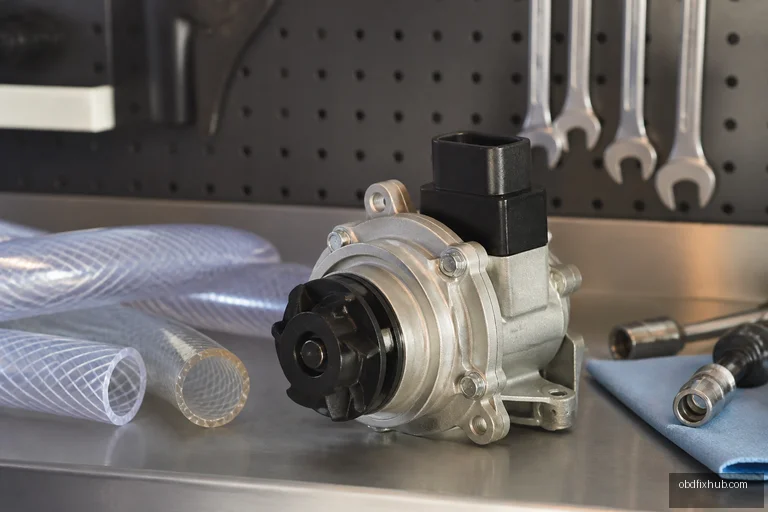
P2B2A means the hybrid or electric-vehicle electronics coolant pump has been detected running faster than expected without moving enough coolant. In practical terms, the pump controller may be seeing a dry-run condition, trapped air, low coolant flow, or an internal pump fault. Do not treat this code as an ordinary engine cooling fault: the affected circuit may cool an inverter, DC-DC converter, battery electronics, or other high-voltage components.
What Does the P2B2A Code Mean?
P2B2A is generally described as Hybrid/EV Electronics Coolant Pump “A” Dry-Run Overspeed. The vehicle monitors pump speed and electrical load while checking whether the expected hydraulic flow is being produced. If the motor spins unusually fast but the system does not detect normal coolant movement, the control module stores the code.
A pump can overspeed during a genuine dry-run because the impeller has little or no liquid resistance. However, the same code can be triggered by air trapped in the cooling circuit, a partially blocked hose, a failing level sensor, incorrect coolant, or inaccurate pump-speed feedback. Exact wording and test procedures vary by manufacturer, so the vehicle-specific service information remains important.
Common Causes of P2B2A
- Low coolant level caused by a leak, poor filling procedure, or an incorrectly serviced reservoir.
- Air trapped in the electronics cooling loop after pump, radiator, hose, or inverter work.
- Internal pump failure, including a worn impeller, seized bearing, damaged motor, or electronic driver fault.
- Restricted flow from a collapsed hose, clogged heat exchanger, contaminated coolant, or blocked passage.
- Loose, corroded, water-damaged, or backed-out terminals at the pump connector.
- Open, shorted, or high-resistance wiring in the pump power, ground, command, or feedback circuit.
- A faulty coolant temperature, pressure, flow, or pump-speed monitoring signal.
- Use of the wrong coolant or a coolant mixture that has created deposits and reduced circulation.
Symptoms You May Notice
The first symptom may be only a check-engine light or a hybrid-system warning. On some vehicles, the cooling pump becomes noticeably louder, produces a high-pitched whine, or runs continuously after the vehicle is switched off.
More serious symptoms include reduced hybrid power, a “Stop Safely” message, limited electric driving, inverter overheating, battery-conditioning faults, or an engine that starts more often than usual. A vehicle may drive normally for a short distance while the electronics cooling system is already losing capacity. That is why clearing P2B2A without testing coolant flow is risky.
How to Diagnose P2B2A Correctly
1. Scan every relevant control module
Use a scan tool that can communicate with the hybrid control, battery, power inverter, and body modules—not just the generic engine computer. Record all stored, pending, and history codes before clearing anything. A companion low-voltage, communication, temperature, or pump-circuit code often identifies the real failure.
2. Check coolant level and visible leaks
Inspect the correct reservoir when the system is cold and follow the manufacturer’s fill marks. Look around the pump, hose connections, radiator, inverter, battery chiller, and underbody lines for dried residue or wetness. A reservoir that appears full does not prove that the pump housing and circuit are filled; air can remain trapped at high points.
3. Listen to the pump and verify commanded operation
With the appropriate scan-tool actuator test, command the electronics coolant pump on at different speeds. A healthy pump normally has a smooth electric whir and creates visible movement or a return stream where the design allows it. A sharp, unloaded whine, intermittent operation, no sound, or immediate shutdown deserves further electrical and hydraulic testing.
4. Test power, ground, command, and feedback
Do not condemn the pump based on voltage at one terminal alone. Check power and ground under load, inspect voltage drop, and verify the control signal with the wiring diagram. If the pump has a built-in controller, the signal may be a network command rather than a simple switched voltage. Compare actual pump speed with commanded speed and check for an implausible feedback value.
5. Bleed the cooling loop using the specified procedure
Hybrid electronics circuits often require a scan-tool bleed routine, a special filling device, or a precise sequence of ignition cycles and pump commands. Conventional radiator bleeding may leave an air pocket in the inverter or battery branch. If the code returns immediately after bleeding, look for an air leak on the suction side or a mechanical restriction rather than repeatedly replacing coolant.
What Does “Coolant Pump A Control Circuit Open” Mean?
“Coolant pump A control circuit open” means the vehicle cannot detect a complete electrical path for the pump’s command or control circuit. Depending on the platform, this may correspond to a separate code such as P2B28, but the exact code definition must be confirmed with a manufacturer-level scan tool.
Typical causes include a disconnected pump plug, a broken wire, a pushed-back terminal, a blown fuse, an open ground, or a failed internal pump controller. This is different from P2B2A: an open-circuit fault means the pump may not be electrically controllable, while P2B2A indicates that the system believes the pump is spinning abnormally with insufficient flow. Both codes can appear together if a pump or its connector is intermittently failing.
Repair Options and Typical Fixes
- Repair the leak and refill with the specified coolant.
- Bleed the electronics cooling loop with the factory procedure.
- Repair damaged wiring, terminals, grounds, or connector seals.
- Replace a pump that fails the actuator test, draws abnormal current, leaks, or produces no usable flow.
- Remove a restriction or replace a contaminated hose, filter, or heat exchanger where applicable.
- Update or reprogram the control module only when a manufacturer bulletin identifies software as the cause.
After repair, clear the codes and perform a complete warm-up and road test while watching commanded pump speed, actual speed, coolant temperature, and system status. A successful repair is confirmed by stable flow and normal data—not simply by a warning light staying off for a few minutes.
Is It Safe to Drive With P2B2A?
Short trips may be possible if there are no overheating warnings, reduced-power messages, or abnormal temperatures, but continued driving can damage expensive hybrid electronics. Stop promptly if the vehicle reports an overheating inverter or battery, limits power, smells of overheated electronics, or activates a red warning. Do not open high-voltage components or disconnect orange cables unless you are trained and equipped to follow the required safety procedures.
Key Takeaway
P2B2A is a coolant-flow and pump-behavior fault, not proof that the pump alone is defective. Start with the coolant level, leaks, trapped air, and related codes, then test the pump electrically and hydraulically. If “control circuit open” is also present, concentrate first on the connector, wiring, fuse, ground, and pump controller before replacing parts.
Frequently Asked Questions
Can low coolant cause P2B2A?
Yes. Low coolant can allow the pump to draw air, making it spin with reduced resistance and triggering a dry-run overspeed calculation. Find and repair the reason for the low level before refilling.
Does P2B2A always mean the coolant pump must be replaced?
No. Air in the circuit, a restriction, poor wiring, or an incorrect sensor signal can create the same code. The pump should be replaced only after flow and electrical tests show that it cannot operate correctly.
What does coolant pump A control circuit open mean?
It indicates an interrupted electrical path in the pump’s control circuit. Inspect the connector, wiring, fuse, ground, and internal pump controller, and verify the exact code definition for the vehicle.
Can I clear P2B2A and keep driving?
Clearing the code does not restore coolant circulation. If the fault returns or any overheating or reduced-power warning appears, stop driving and have the hybrid cooling system diagnosed promptly.




