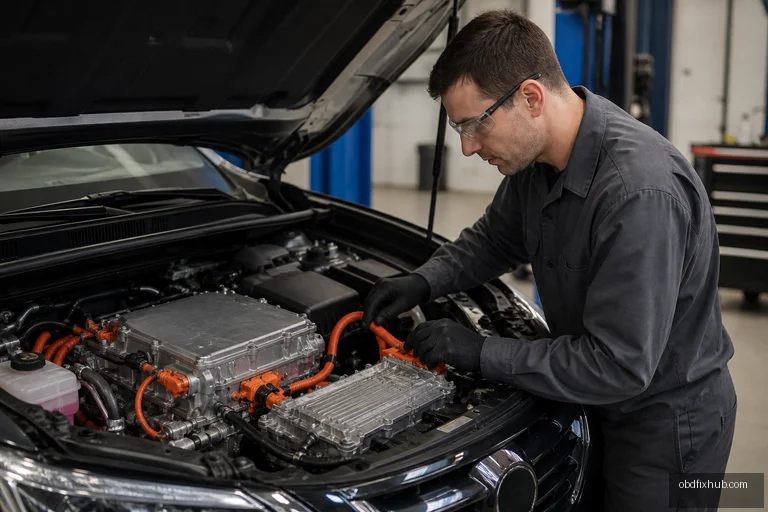
P2D3A Forced Hybrid/EV System Shutdown: Meaning, Causes, Symptoms & Fix
P2D3A Forced Hybrid/EV System Shutdown means the vehicle’s hybrid control system has deliberately disabled high-voltage propulsion because it detected a condition it considered unsafe or potentially damaging. The code does not identify one failed part by itself; it records the shutdown command, so the underlying battery, inverter, isolation, thermal, communication, or safety fault must be found before the code is cleared.
What Does P2D3A Mean?
P2D3A is a powertrain diagnostic trouble code associated with hybrid and electric vehicle systems. In practical terms, a control module has requested a forced shutdown of the high-voltage system. Depending on the vehicle, that command may come from the hybrid powertrain control module, battery energy control module, inverter controller, or another safety-related module.
The exact wording and diagnostic strategy are manufacturer-specific. On one model, P2D3A may appear after a high-voltage battery protection event; on another, it may be set when communication with the battery controller is lost. Always compare the scan tool’s definition and service information with the vehicle’s exact year, make, model, and powertrain.
Symptoms of a P2D3A Forced Shutdown
A forced shutdown can feel more serious than an ordinary check-engine-light fault because the vehicle may disable electric propulsion immediately. The symptoms depend on whether the system can enter a limited operating mode.
- “Stop vehicle safely” or “Hybrid system fault” appears on the instrument cluster.
- The vehicle will not enter READY mode, or it enters READY and then shuts down.
- The gasoline engine runs but electric drive assistance is unavailable.
- Reduced power, limp mode, or very limited acceleration occurs.
- The battery state-of-charge gauge behaves abnormally or disappears.
- Charging stops, refuses to begin, or is interrupted by a warning.
- Cooling fans run at high speed after switching the vehicle off.
- Multiple communication, battery, inverter, or isolation codes are stored with P2D3A.
Do not assume the vehicle is safe to continue driving simply because it still moves. A hybrid may retain enough conventional-engine operation to reach the roadside while the high-voltage system is protecting itself from a more serious failure.
Common Causes of P2D3A
1. High-voltage battery protection event
The battery management system may command shutdown when it detects cell-voltage imbalance, excessive current, overtemperature, undertemperature, or a state-of-charge value outside its permitted range. A weak cell block can trigger the code under acceleration, while a temperature problem may appear during fast charging or hot-weather driving.
2. High-voltage isolation fault
The system continuously checks whether high voltage is leaking toward the vehicle chassis. Damaged orange cables, moisture inside a battery enclosure, coolant contamination, a failed compressor, or an internal battery fault can reduce insulation resistance. In this situation, the shutdown is a safety response, not an inconvenience to be reset.
3. Inverter, motor, or DC-DC converter fault
The inverter controls the motor-generators and handles extremely high electrical currents. An internal power transistor failure, overheating event, phase-current fault, or DC-DC converter problem can cause the controller to open the high-voltage contactors and log P2D3A.
4. Loss of module communication
Hybrid and EV controllers exchange safety-critical data over CAN networks. A weak 12-volt battery, corroded ground, damaged wiring, blown fuse, water intrusion, or a failed control module can interrupt that communication. A surprisingly large number of “hybrid battery” diagnoses begin with an unstable 12-volt supply.
5. Crash signal, service disconnect, or interlock issue
A crash event, battery service plug that is not fully seated, an open high-voltage interlock loop, or a connector cover that is not locked can request a forced shutdown. Recent repair work near the battery, inverter, rear seat, or charging equipment is an important diagnostic clue.
6. Excessive temperature or cooling-system failure
Blocked battery-air ducts, a failed battery fan, low coolant, a stuck pump, or a restricted radiator can push the battery or inverter beyond its safe temperature range. Inspecting the cooling system is especially important when the code appears after sustained highway driving, towing, fast charging, or operation in extreme heat.
How to Diagnose P2D3A Correctly
The most useful diagnostic information is often not P2D3A itself but the companion codes stored at the same time. A professional scan tool should access every relevant module, not only the engine computer. Record all current, pending, and history codes before erasing anything.
- Check the 12-volt system first. Test the battery at rest and under load, inspect the terminals and grounds, and verify charging voltage. Low 12-volt voltage can create several misleading network and hybrid-system faults.
- Review freeze-frame and live data. Look for battery temperature, cell-voltage spread, isolation resistance, inverter temperature, contactor status, and the reason for shutdown. The data recorded immediately before the event is more valuable than a generic code definition.
- Inspect recent work and visible wiring. Check high-voltage connectors, interlock circuits, underbody cables, cooling ducts, coolant leaks, and signs of water intrusion. Do not disconnect orange high-voltage connectors without the manufacturer’s required safety procedure.
- Test isolation and high-voltage components properly. Isolation testing requires suitable equipment and manufacturer-specific limits. A conventional multimeter is not a safe substitute for approved procedures, and probing a live high-voltage circuit can cause fatal injury.
- Clear the code only after the cause is repaired. Some systems require a controlled key-off period, a scan-tool reset, or a battery-management relearn before the vehicle will return to READY mode.
How to Fix P2D3A
The repair depends on the fault that caused the shutdown. A weak 12-volt battery may be the entire problem, while an isolation fault could require replacing a damaged cable, compressor, battery component, or inverter. If the battery has a confirmed cell imbalance, the proper repair may involve a module-level service procedure or replacement of the complete battery assembly, depending on the manufacturer and available parts.
For example, a vehicle that sets P2D3A after heavy rain and also stores an isolation code should be inspected for water intrusion before anyone condemns the traction battery. In contrast, a vehicle that shuts down under acceleration with a large cell-voltage difference may need battery-load testing rather than a wiring repair. The operating conditions that trigger the fault are often the best diagnostic clue.
Can You Drive With P2D3A?
Only drive far enough to reach a safe location if the vehicle is still operating normally and no red warning, burning smell, smoke, fluid leak, or unusual heat is present. Do not continue driving when the vehicle refuses READY mode, loses power repeatedly, displays a high-voltage warning, or has evidence of collision or water damage. Arrange professional hybrid/EV recovery instead.
Never open a high-voltage battery, remove orange cables, or bypass an interlock as a do-it-yourself test. These systems can remain dangerous even after the ignition is switched off, and the correct shutdown and verification procedure varies by vehicle.
Key Takeaway
P2D3A is a warning that the hybrid or EV system intentionally shut down propulsion to protect the vehicle or its occupants. Start with a complete module scan and a 12-volt battery check, then follow the companion codes and live data toward the real cause. Avoid repeated code clearing and parts swapping; a qualified hybrid/EV technician can determine whether the problem is electrical, thermal, mechanical, or communication-related.
Frequently Asked Questions About P2D3A
Can a weak 12-volt battery cause P2D3A?
Yes. Low 12-volt voltage can interrupt communication between hybrid modules or prevent contactors from operating correctly. Test the battery and charging system before replacing expensive high-voltage components, but confirm that no additional battery or isolation fault remains.
Will disconnecting the battery reset P2D3A?
Disconnecting the 12-volt battery may erase some temporary data, but it does not repair the cause and can create additional initialization issues. The code may return as soon as the system performs its next safety check.
Is P2D3A the same as a bad hybrid battery?
No. P2D3A indicates a forced shutdown, not a definitive battery failure. The battery may be involved, but the trigger can also be an inverter, isolation fault, cooling problem, interlock, wiring issue, or low-voltage supply.
Should I clear P2D3A before taking the vehicle to a shop?
No. Leave the codes and freeze-frame information stored whenever possible. That evidence can show the temperature, voltage, and operating conditions that caused the shutdown and can significantly shorten diagnosis time.




