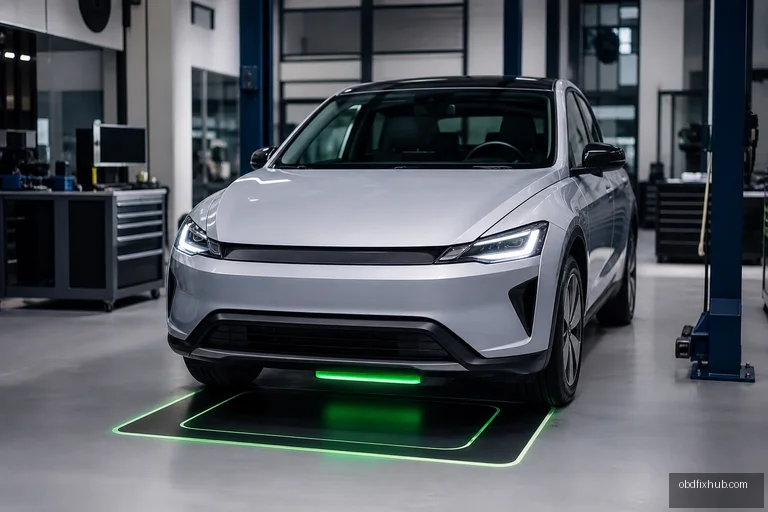
P2D33 Inductive Battery Charger Processor Performance means the vehicle has detected an abnormal operating condition inside the control processor responsible for wireless, or inductive, high-voltage battery charging. In practical terms, the charger may stop charging, refuse to start, or operate intermittently. The code does not automatically prove that the charging processor itself has failed; power supply, communication, software, alignment, cooling, and high-voltage safety faults can produce the same result.
This is an informational diagnosis, not a parts-shopping code. Because the system works with high-voltage battery circuits, testing beyond basic visual checks should be performed with the manufacturer’s service information and appropriate EV safety equipment.
What Does P2D33 Mean?
P2D33 is an OBD-II powertrain fault code associated with the performance of an inductive battery charger processor. An inductive charger transfers energy through magnetic fields between a ground-side charging pad and a receiving coil mounted on the vehicle. The charger processor supervises functions such as power transfer, coil communication, temperature monitoring, current control, and shutdown protection.
When the processor’s calculated values, commands, or responses do not match expected limits, the vehicle stores P2D33. The precise definition and enabling conditions can vary by manufacturer, so the OEM description, freeze-frame data, and technical service bulletins are more reliable than a generic code database alone.
Common Symptoms of P2D33
Some vehicles display a warning immediately; others only reveal the problem when the driver attempts wireless charging. The most useful symptom is whether the fault occurs during every charging attempt or only under particular conditions, such as a hot battery or poor vehicle-to-pad alignment.
- Inductive charging will not begin or stops shortly after starting.
- The instrument cluster shows a hybrid, EV, charging-system, or powertrain warning.
- The charging pad reports a communication or alignment error.
- Charging power is reduced, inconsistent, or significantly slower than normal.
- P2D33 returns immediately after clearing or returns only during a charging session.
- Related low-voltage, CAN communication, temperature, or isolation codes are stored.
A vehicle can still drive normally with this code if conventional plug-in charging and propulsion systems remain unaffected. That does not make the fault harmless: repeated charging interruptions can leave the high-voltage battery below the level required for normal use.
Most Likely Causes
1. Low-voltage power or ground problems
The inductive charger processor depends on a stable 12-volt supply. A weak auxiliary battery, corroded ground, loose connector, blown fuse, or voltage drop during wake-up can make a healthy processor appear defective. On many EVs, a marginal 12-volt battery is one of the first things worth checking because it can create several unrelated-looking electronic codes at once.
2. CAN communication or network faults
The charger controller must exchange data with the battery management system, body controller, and other charging modules. Open circuits, shorted CAN wiring, water intrusion, termination faults, or a module that is not waking up can interrupt those messages and trigger a processor-performance code.
3. Software or calibration issues
Some P2D33 cases are caused by outdated charger firmware or a calibration mismatch after a module replacement. If a manufacturer has released a software update or service bulletin, programming may correct the fault without replacing hardware. Never interrupt a control-module update with a weak 12-volt battery or an unstable power supply.
4. Charging-pad alignment and foreign objects
Inductive charging systems are sensitive to the distance and position between the ground pad and vehicle receiver. Metal objects, thick debris, damaged pad covers, incorrect parking position, or a shifted receiver can cause excessive heat or abnormal coupling. These conditions may cause the processor to shut down as designed.
5. Thermal, cooling, or high-voltage protection faults
Temperature sensors, coolant circulation, inverter electronics, insulation monitoring, and high-voltage interlock circuits all influence charging. A blocked cooling passage, failed pump, overheated receiver, or detected insulation problem can force the processor into a protective state and set P2D33 as a secondary code.
How to Diagnose P2D33 Properly
- Confirm the code with an EV-capable scan tool. Record every stored, pending, and history code, not just P2D33. Note freeze-frame information such as battery temperature, 12-volt voltage, charging state, and vehicle speed.
- Check the 12-volt system first. Measure resting voltage and observe voltage during vehicle wake-up. Inspect battery terminals, grounds, charger fuses, and visible connectors. A voltage reading that looks acceptable at rest can still collapse under load.
- Inspect the wireless charging hardware. Look for cracked housings, moisture, impact damage, contamination, and signs of overheating on the pad and vehicle receiver. Remove metal objects and test with the vehicle positioned exactly as specified by the manufacturer.
- Review live data. Compare requested and actual charging power, processor status, receiver temperature, alignment status, communication state, and interlock state. The failed parameter often identifies whether the issue is control, communication, or a physical charging condition.
- Check software and technical bulletins. Verify the software version and module configuration before condemning the charger. A replacement module may require initialization, pairing, parameter writing, or a calibration procedure.
- Perform high-voltage tests only as authorized. Insulation resistance and connector testing require the correct disabling procedure, insulated equipment, and manufacturer-specific limits. Do not probe orange high-voltage connectors casually.
P2D33 Inductive Battery Charger Processor Performance: Fixes
The correct repair depends on the failed test. Cleaning the charging area, correcting vehicle alignment, repairing a poor ground, replacing a weak 12-volt battery, or repairing CAN wiring may resolve the code. If software is outdated, a dealer or qualified EV technician may need to reprogram the inductive charger controller and complete a post-programming calibration.
If live data confirms an internal processor fault, the inductive charger assembly or its control module may require replacement. Before installation, confirm that power, ground, network communication, cooling, and high-voltage safety checks have passed. Otherwise, the replacement unit may fail for the same reason or produce a new configuration fault.
Can You Drive With P2D33?
If the vehicle has no red high-voltage warning, overheating message, loss of propulsion, or charging-system shutdown, limited driving may be possible. However, avoid relying on the wireless charger until the issue is diagnosed, and use an approved alternative charging method if the manufacturer permits it. Stop driving and arrange professional assistance if warning messages escalate, the battery becomes unusually hot, there is a burning smell, or multiple high-voltage isolation codes appear.
How to Prevent Repeat Failures
- Keep the charging pad and receiver area clean and free of metal debris.
- Do not place tools, coins, magnetic accessories, or luggage between the pad and receiver.
- Maintain the 12-volt battery according to the vehicle’s service schedule.
- Install available software updates using a stable programming power source.
- Investigate every related communication or voltage code instead of clearing codes repeatedly.
Summary
P2D33 points to abnormal performance in the processor that manages inductive high-voltage battery charging, but it is not a guaranteed processor replacement diagnosis. Start with the 12-volt supply, fuses, grounds, communication network, charging alignment, temperature data, and software status. Because the system combines wireless power electronics with hazardous high voltage, use professional diagnostic procedures for internal testing and repairs.
Frequently Asked Questions
Is P2D33 caused by a bad hybrid battery?
Not necessarily. P2D33 is associated with the inductive charger processor, although a battery temperature, communication, isolation, or battery-management fault can prevent the charger from operating and set related codes.
Can a weak 12-volt battery trigger P2D33?
Yes. Low voltage during module wake-up can interrupt processor operation or network communication. Testing the auxiliary battery under load is often more useful than checking its resting voltage alone.
Will clearing P2D33 fix the charging problem?
Clearing the code only removes the stored fault until the monitoring test runs again. If the underlying voltage, alignment, software, communication, or hardware problem remains, the code will return.
Can I repair P2D33 at home?
Basic checks such as removing foreign objects, inspecting the charging area, and checking visible 12-volt connections may be reasonable. High-voltage testing, module programming, and charger replacement should be left to a qualified EV technician.
Does P2D33 always require replacing the inductive charger?
No. Many possible causes are external to the charger, including a weak auxiliary battery, poor ground, CAN fault, software issue, overheating, or incorrect alignment. Confirm the failed circuit with live data and service procedures before replacing an expensive assembly.




